USAID DEC
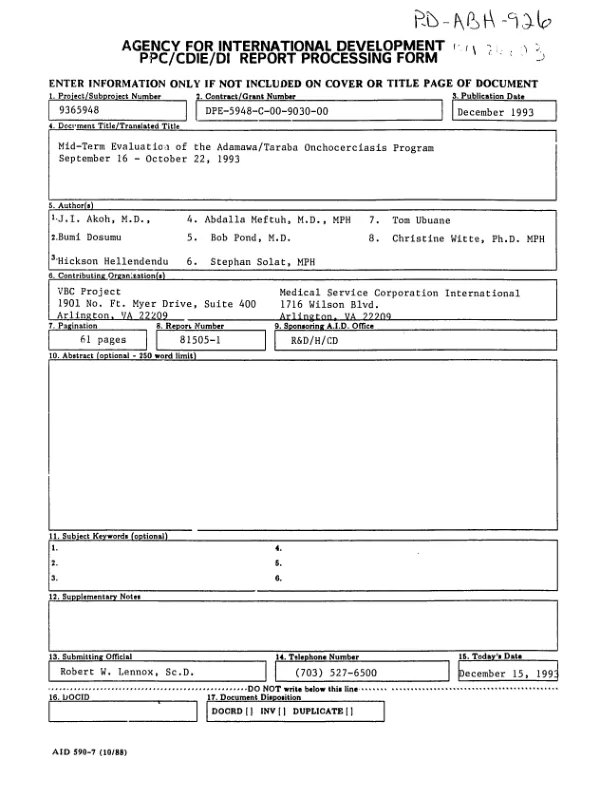
Mid-term evaluation of the Adamawa/Taraba onchocerciasis program -- September 16-October 22, 1993
Sign inMEDICAL SERVICE CORP. INTERNATIONAL
Mid-term evaluation of the Adamawa/Taraba onchocerciasis program -- September 16-October 22, 1993
Mid-term evaluation of a project to institutionalize ivermectin delivery within Nigeria's local public health care system.
Akoh, J. I.|Dosumu, Bumi · 1993
Sign in to readA free account is required to download.
Abstract
The evaluation covers the period 8/91-9/93. The project has made satisfactory progress in strengthening the capacity of the government health services to provide cost-effective and sustainable delivery of ivermectin. Adequate numbers and categories of field staff have been trained at both the local and state government levels. In two of the three local government areas (LGAs) visited by the evaluation team, policy makers appear to have adopted the program as their own responsibility; during the second year of the project they dedicated sufficient management capacity to address most of the administrative needs and sufficient funds to pay for at least 75% of the running costs of distribution. The third LGA, however, has failed to adequately support ivermectin distribution activities despite an abundance of resources. Although the state governments express support for the project, the State Ministries of Health (SMOH), particularly the Taraba SMOH, appear to have made inadequate progress toward assuming management responsibility or responsibility for paying for the field expenses of the State Onchocerciasis Control Unit (SOCU). Rapid assessment (nodule palpation and blindness) surveys were carried out by local government health workers trained and supervised by SMOH staff. Epidemiological assessment has been completed in all 16 of the LGAs of Adamawa State, but in only three in Taraba State. Based upon the rapid assessment data, it appears that in addition to the three LGAs that which have already benefited from ivermectin distribution, Adamawa State has two more LGAs that are in need of distribution services. The epidemiological surveys have confirmed that the public health impact of river blindness in parts of these two states is significantly greater than in most other areas with endemic onchocerciasis. In the 100 communities rapidly assessed during the first year of the project, an average of 15% of the men were blind. Under these circumstances, treatment of onchocerciasis should be and has become a leading public health priority in selected parts of Adamawa and Taraba States. During the first 12 months of distribution (3/92-2/93), ivermectin was distributed to 84,300 people, covering all targeted LGAs. By the 19th month, the project had exceeded the End-of-Project objective for ivermectin distribution. Based on enumeration carried out by the project itself, 86% of eligible persons in the target communities were treated during the first round of distribution. The second round of distribution began in May 1993 and was about half completed at the time of the evaluation; an estimated 80% of the eligible persons in the targeted communities have been treated. (Author abstract)