USAID DEC
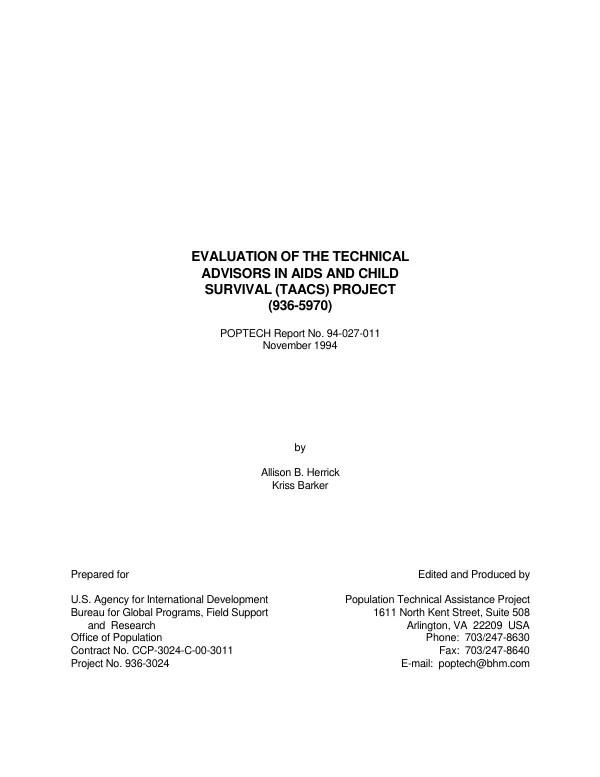
Evaluation of the technical advisors in AIDS and child survival (TAACS) project (936-5970)
Sign inBASIC HEALTH MANAGEMENT INTERNATIONAL (BHM)
Evaluation of the technical advisors in AIDS and child survival (TAACS) project (936-5970)
Evaluates project to provide mid- to senior-level technical experts to USAID offices and Missions and cooperating country institutions to plan, implement, and evaluate child survival (CS), HIV/AIDS, and family planning (FP) activities (TAACS project).
Herrick, Allison B.|Barker, Kriss · 1994
Sign in to readA free account is required to download.
Abstract
Interim evaluation covers the period 1988-11/94. TAACS has fulfilled its mandate by expanding USAID's capacity to carry out CS activities as well as AIDS research, treatment, and control activities. Since the addition of FP activities to the project in 1993, the project has recruited eight FP advisors. Although the project design lent priority to the 22 countries designated as "CS emphasis countries," 15 of the 31 CS advisors who have completed their assignments were assigned in Washington, where they helped to design or manage regional or global projects that require centralized management. All told, 58 advisors have been assigned to 63 positions at the Center for Population, Health, and Nutrition, the regional Bureaus, and 24 countries overseas. Advisors have been provided under the Intergovernmental Personnel Act, the PASA with the U.S. Public Health Service through the Office of International Health of the Department of Health and Human Services, the Centers for Disease Control (CDC), and through two NGOs -- the Centre for Development and Population Activities (CEDPA) and the American National Red Cross (ANRC). The NGOs have proven their ability to recruit TAACS candidates and have developed a pool of future candidates. All current institutional sponsors are interested in continuing to provide USAID with TAACS advisors. The use of non-direct hire advisors to manage major parts of the Agency's CS, family planning, and HIV/AIDS programs is a second-best solution to an acute staffing problem. However, until direct hire staff can be expanded, or an operating expense-funded limited career appointment system is established, the TAACS advisors offer a very high level of performance. Fear that the use of TAACS advisors would lead to the elimination of direct hire positions in Population, Health, and Nutrition (PHN) has proved unfounded; while there have been a few instances of cuts in deputy PHN chief positions, no Missions to which TAACS advisors have been assigned have eliminated all direct-hire health/population positions. The following conclusions are offered. (1) USAID Missions and offices have not been adequately informed either of the special mandate by which TAACS advisors are to serve under conditions comparable to those of U.S. direct hire staff, or of their status within their sponsoring institutions. (2) CEDPA should improve its orientation course for its advisors, specifically as regards USAID procurement procedures and financial systems. (3) It is less cumbersome for the USAID Mission, rather than the sponsoring institution, to provide TAACS advisors with local support (e.g., travel and living expenses). (4) Some advisors filled positions that could have been filled under personal services contracts. (5) A.I.D. has no system for consolidating and assessing the effectiveness of individual advisors. (6) Except for placements by CEDPA, for which the USAID Office of Procurement has not yet established an off-site overhead rate, the cost of a person-year of technical service under the TAACS activity is less than that of similar services procured by USAID under personal services or institutional contracts. It is not possible, in the absence of information on the costs of in-house supervisory and support functions and the fringe benefits and allowances covered by USAID, to compare the costs of a TAACS advisor to those of a direct-hire employee.