USAID DEC
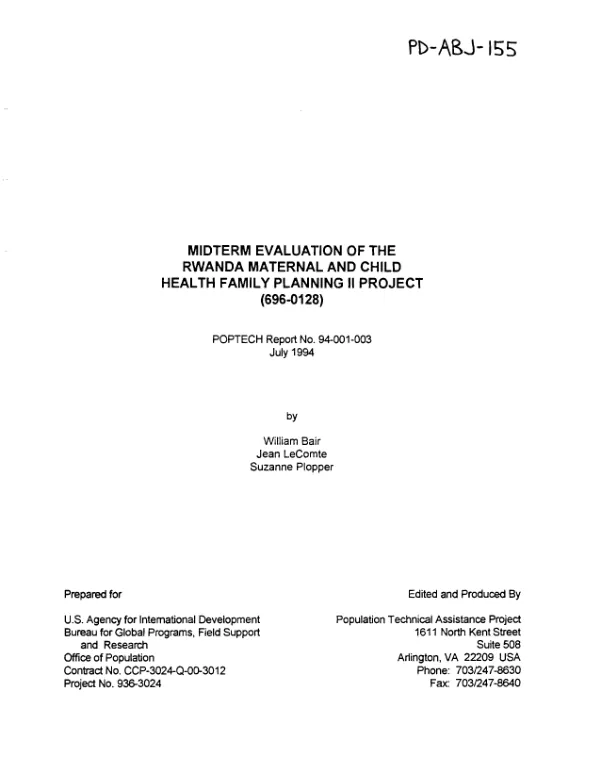
Midterm evaluation of the Rwanda maternal and child health family planning II project (696-0128)
Sign inBASIC HEALTH MANAGEMENT INTERNATIONAL (BHM)
Midterm evaluation of the Rwanda maternal and child health family planning II project (696-0128)
Evaluates project to expand family planning (FP) information and services in Rwanda.
Bair, William; LeComte, Jean +1 more · 1994
Sign in to readA free account is required to download.
Abstract
Mid-term evaluation covers the period 1989-4/94. The project faced formidable obstacles, most notably the civil conflict which began in earnest in 1990 and continued with varying intensity throughout the life of the project. Escalating fighting during the evaluation"s data collection phase forced the evacuation of the evaluation team and the entire U.S. Mission. However, the evaluation does provide a fairly accurate assessment of progress made, and includes suggestions for future programming. As might be expected under the circumstances, institutional development of FP organizations was very difficult. While the skills of individual ONAPO (National Population Office) staff and Ministry of Health service providers were upgraded through training, turnover and vacancies made any continuity unlikely. Overall, the project had little impact on the development of ONAPO"s management capabilities, nor did it have much impact upon the development of the private sector. However, the project did have significant success, through its IEC, training, and FP service delivery components, in increasing knowledge of FP (to 97%), improving attitudes toward FP (93% favoring), lowering desired family size (to 4.4), and increasing the prevalence of modern contraceptive use (to 13%), as measured by the 1992 Demographic and Health Survey. These data indicate a substantial reduction in fertility and the natural rate of population growth in Rwanda; nevertheless, rates remain high enough to be a serious constraint to Rwanda"s socioeconomic development. Lessons learned included the following. (1) The structure of FP programs need to be flexible enough to adapt to changing circumstances; in particular, programs need to guard against becoming too closely identified with a particular political party. (2) Although the private sector can play an important role in providing FP services, more support is required than this project provided; further, the involvement of the public sector in private initiatives should be viewed with caution. (3) The development of computerized management information systems must be prioritized carefully with respect to other requirements of programmatic monitoring and other means of gaining management information through field observation. There will continue to be a population problem in Rwanda; it must be addressed with attention to policy development, IEC, and training, but increasing access to quality FP services will be of paramount importance.