USAID. MISSION TO SOUTH AFRICA
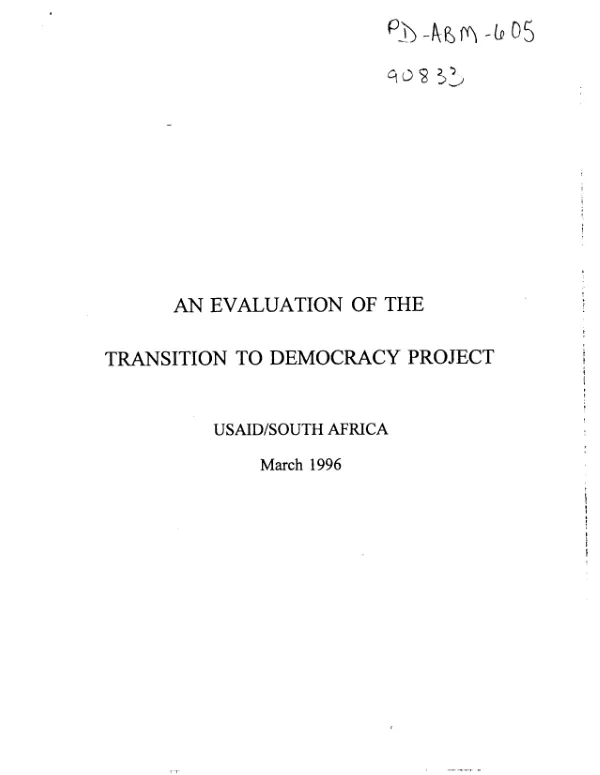
Evaluation of the transition to democracy project
Final, ex-post evaluation of a project (9/2/91-3/94) to help to "level the political playing field" in South Africa by strengthening the capacity of previously disenfranchised political parties to participate in the national process of negotiating a new, non-racial, democratic government.
1996
Sign in to readA free account is required to download.
Abstract
The project was implemented by the U.S.-South African Leadership Exchange Program (USSALEP). The project achieved its objectives only partially. From the beginning there was debate over who the recipients should be, what would be an appropriate level of funding, and areas of expenditures. Contrary to expectations, only two opposition political parties qualified for assistance, the Inkatha Freedom Party (IFP) and the African National Congress (ANC). A major problem arose when USAID/SA, fearing the use of grant funds for party-building purposes, disallowed the payment of salaries, which had been expressly allowed in the original subagreements. This restriction severely affected both subgrantees, and both criticized USAID's unilateral action. The IFP, which had fewer funding sources than the ANC, was especially hard hit. IFP had its own compelling agenda, and a critical need to find the resources to fund it; it needed to pay its office bearers and mobilize its support base. In the end, IFP found a way (it used part of the grant to purchase a building, which it promptly sold) to fund its major purposes, salaries and motor vehicles, both of which were expressly excluded in the amended grant. Another case of disagreement was a planned IFP voter education project, which was rejected by the USSALEP project manager, a very careful and rigorous individual, on suspicion that the trainer was actually a military intelligence front man. On the positive side, IFP used grant monies to purchase equipment (especially computers) which helped it to set up financial systems and improve branch and regional administration. In such ways, the grant may have indirectly supported the negotiation process. The USSALEP project manager felt that the grant's main value was to keep IFP's institutional structures alive, and thereby reduce the likelihood of further violence in the country. At the root of problems with the grant was a dilemma inherent in the project design: how can USAID support a political party without becoming involved in the internal building up of the party? This dilemma was never resolved. ANC's was a similar story: USAID denied salary reimbursements and USSALEP -- due to ANC's poor accounting practices -- vetoed funding for airfares and other travel costs (and later denied advances). ANC, which had been an underground operation, simply did not have the human resources to do everything that was necessary. (ANC said that it had planned to use the promised, but withheld, salary reimbursements to hire qualified financial staff). Another problem was that the ANC did not delegate authority; all decisions had to be discussed with key office holders and it was often difficult for USSALEP to get hold of these individuals to discuss matters pertaining to the project. Much of the grant funds were spent on buildings, renovations, computers, and training. While ANC, as a formerly underground group, felt that buildings gave it a desired visibility, USSALEP would have preferred to channel these resources into the Peace Accords. Did the grant funds have the desired impact on ANC capacity building for the purpose of negotiation? On the one hand, clearly ANC needed financial assistance to move from a resistance movement to a leading negotiator, to contest the elections, and then assume a dominant position in the new government. On the other hand, the ANC received funds from many quarters, and the USAID funds did not have the desired impact in the targeted area of capacity building for negotiation. The key lesson from both subgrants is that it is difficult to give political aid and at the same time to dictate the terms on which the aid will be used. It proved impossible to establish or sustain a distinction between "party-building" and the promotion of the negotiation process. Another lesson is the labor-intensive nature of managing such a project. According to USAID/SA, the model of contracting out project management worked well, and the Mission will seek to use it more extensively.
Related documents