BASIC HEALTH MANAGEMENT INTERNATIONAL (BHM)
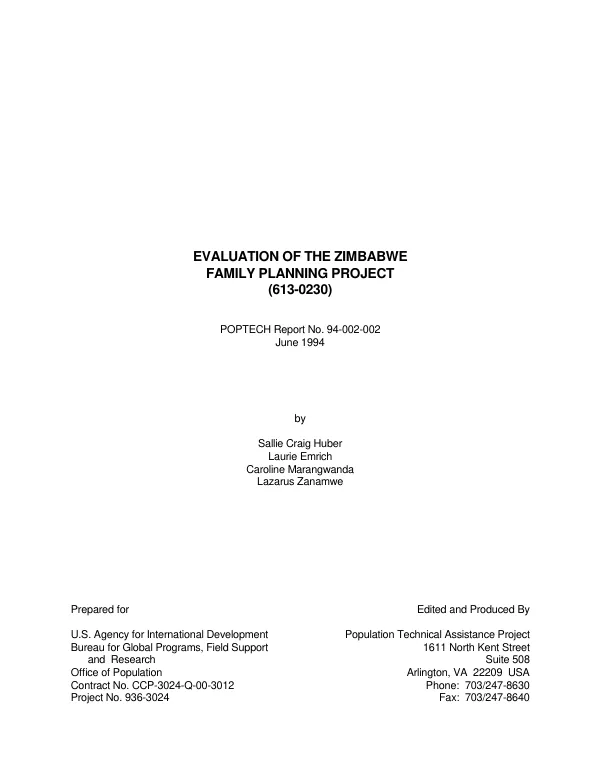
Evaluation of the Zimbabwe family planning project (613-0230)
This mid-term evaluation of the Zimbabwe Family Planning (FP) Project (6130230) was carried in March and April 1994.
Huber, Sallie Craig; Emrich, Laurie · 1994
Sign in to readA free account is required to download.
Abstract
This is a forward-looking evaluation because USAlD/Z plans to prepare a Project Paper Supplement and Grant Amendment which will add funds and extend the project by 2 years, until 1998. The project, implemented by the Zimbabwe National FP Council (ZNFPC), is progressing satisfactorily and is predicted to meet or exceed most of its objectives by the extended project end date. The project"s goals -- to reduce the total fertility rate (TFR) and increase sustainability -- were examined and found to remain sound. Environmental factors, including the economic structural adjustment program, the 1991-92 drought, the AIDS epidemic, upcoming elections and related political factors, and the economic recession, have affected Government of Zimbabwe (GOZ) priorities and have had an impact on timely implementation of the project. Despite these constraints, the project remains essentially on track. Progress is being made on the first two end-of-project indicators -- increased use of modern contraceptive methods and ensuring the availability of a wider variety of methods -- and the evaluation team feels these are achievable within the extended life of the project. Achievement of the latter two -- increased services provided and/or financed by the private sector and reduced net government costs for FP services -- appear less certain. Three project indicators -- reduced TFR, increased use of modern methods, and increased private sector participation --were revised to more conservative levels in the 1993 USAID Country Program Strategic Plan (CPSP). The team does not feel the reductions in the first two are necessary, especially in light of the proposed time extension. The third indicator should remain at its reduced level or be further moderated unless the report recommendations aimed at strengthening private sector FP financing are included in the project amendment. Method diversification activities are proceeding as expected, with only slight delays. Suggestions and recommendations are made for enhanced use of TA and local currency funding to address some of these delays. Program sustainability is being affected by a number of policies and other factors which are beyond the direct control of ZNFPC and its parent body, the Ministry of Health and Child Welfare (MOH). At the same time, ZNFPC is making significant progress in working toward cost recovery. Much needs to be done to enhance progress in the private sector activity area. The team recommends integrating the activities in this area into a comprehensive, limited-term private sector FP financing initiative. This initiative would be coordinated by ZNFPC and subcontracted to an external entity experienced in health care financing and in working with the private sector. Use of local currency support appears to be lagging; however, the team was unable to obtain a complete picture of local currency expenditures by program area. Recommendations are made as to possible activities and items to be funded under this budgetary component in the project amendment, including the financing initiative noted above. An additional recommendation advises using the existing local currency budget to contract for assistance in the development of financial reporting systems. The role of Cooperating Agencies (CAs) was examined and found to be acceptable. TA from USAID-funded CAs is generally appreciated by ZNFPC. The team recommends continued use of this mechanism along with local contracts to assist with implementation of the amended project. The team did not find evidence of extensive duplication or project complications due to the lack of regular or formal coordination among FP donors. A number of possible topics for research are noted with the suggestion that ZNFPC create a database of experienced individuals and research firms that can assist in undertaking some of the research. Adolescent reproductive health is a new area of interest to ZNFPC and a new priority for the MOH. Suggestions are given for specific ways USAID funding can assist with the recommendation that this area be included in the amended PP. A number of specific policy issues, which constrain full achievement of GOZ program and USAID project objectives, were identified during this evaluation. These are listed and discussed in some detail as background for USAlD"s upcoming nonproject assistance program planning exercise. (Author abstract, modified)