USAID DEC
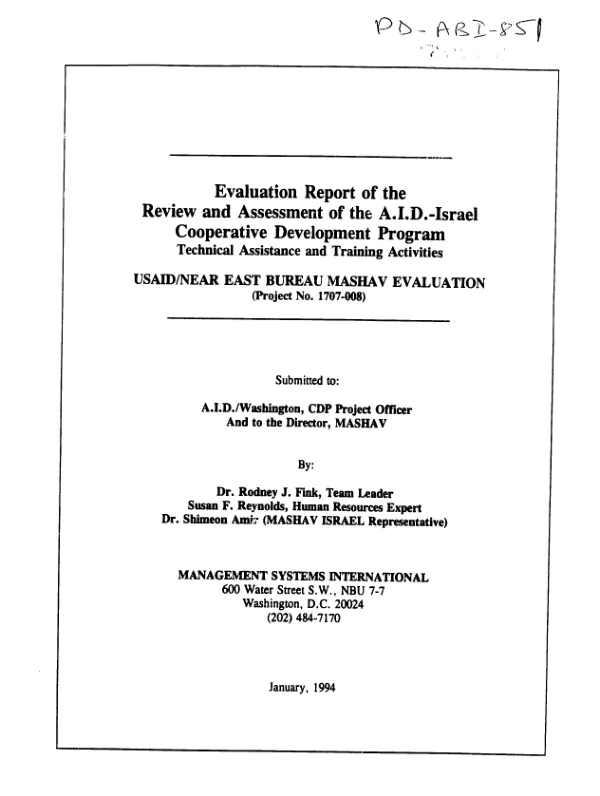
Evaluation report of the review and assessment of the AID-Israel cooperative development program : technical assistance and training activities -- USAID/Near East Bureau MASHAV evaluation (project no. 1707-008)
Sign inMANAGEMENT SYSTEMS INTERNATIONAL, INC. (MSI)
Evaluation report of the review and assessment of the AID-Israel cooperative development program : technical assistance and training activities -- USAID/Near East Bureau MASHAV evaluation (project no. 1707-008)
Evaluates project to support the Cooperative Development Program of Israel's Ministry of Foreign Affairs (MASHAV), which provides TA and training to developing countries.
Fink, Rodney J.|Reynolds, Susan F.|Amir, Shimeon · 1993
Sign in to readA free account is required to download.
Abstract
The evaluation covers the period 1988-12/93. The project has been a success, its positive aspects far outweighing problems encountered with management and delivery. MASHAV has effectively used program resources to deliver Israeli expertise to developing countries for improved agriculture development, environment/natural resource management, social development, and personnel development. MASHAV has provided training in Israel to 2,135 individuals, conducted 199 On the Spot Training Courses (OTSCs), and provided 156 short-term consultancies and 95 person-years of long-term TA. Trainees in Israel, who, along with OTSC participants, have overwhelmingly endorsed training effectiveness, were made aware of the scarcity of natural resources in Israel and the necessary role that education and personnel development play in sustainable development. TA, which emphasized skills transfer and applied technologies, has provided a variety of contributions, ranging from the development of poultry cooperatives in Africa and assistance to tomato producers in Honduras, to eye care in Malawi. Assistance has been channelled through Israeli Embassies, enhancing both the Embassies' and Israel's standings in assisted countries. Israel has expanded diplomatic relations from 6 to 26 countries in Africa and from 17 to 22 in Asia and Oceania. In addition, A.I.D. Missions and Israeli Embassies have developed significant cooperation in the utilization of Israeli long-term experts. It is recommended that MASHAV: (1) expand its activities in the Central Asian Republics and Eastern Europe (a Farmer-to-Farmer program in the New Independent States is particularly recommended); (2) increase interaction with A.I.D. Missions so as to improve the integration of development objectives; (3) expand its evaluation system to include strategic planning; (4) increase training targets for women and persons from the private and NGO sectors; and (5) direct more long-term TA to private organizations.
Related documents