USAID DEC
Evaluation Summary: Training on Best Practices for Land Tenure and Natural Resource Governance in Africa
Sign inTETRA TECH ARD, INC.
Evaluation Summary: Training on Best Practices for Land Tenure and Natural Resource Governance in Africa
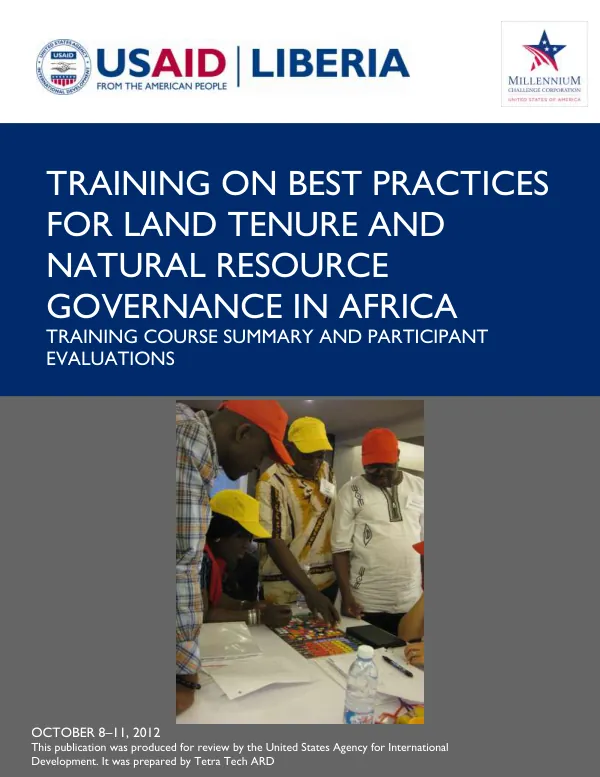
The Best Practices for Land Tenure and Natural Resource Governance in Africa short course was held in Monrovia, Liberia between October 8 and 11, 2012.
2012 · 29 pages
Sign in to readA free account is required to download.
Abstract
This was the United States Agency for International Development's (USAID's) sixth international course held under the Property Rights and Rural Governance Project (PRRGP). The short course provided 36 United States Government (USG) foreign assistance practitioners and representatives from Liberia, Malawi, Mozambique, Sierra Leone, South Sudan, and Uganda training that strengthens their knowledge and skills in addressing land tenure and property rights (LTPR) challenges in their region. The key objectives of the course included exchanging experiences and strengthening understanding of LTPR issues, best practices internationally, and their application to programming. The course also aimed to introduce LTPR concepts and approaches aimed at improving programmatic interventions in economic growth, food security, governance, natural resource management, conflict mitigation, and climate change. Additionally, the course taught tools to address land tenure and property rights issues, or use land tenure and property rights interventions to strengthen economic development, governance, conflict mitigation, and natural resource management objectives. Of the 36 participants, eight were female, all attending from Liberia. Twenty-seven of the 36 attendees were from Liberia, representing various government agencies, including the Land Commission, USAID, the Ministry of Agriculture, the Center for National Documents and Records Agency (CNDRA), the Ministry of Interior, the Ministry of Justice, and the Ministry of Lands, Mines and Energy. The remaining participants were from Malawi, Sierra Leone, South Sudan, Uganda, and USAID in Mozambique. The course was co-sponsored by the Liberia Land Policy and Institutional Support (LPIS) Project, which is implemented by USAID under PRRGP with funding from the Millennium Challenge Corporation's (MCC) Threshold program. The course was designed to strengthen the knowledge and skills of USG foreign assistance practitioners and representatives from the region in addressing LTPR challenges. The training course consisted of several modules, including evaluation, modules, GLUT simulation, and overall course. The evaluation methods used included participant feedback, module assessments, and a GLUT simulation exercise. The evaluation results showed that the course was successful in achieving its objectives, with participants demonstrating a strong understanding of LTPR concepts and approaches. The course also included a GLUT simulation exercise, which was designed to test participants' knowledge and skills in addressing LTPR challenges. The overall course evaluation showed that participants were satisfied with the course content, delivery, and facilitation. The course also identified several best practices for land tenure and natural resource governance in Africa, which can be replicated in other courses. The course concluded with several recommendations for future regional courses, including improving the course content, delivery, and facilitation. The course also identified several practices from Liberia that can be replicated in other courses, including the use of community-based approaches to land tenure and property rights management. The training course was a success in achieving its objectives, with participants demonstrating a strong understanding of LTPR concepts and approaches. The course also identified several best practices for land tenure and natural resource governance in Africa, which can be replicated in other courses. The course concluded with several recommendations for future regional courses, including improving the course content, delivery, and facilitation. The participant evaluations showed that the course was well-received by participants, with many praising the course content, delivery, and facilitation. The evaluations also identified several areas for improvement, including the need for more practical exercises and case studies. The course organizers took note of these recommendations and will incorporate them into future courses. The course was a significant step forward in strengthening the knowledge and skills of USG foreign assistance practitioners and representatives from the region in addressing LTPR challenges. The course also contributed to the development of best practices for land tenure and natural resource governance in Africa, which can be replicated in other courses.