USAID DEC
Evidence Review on the Integration of Conflict Sensitive Practice Within Human-Serving Sectors
Sign inCHEMONICS
Evidence Review on the Integration of Conflict Sensitive Practice Within Human-Serving Sectors
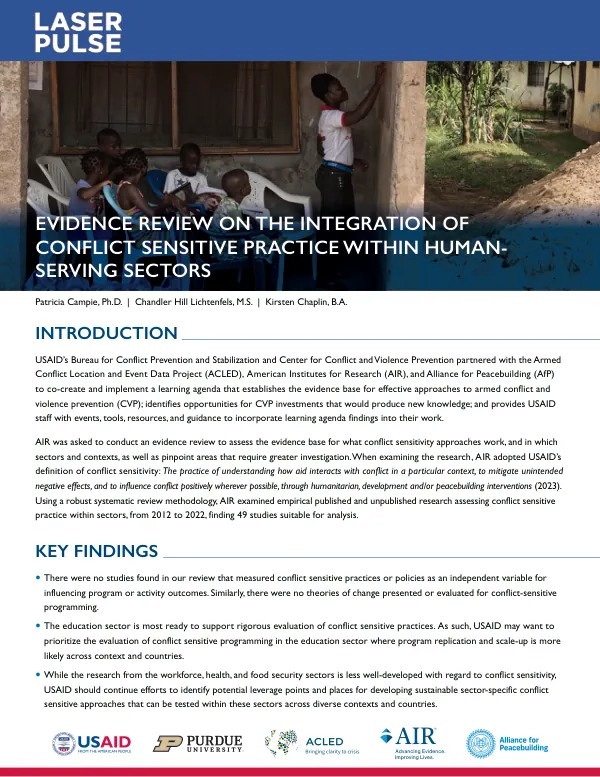
The USAID's Bureau for Conflict Prevention and Stabilization and Center for Conflict and Violence Prevention partnered with several organizations to co-create and implement a learning agenda focused on establishing the evidence base for effective approaches to armed conflict and violence prevention.
2023 · 6 pages
Sign in to readA free account is required to download.
Abstract
The learning agenda aimed to identify opportunities for investments that would produce new knowledge and provide USAID staff with events, tools, resources, and guidance to incorporate learning agenda findings into their work. The American Institutes for Research (AIR) was tasked with conducting an evidence review to assess the evidence base for conflict sensitivity approaches. AIR adopted USAID's definition of conflict sensitivity, which involves understanding how aid interacts with conflict in a particular context to mitigate unintended negative effects and influence conflict positively. Using a systematic review methodology, AIR examined empirical published and unpublished research assessing conflict sensitive practice within sectors from 2012 to 2022, identifying 49 studies suitable for analysis. The evidence review found that there were no studies that measured conflict sensitive practices or policies as an independent variable for influencing program or activity outcomes. Additionally, no theories of change were presented or evaluated for conflict-sensitive programming. However, the education sector was identified as being most ready to support rigorous evaluation of conflict sensitive practices, with USAID potentially prioritizing the evaluation of conflict sensitive programming in this sector. The review also highlighted the need for improved research in the workforce, health, and food security sectors, with USAID continuing efforts to identify potential leverage points and places for developing sustainable sector-specific conflict sensitive approaches. The overall credibility of evidence from research studies in this review was poor due to a lack of mixed-methods evaluation studies specifically designed to measure the impact of conflict sensitive practices. To improve research moving forward, USAID may want to provide clear expectations for conducting conflict sensitive evaluation designs that aim to explicitly measure conflict sensitive practice against development outcomes. The review also identified five studies that mentioned conflict sensitivity in their discussion of findings without measuring impact on outcomes, highlighting promising conflict-sensitive strategies to test for efficacy in future evaluation. The review included studies from various sectors, including education, health, and food security, which provided insights into conflict sensitive practices and their impact on development outcomes. The studies highlighted the importance of understanding local socio-political dynamics, providing conflict sensitivity training and education, developing clear policies and procedures for conflict sensitive practice, and structuring projects to support and engage vulnerable populations. The evidence review on the integration of conflict sensitive practice within human-serving sectors aimed to provide a comprehensive understanding of the evidence base for conflict sensitivity approaches. The review identified gaps in research and highlighted the need for improved evaluation designs and methodologies to measure the impact of conflict sensitive practices. The findings of the review have implications for USAID's investments in conflict prevention and stabilization, as well as for the development of effective approaches to addressing armed conflict and violence.
Related documents