USAID DEC
USAID/OFDA Latin America and The Caribbean Humantiarian Assistance in Review, FY2002 - 2011
Sign inUSAID/FFP
USAID/OFDA Latin America and The Caribbean Humantiarian Assistance in Review, FY2002 - 2011
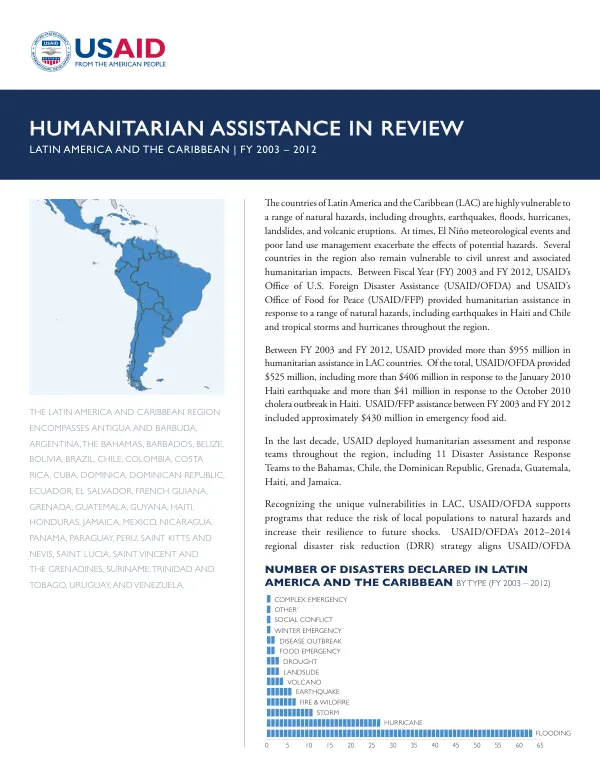
The Latin America and Caribbean (LAC) region is highly vulnerable to a range of natural hazards, including droughts, earthquakes, floods, hurricanes, landslides, and volcanic eruptions.
2011 · 2 pages
Sign in to readA free account is required to download.
Abstract
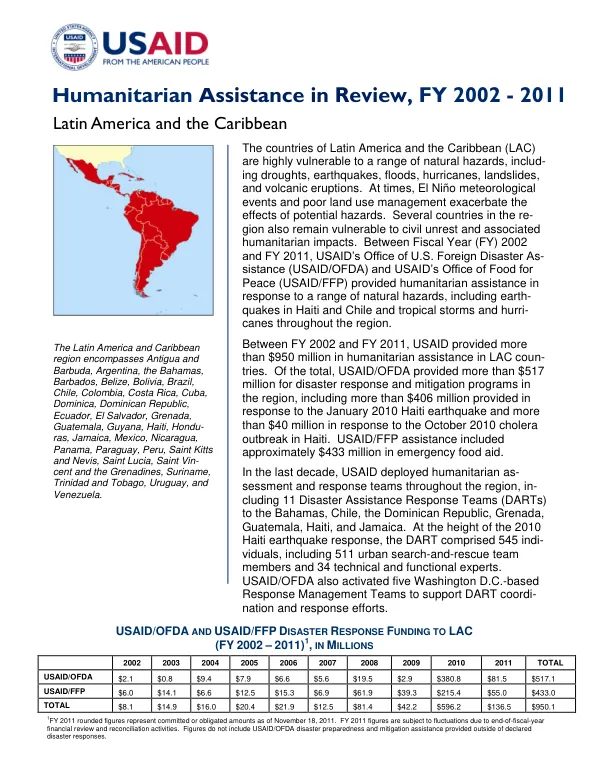
At times, El Niño meteorological events and poor land use management exacerbate the effects of potential hazards. Several countries in the region also remain vulnerable to civil unrest and associated humanitarian impacts. Between Fiscal Year (FY) 2002 and FY 2011, USAID's Office of U.S. Foreign Disaster Assistance (USAID/OFDA) and USAID's Office of Food for Peace (USAID/FFP) provided humanitarian assistance in response to a range of natural hazards, including earthquakes in Haiti and Chile and tropical storms and hurricanes throughout the region. Between FY 2002 and FY 2011, USAID provided more than $950 million in humanitarian assistance in LAC countries. Of the total, USAID/OFDA provided more than $517 million for disaster response and mitigation programs in the region, including more than $406 million provided in response to the January 2010 Haiti earthquake and more than $40 million in response to the October 2010 cholera outbreak in Haiti. USAID/FFP assistance included approximately $433 million in emergency food aid. In the last decade, USAID deployed humanitarian assessment and response teams throughout the region, including 11 Disaster Assistance Response Teams (DARTs) to the Bahamas, Chile, the Dominican Republic, Grenada, Guatemala, Haiti, and Jamaica. The LAC region encompasses 32 countries, including Antigua and Barbuda, Argentina, the Bahamas, Barbados, Belize, Bolivia, Brazil, Chile, Colombia, Costa Rica, Cuba, Dominica, Dominican Republic, Ecuador, El Salvador, Grenada, Guatemala, Guyana, Haiti, Honduras, Jamaica, Mexico, Nicaragua, Panama, Paraguay, Peru, Saint Kitts and Nevis, Saint Lucia, Saint Vincent and the Grenadines, Suriname, Trinidad and Tobago, Uruguay, and Venezuela. Recognizing unique vulnerabilities in the LAC region, USAID/OFDA supports disaster preparedness and mitigation programs aimed at reducing loss of life, alleviating human suffering, and reducing the social and economic impact of natural disasters. USAID/OFDA prioritizes hurricane preparedness and capacity-building activities in the LAC region throughout the year to enable rapid response to humanitarian needs during hurricane season. In the event of a disaster, stockpiled emergency relief supplies are available for rapid shipment throughout the LAC region from the USAID/OFDA warehouse in Miami, Florida, to address needs identified by USAID/OFDA staff. In addition, USAID/OFDA has agreements with air charter services for transportation of personnel and relief supplies to storm-affected areas, if needed. USAID/OFDA's disaster risk management specialists and surge-capacity consultants throughout the region are also immediately available to monitor and assess the impact of disasters and provide technical assistance to national governments, as needed. Between FY 2002 and FY 2011, USAID/OFDA provided significant funding for disaster response and mitigation programs in the LAC region. The funding breakdown for USAID/OFDA and USAID/FFP assistance during this period is as follows: USAID/OFDA provided more than $517 million, while USAID/FFP provided approximately $433 million in emergency food aid. The total humanitarian assistance provided by USAID during this period exceeded $950 million.