USAID DEC
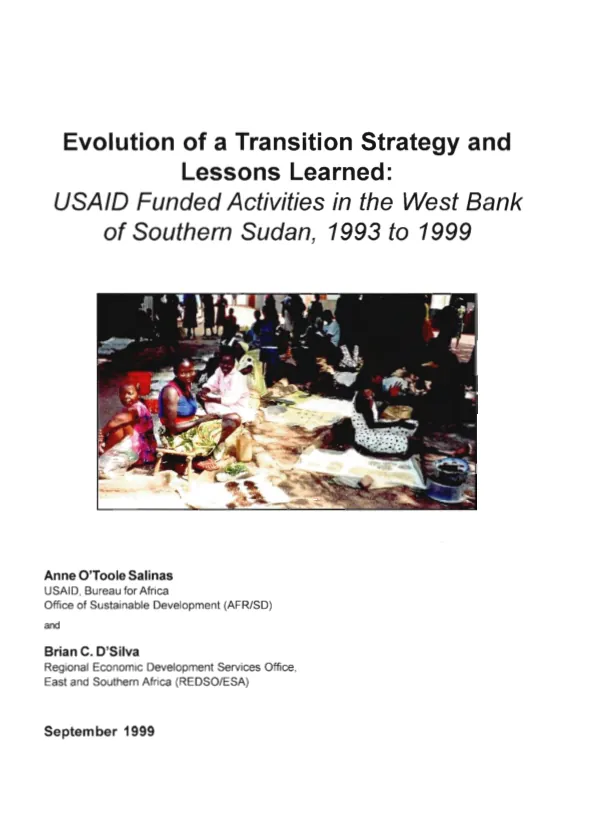
Evolution of a transition strategy and lessons learned : USAID funded activities in the West Bank of Southern Sudan, 1993 to 1999
Sign inUSAID. BUR. FOR AFRICA. OFC. OF SUSTAINABLE DEVELOPMENT
Evolution of a transition strategy and lessons learned : USAID funded activities in the West Bank of Southern Sudan, 1993 to 1999
In 1993, USAID's Office of Foreign Disaster Assistance (OFDA).
Salinas, Anne O'Toole|D'Silva, Brian C. · 1999
Sign in to readA free account is required to download.
Abstract
began to fund economic rehabilitation activities in Sudan's West Bank, an area comprising all parts of Equatoria province lying west of the Nile, and one enjoying increased stability and security as a result of military advances made by the Sudan Peoples Liberation Army (SPLA). This case study traces the evolution of this rehabilitation program and summarizes its impact and lessons. Rehabilitation activities supported under the program have ranged from road repair to small grants to community groups, and each activity has generated valuable lessons, some of them relevant to all rehabilitation-oriented activities. Opportunities that arise in the ever-evolving transition context must be seized as quickly as possible, so that intervention, if warranted, can have the greatest impact; flexible funding mechanisms that allow for quick response are therefore critical. It is also clear that knowledgeable people in the field are the best placed to identify these opportunities and should thus be empowered to make decisions and implement innovative programs on the ground. The West Bank experience has also shown that, in order for an activity to be as effective as possible, the implementing partner must make frequent impact assessments (with special attention to economic impact) and coordinate activities with both local authorities and others active in the area. Finally, the sharing of lessons learned from these innovative activities must be improved so that future activities are even more effective. Overall, the West Bank experience provides evidence of USAID's success in promoting economic and political transition through targeted interventions. Complex emergencies and conflicts are not absolute terms. Even in a situation of ongoing conflict, there are often pockets of stability and potential for transition that can benefit from rehabilitation-oriented programs. If programmed properly, a small amount of assistance (in this case, only 4% of USAID's total assistance to Sudan over the past 6 years) can go a long way toward restoring people's coping mechanisms and enabling them to reengage in economic activities. These interventions serve to jump start the market economy, promote the development of civil society, and further the creation of a functional, transparent, and accountable civil administration. Ultimately, these types of transition programs foster the transition to resilient development and community self-sufficiency, preventing or mitigating the effects of current and future complex emergencies, and reducing the overall costs of relief interventions.
Related documents