USAID. BUR. FOR POLICY AND PROGRAM COORDINATION. CENTER FOR DEVELOPMENT INFORMATION AND EVALUATION (CDIE)
Providing emergency aid to Mozambique
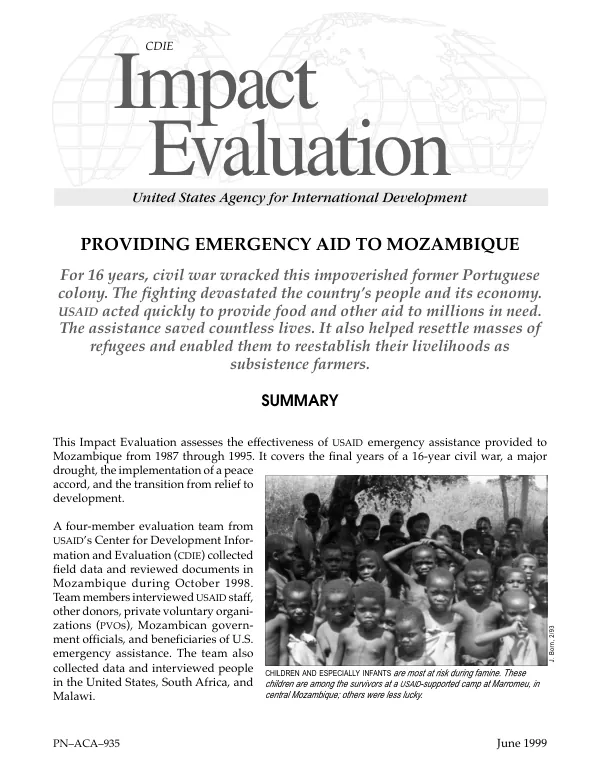
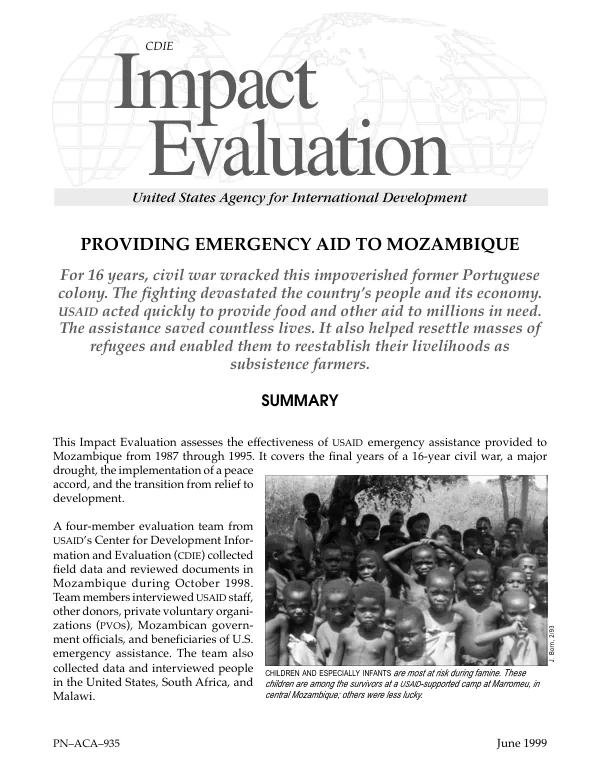
This study assesses the humanitarian, political, and economic effectiveness of USAID's emergency assistance to Mozambique from 1987 through 1995.
Lieberson, Joe|Adelski, Elizabeth · 1999
Sign in to readA free account is required to download.
Abstract
It covers the final years of the civil war, a major drought, the implementation of a peace accord, and the transition from relief to development. USAID and U.S. PVOs know how to run an effective relief program. In Mozambique they were able to manage a long- term emergency, which at its peak affected more than 6 million people. While other donors were slow to act during the worst part of the famine, USAID creatively diverted P.L. 480 shipments from other countries to Mozambique. USAID food poured into the country and U.S. PVOs delivered massive amounts of food and other aid to those in need. U.S. assistance helped mitigate the effects of a major human catastrophe. The food aid did not significantly affect the course of the war, which was fueled by external politics and military aid from abroad and which ended when both sides lost their foreign financial backers and arms suppliers. After the General Peace Accord of 1992 and the end of the drought, people began a massive movement and resettlement. More than a third of Mozambique's population was resettled in a little over 2 years. U.S. assistance supported the resettlement effort by helping avert conflicts, reduce social tensions, and cement the peace process down to the village level. It helped maintain social calm and prevent political instability by providing food aid to farmers and helping them reestablish their livelihoods. Lessons learned include the following: (1) The host government's emergency management agency lacked the technical expertise to plan, organize, and manage massive relief aid. There were reports of corruption, theft, and political or personal favoritism. Target populations did not always receive timely and sufficient food aid. USAID had to take action to save lives and ended up managing much of the logistics. (2) At times, donor efforts overlapped or were at cross-purposes. Nor was there a universal transition from relief to rehabilitation or development programs. This lack of coordination confused beneficiaries and undermined efforts to reduce dependency. (3) USAID economic policy reform programs, development projects, and non-emergency food aid all bolstered relief efforts. Conversely, some relief programs also helped support economic development. This demonstrates the need for a coherent U.S. approach in which each type of aid not only accomplishes its own goals, but supports other aid efforts as well. Conversely, split responsibilities for aid increases the risk that programs will lack coherence and may even waste U.S. funds. (4) Relief assistance creates dependency, particularly during a long-term emergency. Humanitarian aid should include assistance that helps people support themselves. (5) Using expatriates to operate relief programs is expensive and marginalizes local nationals. A training component should be included in emergency relief efforts. (6) Rapid demobilization and reintegration into civilian life is essential for the transition from relief to recovery. (7) At the end of the emergency, refugee return programs need both a push to move people out of camps and a pull to draw them back home. In the present case, cutting off food aid helped push refugees and internally displaced persons out of the camps, while a resettlement package of food, seeds, farming tools, and household goods helped draw them back to their home villages and begin producing their own food. Free food aid until the first harvest was an important element. (8) The transition from relief to development is often the most difficult phase of complex humanitarian emergencies. Both aspects must be funded in order to reduce the usual gap in assistance. USAID and NGOs need to work creatively with USAID regulations.
Related documents