USAID
Examen Final: Séismes et Bâtiments
The International Building Code (IBC) is a comprehensive set of regulations governing the design, construction, and maintenance of buildings.
2019 · 8 pages
Sign in to readA free account is required to download.
Abstract
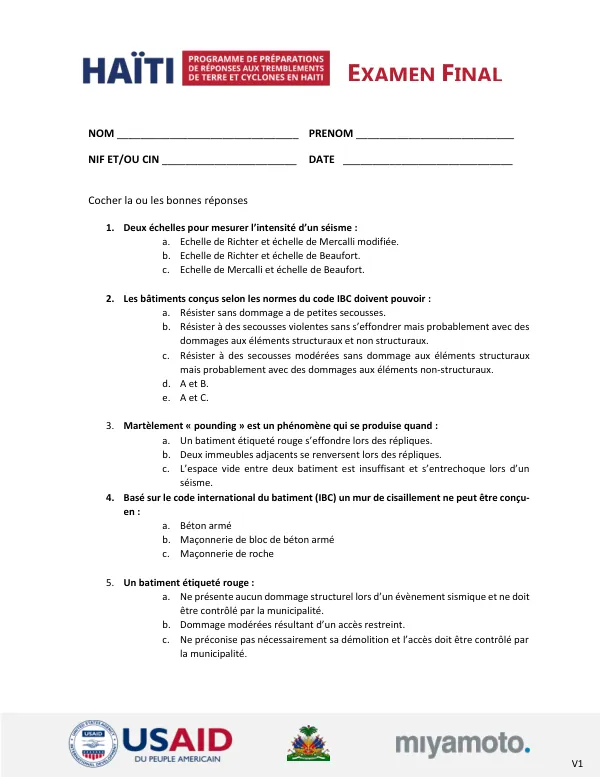
The IBC is a critical component of building safety, as it ensures that structures can withstand various natural hazards, including earthquakes and high winds. Two primary scales are used to measure the intensity of an earthquake: the Richter scale and the Modified Mercalli scale. The Richter scale measures the magnitude of seismic waves, while the Modified Mercalli scale assesses the impact of the earthquake on the surrounding environment. Buildings designed according to IBC standards must be able to withstand moderate seismic activity without sustaining significant damage to structural elements. However, they may experience damage to non-structural components. In the event of a violent earthquake, buildings designed to IBC standards should be able to resist collapse but may suffer damage to structural elements. Martellement, or pounding, occurs when two adjacent buildings collide during an earthquake due to insufficient space between them. This phenomenon can cause significant damage to both structures. According to the IBC, a wall of shear can be designed using reinforced concrete, but not using masonry or rock. A building labeled "red" indicates that it has suffered significant damage and poses a risk to occupants. This label is typically assigned after a detailed evaluation of the building's condition. A change in the building's label is possible when the original damage has been corrected, or when new information becomes available. This can occur due to the correction of an error or omission, or as a result of additional seismic events. The factors influencing wind forces on a building include its height, the surrounding geography and topography, and the building's load-bearing capacity. The IBC takes these factors into account when determining the building's wind resistance. Short columns are those that are shortened by an adjacent rigid element, such as a wall, or by a combination of a slab and a beam. During an earthquake, damage often occurs in masonry walls and lightweight roofs. These areas are particularly vulnerable to seismic activity. The conditions for rapid evaluation include assessing the building's collapse, identifying risks of falling non-structural elements, and evaluating foundation displacement. In a building with limited or hazardous access, visible cracks or flaking in structural elements may be observed. This indicates a potential risk to occupants. A building can be labeled "red," "yellow," or "green" based on its condition after an earthquake. The label is assigned after a rapid evaluation of the damage. A structure with a base resistant to lateral loads can be designed using special porticos or rigid frames, or using shear walls. Encircling a building with a regular shape is a common method of evaluation. Encircling a building with a multi-story structure is another common method of evaluation. The figure below illustrates a column that is too short or captive, which is a type of vulnerability. The equipment required for evaluating damage includes a hard hat, safety glasses, boots, long pants, a vest, and a cell phone. The wind speed at the point indicated by the red "X" in the figure is 120 MPH or 54 m/s. Based on the methodology presented, the building below should be labeled "yellow." Based on the methodology presented, the building below should be labeled "red." After an hurricane, the building below should be labeled "yellow." After an hurricane, the building below should be labeled "red." Based on the figure below, the type of vulnerability observed in the structure is a wall of shear out of plane. Based on the figure below, the type of vulnerability observed in the structure is a multi-story building. The IBC is a critical component of building safety, as it ensures that structures can withstand various natural hazards. The code provides guidelines for designing and constructing buildings that can resist earthquakes and high winds.