AGENCE CAPSULE
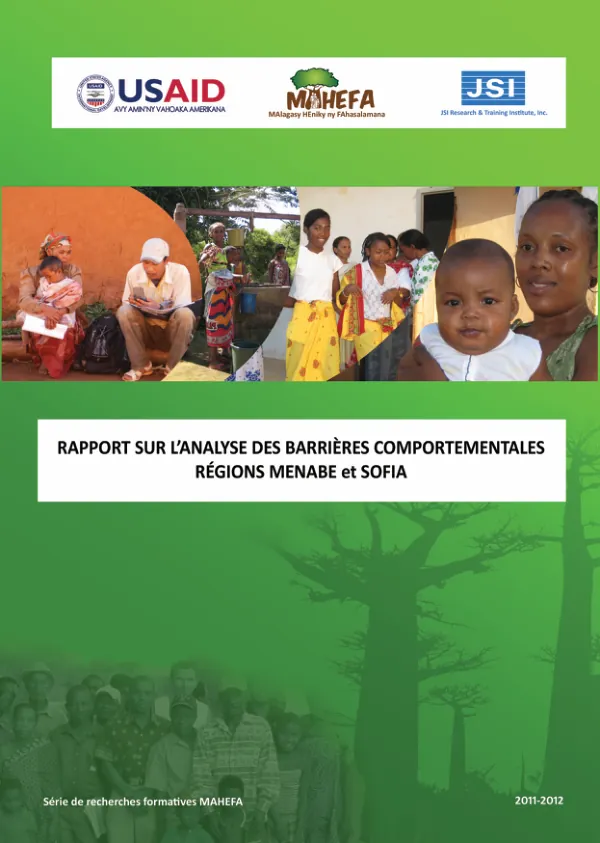
Rapport sur l’Analyse des Barrières Comportementales Régions Menabe & Sofia
The analysis of behavioral barriers in the Menabe and Sofia regions of Madagascar was conducted by the MAHEFA program, with assistance from the Agence CAPSULE.
2012 · 239 pages
Sign in to readA free account is required to download.
Abstract
The study aimed to identify the main barriers to health behaviors among the target population. The research was funded by the United States Agency for International Development (USAID). The study focused on 15 health behaviors, including the treatment of water, prenatal consultations, assisted childbirth, and vaccination. The research team collected data through a survey of 1,500 households in the Menabe and Sofia regions. The survey was conducted by a team of trained enumerators who administered questionnaires to the respondents. The data was analyzed using a combination of quantitative and qualitative methods. The results showed that the majority of the respondents reported engaging in some of the health behaviors, but with varying levels of adherence. For example, 70% of the respondents reported treating their water, while only 40% reported receiving four or more prenatal consultations. The study identified several barriers to health behaviors, including lack of knowledge, lack of access to healthcare services, and cultural and social norms. The research team also identified several determinants of health behaviors, including education level, income, and access to healthcare services. The study's findings have important implications for the design and implementation of health programs in the Menabe and Sofia regions. The results suggest that health programs should focus on increasing access to healthcare services, improving knowledge and awareness of health behaviors, and addressing cultural and social norms that may be barriers to health behaviors. The study's methodology involved several steps, including the development of a questionnaire, the training of enumerators, and the collection and analysis of data. The research team encountered several challenges during the study, including difficulties in recruiting respondents and collecting data in remote areas. The study's limitations include the reliance on self-reported data and the potential for social desirability bias. However, the study's findings provide valuable insights into the health behaviors and barriers to health behaviors among the target population. The study's results are presented in several tables and figures, which provide a detailed overview of the data. The study's conclusions and recommendations are presented in the final section of the report. The MAHEFA program has several recommendations for improving health behaviors among the target population. These include increasing access to healthcare services, improving knowledge and awareness of health behaviors, and addressing cultural and social norms that may be barriers to health behaviors.
Related documents