USAID/FFP
West Africa Humanitarian Assistance in Review FY 2005-2014
The West Africa region has faced significant humanitarian challenges over the past decade, including chronic food insecurity and malnutrition, cyclical drought, locust infestations, seasonal floods, disease outbreaks, and recurrent complex emergencies.
2014 · 2 pages
Sign in to readA free account is required to download.
Abstract
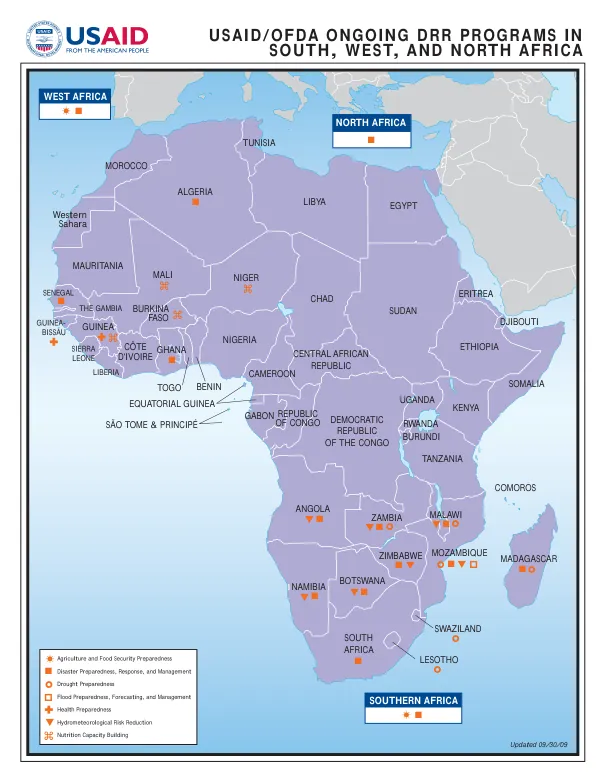
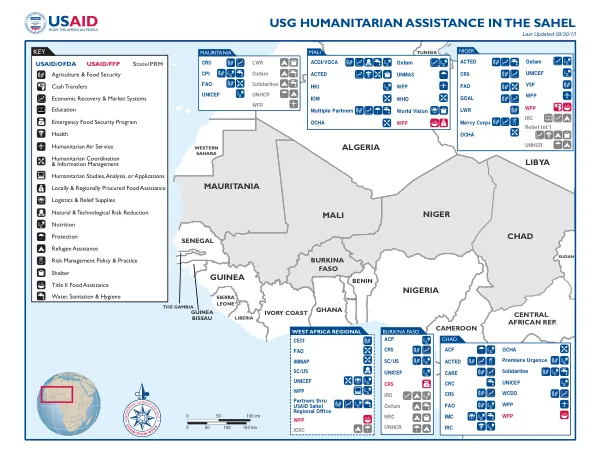
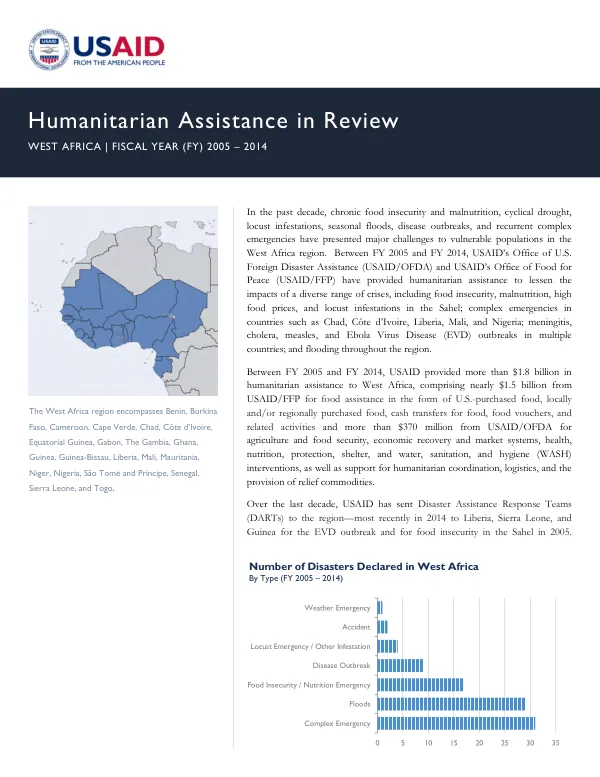
These crises have affected vulnerable populations, resulting in substantial humanitarian needs. Between FY 2005 and FY 2014, USAID's Office of U.S. Foreign Disaster Assistance (USAID/OFDA) and USAID's Office of Food for Peace (USAID/FFP) provided humanitarian assistance to lessen the impacts of these crises. The assistance included food assistance, agriculture and food security support, economic recovery and market systems interventions, health, nutrition, protection, shelter, and water, sanitation, and hygiene (WASH) interventions, as well as support for humanitarian coordination, logistics, and the provision of relief commodities. USAID provided more than $1.8 billion in humanitarian assistance to West Africa during this period, with nearly $1.5 billion from USAID/FFP for food assistance and over $370 million from USAID/OFDA for various interventions. Disaster Assistance Response Teams (DARTs) were deployed to the region, including a recent deployment in 2014 to Liberia, Sierra Leone, and Guinea for the Ebola Virus Disease (EVD) outbreak and for food insecurity in the Sahel in 2005. The West Africa region encompasses 18 countries, including Benin, Burkina Faso, Cameroon, Cape Verde, Chad, Côte d'Ivoire, Equatorial Guinea, Gabon, The Gambia, Ghana, Guinea, Guinea-Bissau, Liberia, Mali, Mauritania, Niger, Nigeria, São Tomé and Príncipe, Senegal, Sierra Leone, and Togo. The region has experienced a range of disasters, including weather emergencies, accidents, locust emergencies, disease outbreaks, food insecurity, floods, and complex emergencies. USAID/OFDA's humanitarian assistance to West Africa has focused on meeting immediate needs while building resilience against future crises. The agency supports the provision of emergency relief supplies and basic services, as well as protection activities, to assist conflict-affected populations. Following periods of below-average agricultural yields, droughts, and floods, USAID/OFDA programs aim to improve livestock health and crop production, strengthen management of acute malnutrition, support livelihoods activities, and improve water and sanitation conditions. In addition to short-term urgent assistance, USAID/OFDA supports national and regional structures to strengthen early warning and response systems. The agency's West Africa disaster risk reduction (DRR) strategy seeks to reduce the risks and effects of acute malnutrition, displacement, and epidemics through programs that decrease community and household fragility and increase resilience to future shocks. USAID/FFP supplements its emergency food aid with development food assistance, which aims to address the underlying causes of food insecurity and increase the resilience of vulnerable populations to cope with future shocks.
Related documents