USAID DEC
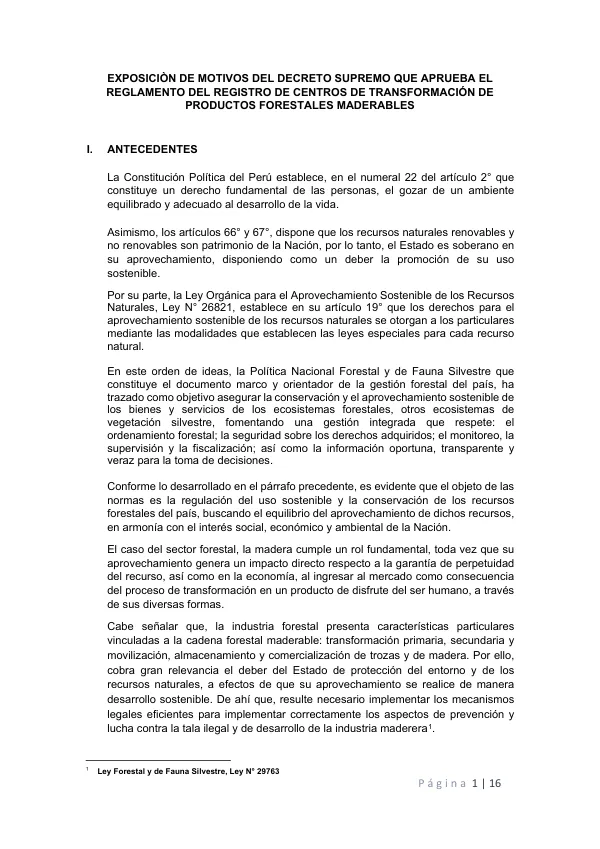
Exposición de motivos del decreto supremo que aprueba el reglamento del registro de centros de transformación de productos forestales maderables
Sign inUSAID DEC
Exposición de motivos del decreto supremo que aprueba el reglamento del registro de centros de transformación de productos forestales maderables
The regulation of the use of forest resources in Peru is governed by the Constitution, which establishes the right to a balanced and adequate environment for the development of life.
16 pages
Sign in to readA free account is required to download.
Abstract
The Law on the Sustainable Use of Natural Resources (Ley N° 26821) and the National Forest Policy and Wildlife Policy (Política Nacional Forestal y de Fauna Silvestre) aim to ensure the conservation and sustainable use of forest resources. The forestry sector plays a crucial role in the country's economy, with wood being a fundamental product. However, the industry is characterized by a lack of regulation, particularly in the area of transformation centers. The current regulatory framework, established by the Law on Forests and Wildlife (Ley N° 29763) and its regulations, only provides definitions for transformation centers, storage or collection centers, and commercialization centers, and establishes the competent authority for the authorization of these establishments. The lack of clear regulations on transformation centers has led to a situation where these establishments operate without proper authorization, and there is no effective control or regulation of their activities. This has resulted in a high level of informality in the sector, with many transformation centers not being registered or authorized to operate. The transformation of wood into products such as lumber, plywood, and furniture is a complex process that requires specialized machinery and equipment. Transformation centers can be primary or secondary, with primary centers being those that transform raw wood into products such as lumber or plywood, and secondary centers being those that transform these products into final goods such as furniture. The lack of clear regulations on transformation centers has created a situation where there is no effective control or regulation of their activities. This has resulted in a lack of transparency and accountability in the sector, and has made it difficult to track the origin and movement of wood products. The Peruvian government has established a number of policies and regulations aimed at promoting the sustainable use of forest resources and regulating the forestry sector. These include the National Forest Policy and Wildlife Policy, which aims to ensure the conservation and sustainable use of forest resources, and the Law on Forests and Wildlife, which regulates the use of forest resources and establishes penalties for non-compliance. However, despite these efforts, the forestry sector in Peru remains characterized by a lack of regulation and transparency. The lack of clear regulations on transformation centers has created a situation where these establishments operate without proper authorization, and there is no effective control or regulation of their activities. The Peruvian government has recognized the need to establish clear regulations on transformation centers, and has taken steps to address this issue. The Ministry of Agriculture and Irrigation has established a number of regulations and guidelines aimed at promoting the sustainable use of forest resources and regulating the forestry sector. One of the key challenges facing the forestry sector in Peru is the lack of effective control and regulation of transformation centers. The current regulatory framework does not provide clear guidelines on the types of activities that can be carried out by transformation centers, or the requirements for authorization and registration. The forestry sector in Peru is characterized by a lack of regulation and transparency, with many transformation centers operating without proper authorization. The lack of clear regulations on transformation centers has created a situation where there is no effective control or regulation of their activities. The regulation of transformation centers is a critical issue in the forestry sector in Peru, and requires the establishment of clear guidelines and regulations to ensure the sustainable use of forest resources and the effective control and regulation of transformation centers.
Related documents
Documents in this collection
 2020
2020USAID DEC
HOJA DE RUTA QUE PLANTEA LAS ACCIONES A SEGUIR PARA LA CORRECTA IMPLEMENTACIÓN DEL PROYECTO NORMATIVO QUE DEFINE LOS TIPOS DE TRANSFORMACIÓN Y OTROS REFERIDOS A LA INDUSTRIA DE LA MADERA EN EL PERÚ
Open record 2018
2018USAID DEC