USAID DEC
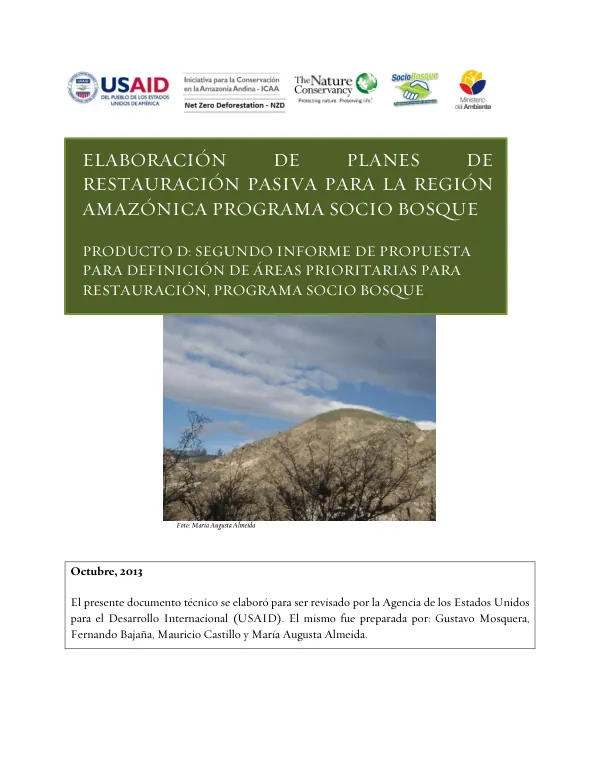
Segundo Informe de Propuesta para Definición de Áreas Prioritarias para Restauración, Programa Socio Bosque
Sign inAMAZON CONSERVATION TEAM
Segundo Informe de Propuesta para Definición de Áreas Prioritarias para Restauración, Programa Socio Bosque
The Programa Socio Bosque (PSB) of the Ministerio del Ambiente del Ecuador has initiated a process to activate restoration of degraded ecosystems through passive restoration.
2013 · 37 pages
Sign in to readA free account is required to download.
Abstract
This process aims to restore at least 40,000 hectares of land in priority areas of the country. The selection of these areas will be based on bio-physical, ecological, social, economic, and practical criteria. The PSB has sought support from The Nature Conservancy (TNC) to strengthen the Capítulo de Restauración Ecológica Pasiva (REP) within the program. The REP aims to ensure that restoration efforts are technically, politically, and socially sound. The program has identified several key aspects to consider in the restoration process, including the need to improve the quality of life for local communities and to promote sustainable development. The PSB has conducted a review of the legal framework that supports its work, including the Constitution of the Republic of Ecuador, the Plan Nacional del Buen Vivir, and the Acuerdos Ministeriales that govern the REP. The review has identified several key articles and provisions that support the restoration of degraded ecosystems, including the recognition of the rights of nature and the need to maintain and restore the cycles of life, structure, functions, and evolutionary processes of ecosystems. The PSB has also adopted policies and strategies to reduce deforestation rates through the application of instruments of encouragement for the conservation of native forests and páramos. The program has established a system of incentives for the sustainable management and reforestation of forest areas, both public and private. The PSB has also established norms and technical standards for forestation and reforestation projects. The restoration process will involve the selection of priority areas based on a set of criteria, including bio-physical, ecological, social, economic, and practical considerations. The PSB will work with local communities and stakeholders to identify areas of high conservation value and to develop restoration plans that take into account the needs and concerns of local communities. The program will also establish a system of monitoring and evaluation to track the progress of restoration efforts and to identify areas for improvement. The PSB has identified several key challenges and opportunities in the restoration process, including the need to balance the interests of local communities with the need to protect and restore degraded ecosystems. The program will need to work closely with local stakeholders to develop restoration plans that are socially, economically, and environmentally sustainable. The PSB will also need to establish a system of incentives and disincentives to encourage the adoption of sustainable land-use practices and to discourage deforestation and degradation. The restoration process will be implemented through a series of phases, including the selection of priority areas, the development of restoration plans, and the implementation of restoration activities. The PSB will work closely with local communities, stakeholders, and technical experts to ensure that the restoration process is technically, politically, and socially sound. The program will also establish a system of monitoring and evaluation to track the progress of restoration efforts and to identify areas for improvement. The PSB has identified several key indicators to measure the success of the restoration process, including the area of land restored, the number of communities involved, and the level of community engagement and participation. The program will also track the economic and social benefits of restoration, including the creation of jobs and the improvement of livelihoods. The PSB will use these indicators to evaluate the effectiveness of the restoration process and to identify areas for improvement. The restoration process will be implemented in several regions of the country, including the Amazonas, the Andes, and the coastal regions. The PSB will work closely with local communities, stakeholders, and technical experts to develop restoration plans that take into account the unique characteristics and needs of each region. The program will also establish a system of monitoring and evaluation to track the progress of restoration efforts and to identify areas for improvement. The PSB has identified several key partners and stakeholders to support the restoration process, including local communities, NGOs, and government agencies. The program will work closely with these partners to develop restoration plans, to implement restoration activities, and to monitor and evaluate the progress of restoration efforts. The PSB will also establish a system of incentives and disincentives to encourage the adoption of sustainable land-use practices and to discourage deforestation and degradation. The restoration process will be implemented over a period of several years, with the goal of restoring at least 40,000 hectares of land in priority areas of the country. The PSB will work closely with local communities, stakeholders, and technical experts to ensure that the restoration process is technically, politically, and socially sound. The program will also establish a system of monitoring and evaluation to track the progress of restoration efforts and to identify areas for improvement.
Related documents
Documents in this collection
 2014
2014USAID DEC
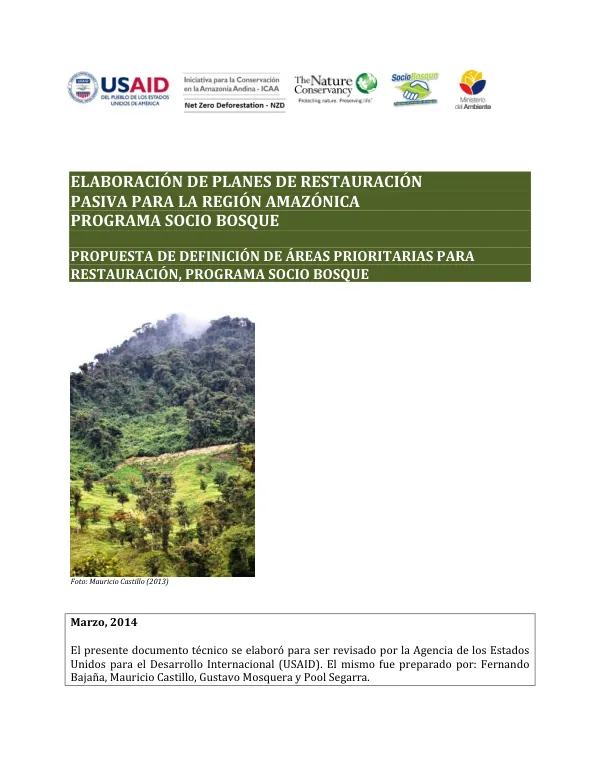
Elaboración de Planes de Restauración Pasiva para la Región Amazónica, Programa Socio Bosque
Open record 2015
2015USAID DEC