DELOITTE CONSULTING, LLP
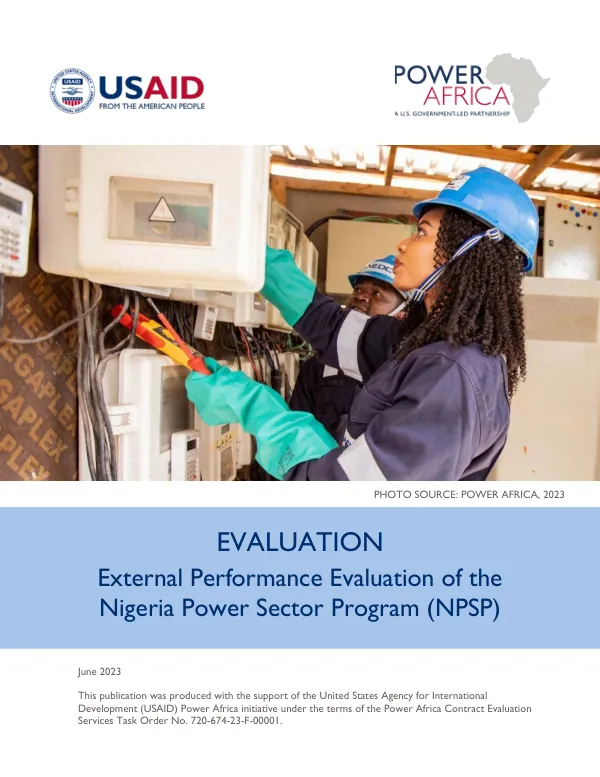
External Performance Evaluation of the Nigeria Power Sector Program (NPSP)
The Nigeria Power Sector Program (NPSP) is a five-year program extended to six-and-a-half years, with a Total Estimated Cost of $109,258,794 and a period of performance from April 2, 2018, to September 30, 2024.
2023 · 72 pages
Sign in to readA free account is required to download.
Abstract
NPSP focuses exclusively on Nigeria and is designed to support comprehensive reform within Nigeria's power sector. The program has a broad, cross-subsector mandate, aiming to accelerate energy transactions that lead to increased power generation and increased connections to end-users by working with government partners to create the policy, legal, and regulatory frameworks necessary for private sector investment and financial sustainability within the power sector. NPSP has built upon progress made in the prior program, Power Africa Transaction and Reforms Program (PATRP), as well as expanded the focus beyond transaction advisory support to further targeting upstream activities. Through a range of technical assistance activities, NPSP seeks to address specific constraints in the energy sector across four outcome areas: (1) increased generation capacity; (2) increased off-grid connections facilitated; (3) improved enabling environment; and (4) improved liquidity of the distribution sector. The implementation team is well regarded and is seen as competent, effective, and reliable, producing quality outputs. The challenges are well understood, and a core element of NPSP's approach is the use of embedded advisors, who provide substantial value within the government entities where they are placed. Informants value the high-quality technical reports and other outputs produced by NPSP and NPSP's hosting and convening activities. NPSP effectively engages and coordinates with a wide range of public and private partners and other stakeholders, though there are some concerns. Overall, NPSP is seen as an effective convener and as liaising with the right stakeholders, though the depth and frequency of engagement varies by stakeholder and opportunity. There is a lack of clarity among several development partners as to what exactly NPSP can offer and by extension what the United States Government (USG) priorities and boundaries in Nigeria are. Even with budget cuts, NPSP is progressing well on indicators for which it has the most direct influence. The progress to date varies significantly across categories, with some targets already exceeded with 18 months remaining, such as the number of people trained and new connections. NPSP is highly unlikely to meet its targets relating to generation capacity, but these were based on unrealistic assumptions. Progress on transmission-related indicators is moderate to date. Personal relationships are highly important in Nigeria, and NPSP is building long-term relationships and gaining respect from counterparts and development partners as a neutral source of unbiased technical information. NPSP appears to have struck the balance between relationship development while avoiding any appearance of excessive favoritism or undue influence. The program is seen as having a good local presence overall, which helps in building relationships, as does having embedded advisors. The program approach must proactively evolve as the context evolves. The context will evolve as new international and national priorities emerge, and NPSP must be prepared to adapt its approach to address these changes. This will require ongoing engagement with stakeholders, including government partners, development partners, and private sector actors, to ensure that NPSP remains relevant and effective in achieving its goals. NPSP's effectiveness in engaging and coordinating with stakeholders is critical to its success. The program must continue to build on its strengths in this area, including its use of embedded advisors and its hosting and convening activities. By doing so, NPSP can ensure that it remains a trusted and effective partner in the Nigerian power sector, and that it continues to make progress towards its goals.