USAID DEC
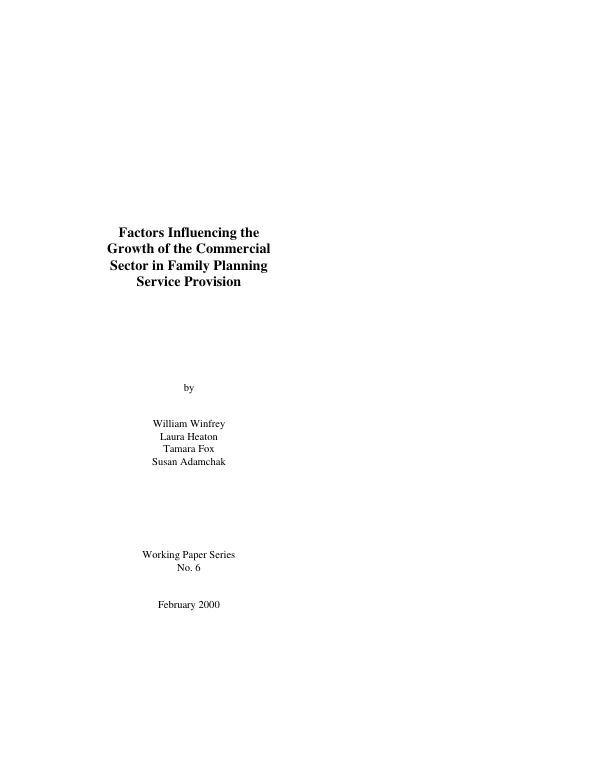
Factors influencing the growth of the commercial sector in family planning service provision
Sign inCENTRE FOR DEVELOPMENT AND POPULATION ACTIVITIES (CEDPA)
Factors influencing the growth of the commercial sector in family planning service provision
Family planning (FP) programs worldwide confront increasingly difficult financial challenges.
Winfrey, William; Heaton, Laura · 2000
Sign in to readA free account is required to download.
Abstract
One option for expanding the resource base for FP and reproductive health services in developing countries is to promote the growth of the commercial FP sector. Using Demographic and Health Survey (DHS) data for 45 countries, this paper demonstrates that the commercial sector (1) plays an important role in national FP markets, even in countries where contraceptive prevalence is low; and (2) does not always develop coincidentally as prevalence grows or as programs mature. The paper examines three sets of factors to explain variations in commercial market share across countries: (1) Microeconomic or household factors. Characteristics of individuals, such as ability to pay or knowledge of contraception, may make them more likely to use the commercial sector. (2) Macroeconomic or business climate factors. Characteristics of a country and its economy may lead to a larger commercial market share for contraceptive services and commodities. (3) Programmatic factors. Characteristics of a FP program, such as government support and method mix, may lead to a larger commercial market share. The commercial market share for FP is related to many factors, which can be grouped in two categories: external factors over which there is no control, but which can be exploited or understood as a program constraint, such as per capita income and the level of urbanization; and programmatic factors that are under the direct or indirect control of the program, such as public sector pricing or program effort. The cross-national analysis shows that broad-based purchasing power, improved knowledge of reproductive health, critical densities of population, and appropriate public policy are each associated with relatively strong commercial sectors. The paper provides recommendations to help public health policymakers integrate the commercial sector into their programs by developing economic and policy environments supportive of its expansion. For many years, many countries have provided FP as if it were a public good, while paying limited attention to the commercial sector, likely assuming that the latter"s share would grow as a consequence of growth in general public interest in FP. Includes references. (Author abstract, modified)
Related documents