USAID. MISSION TO INDONESIA
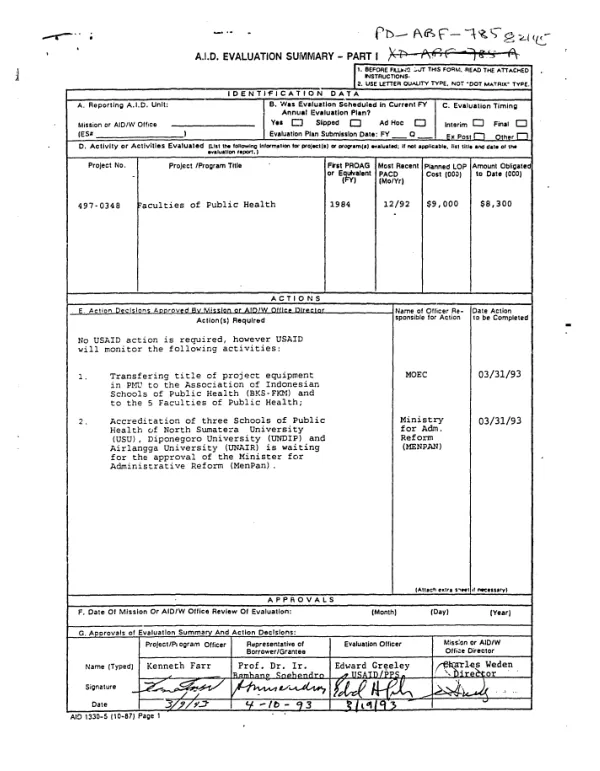
Faculties of public health
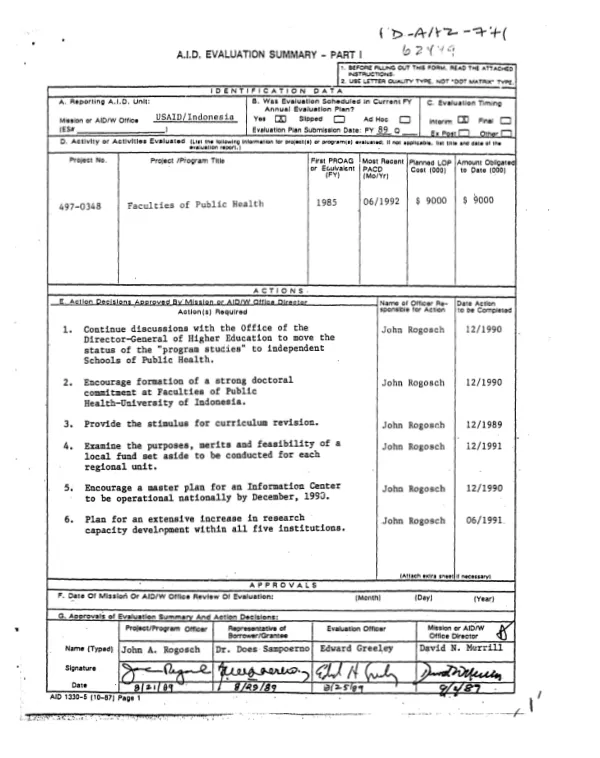
Summarizes mid-term evaluation (PD-AAZ-208) of a project to strengthen faculties of public health at designated universities in Indonesia.
1989
Sign in to readA free account is required to download.
Abstract
External evaluation covered the period 1985-11/88. The project is on schedule, with most of its input and output targets being reached. If present trends continue, over 1,300 Bachelor"s degree candidates will graduate during the life of the project, exceeding goals by 9%. Another 360 students are expected to graduate from Master"s programs. While the University of Indonesia (UI) has delayed approval of a doctoral program in public health, there is an effective doctoral program at Airlangga University (AU). The project"s management procedures have been excellent. Staff training in Indonesia and the United States is on target, and project goals for numbers of new faculty involved in teaching and research in each school will be met. Books, microfiche, computers, and audiovisual aids are in place, but while microfiche are used only by a few faculty, computers are over-used and there is concern about the funding for maintenance and repair. Health texts in English are not nearly as well used as those in Indonesian. Several problems are hindering the project"s effectiveness. Perhaps the most important of these is the overly theoretical nature of the curricula and the lack of field practice. Other problems include duplication of materials, student reliance on memorization rather than reasoning, and the delay in developing competency-based curricula. Moreover, a national resource center to disseminate public health information remains to be established, and only two the five schools being assisted under the project have received separate status as a public health school. In the others, public health is a "program study" within medical schools. There are five major recommendations: (1) AU and UI should jointly design a health doctoral program for use in both schools; (2) additional books and journals should be translated into Indonesian, more microfiche journal subscriptions and computers should be procured, and greater use of audiovisual equipment should be encouraged; (3) inter-departmental curriculum committees should be set up in each school; (4) returning faculty should conduct research and establish better communications with local health agencies so that research can address local needs; (5) about 15% of local cost funds should be set aside for innovative teaching and research activities. USAID/I found recommendations 1 and 5 unfeasible. It also felt that the evaluation should have paid more attention to TA and in-service training and would have welcomed a judgment on whether the Project Management Unit is too pro-active or not pro-active enough.