USAID DEC
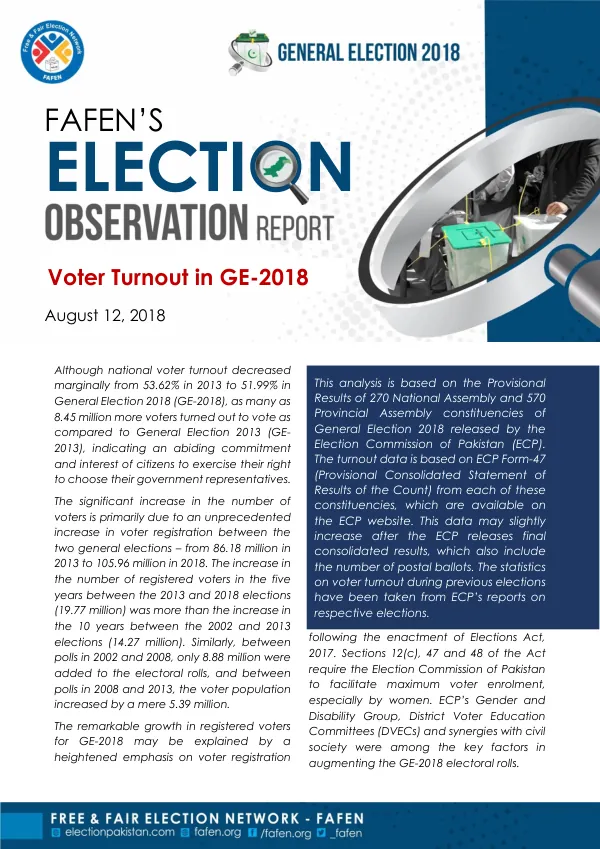
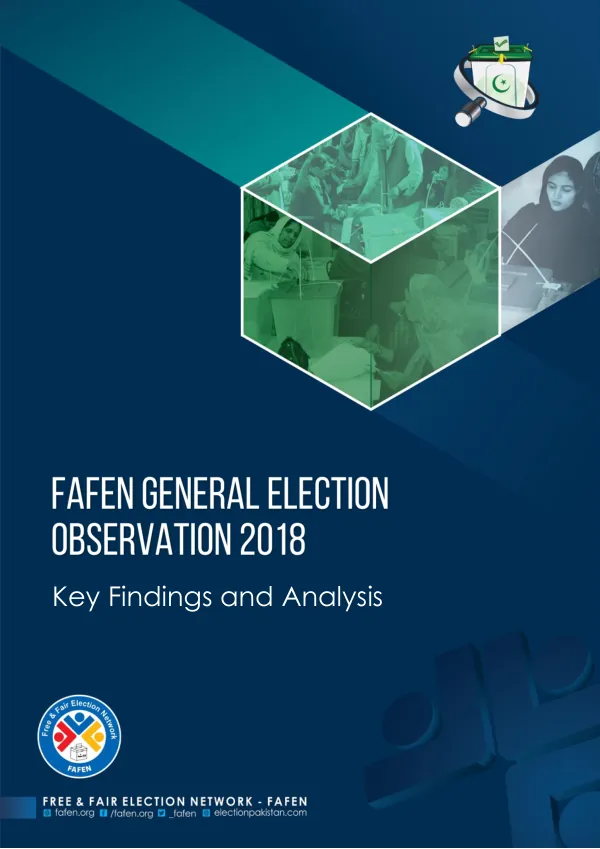
FAFEN General Election Observation 2018: Key Findings and Analysis
Pakistan's 10th General Election were held on July 25, 2018, marking the completion of a decade of continuous democratic rule under civilian governments.
2018 · 40 pages
Sign in to readA free account is required to download.
Abstract
The significance of non-partisan election observation, a powerful tool for improving the quality of elections and enhancing citizens' understanding and confidence in political and electoral processes, cannot be overstated in the context of Pakistan's contemporary fragmented politics and evolving but fragile democratic system. Free and Fair Election Network (FAFEN), a nationwide coalition of 54 Pakistani civil society organizations (CSOs), has built a strong reputation over the last decade among the full range of electoral stakeholders, including the Election Commission of Pakistan (ECP), political parties, and the media, as the country's first and only data-driven, credible, and independent domestic election observation network. FAFEN has successfully observed three General Elections (GE) held since 2008 as well as all by-elections and local government elections. FAFEN's election observation methodologies follow ECP's Code of Conduct for Domestic Observers and the national election law along with international best practices for domestic election observers as articulated in the 2012 Declaration of Global Principles for Nonpartisan Election Observation and Monitoring by Citizen Organizations. These codes guide FAFEN's election observation work, including its commitment to observe all phases of the election process. The observation methodology has also taken into consideration Pakistan's international legal commitments relevant to both election administration and election observation that are based on the country's ratification in 2010 of the International Covenant on Civil and Political Rights (ICCPR) and of the Convention against Corruption (CAC) in 2007. Other particularly relevant international legal obligations stem from Pakistan's ratification of the Convention on the Elimination of all Forms of Discrimination against Women (CEDAW) in 1996 and the Convention on the Rights of Persons with Disabilities in 2011. Building on the experience gained and lessons learnt from FAFEN's nationwide observation of two preceding general elections, namely GE 2008 and GE 2013, FAFEN adopted a methodical, multi-phased approach for its observation of GE 2018. The phases of the observation exercise included: Pre-Election Long-Term Observation, which began in January 2018 and covered 130 districts and 272 National Assembly (NA) constituencies across Pakistan. Observers for this phase received training on the new consolidated election law, the Elections Act, 2017, and the election rules derived from it, along with the ECP's Code of Conduct for Domestic Observers. Pre-Election Medium-Term Observation, which took place in the months leading up to the election and focused on the electoral process, including voter registration, candidate nomination, and campaign activities. Election Day Observation, which involved the deployment of observers to polling stations across the country to monitor the voting process and report on any irregularities or issues that may arise. Post-Election Observation, which took place after the election and focused on the counting and tabulation of results, as well as the overall electoral process. FAFEN's observation methodology also included the use of automated solutions for observation and reporting, parallel vote tabulation, and quality assessment of election results. The network's observers were trained to identify and report on irregularities and issues that may affect the integrity of the electoral process. The geographical scope of the observation exercise included 130 districts and 272 National Assembly (NA) constituencies across Pakistan. The observers for each observation phase received training on the new consolidated election law, the Elections Act, 2017, and the election rules derived from it, along with the ECP's Code of Conduct for Domestic Observers.
Related documents