USAID DEC
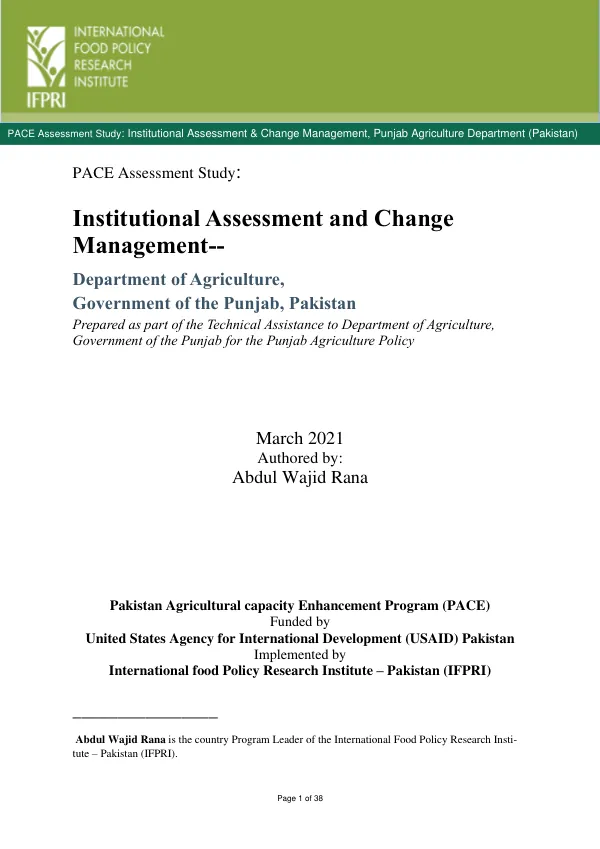
PACE Assessment Study: Institutional Assessment and Change Management, Punjab Agriculture Department (Pakistan)
Sign inUSAID DEC
PACE Assessment Study: Institutional Assessment and Change Management, Punjab Agriculture Department (Pakistan)
The agricultural development initiative in Pakistan's Punjab province began with the devolution of functions from the Ministry of Food, Agriculture, and Livestock to the provinces in 2010.
2021 · 38 pages
Sign in to readA free account is required to download.
Abstract
This devolution led to increased attention to agriculture, with a focus on unlocking the potential for economic growth and employment creation through productivity improvement and diversification. The Punjab agriculture sector is crucial to the province's economy and national economy, accounting for 27% of its GDP and providing employment to over 40% of its workforce. Punjab is home to more than 110 million people, with 36% living in urban areas. The province accounts for more than half of Pakistan's GDP and is a major contributor to the country's exports, with over 75% of exports being agriculture-based. The average monthly household income in rural Punjab is $285, with two-thirds of farms being smaller than 2 hectares. The performance of the agriculture sector is therefore crucial to any strategy for generating higher income. Agriculture growth in Pakistan, including Punjab, has been lackluster for nearly three decades, with previous growth largely based on expansion of cereal production with heavy government intervention. The Punjab agriculture sector faces several challenges, including soil degradation, limited market access, and inadequate infrastructure. The sector also faces constraints related to organizational and functional issues, monitoring and evaluation, human resources, financial resources, and environmental concerns. The Punjab Agriculture Department plays a crucial role in addressing these challenges and promoting the development of the agriculture sector. The department's existing structure includes various functions, such as planning, coordination, and implementation of agricultural policies and programs. However, the department faces several constraints, including inadequate resources, inefficient management, and lack of coordination with other stakeholders. The proposed restructuring of the Punjab Agriculture Department aims to address these constraints and improve the department's effectiveness in promoting the development of the agriculture sector. The proposed restructuring includes the establishment of coordination committees, improvement of monitoring and evaluation systems, and enhancement of human resources and financial management. The restructuring also aims to promote the use of information and communication technology (ICT) and geographical information systems (GIS) to improve the department's decision-making and planning processes. The Punjab Agriculture Department's functions include planning, coordination, and implementation of agricultural policies and programs. The department is responsible for promoting the development of the agriculture sector, improving agricultural productivity, and enhancing the livelihoods of farmers and rural communities. The department's functions are supported by various institutions, including the Ministry of National Food Security and Research, the Planning and Development Department, and the Punjab Procurement Regulatory Authority. The department's performance is evaluated through various indicators, including agricultural productivity, farmers' income, and rural poverty reduction. The department's budget is allocated through the Annual Development Plan, with a focus on promoting the development of the agriculture sector. The department's human resources are managed through the Financial Accounting and Budget System, with a focus on improving the efficiency and effectiveness of the department's operations.