USAID DEC
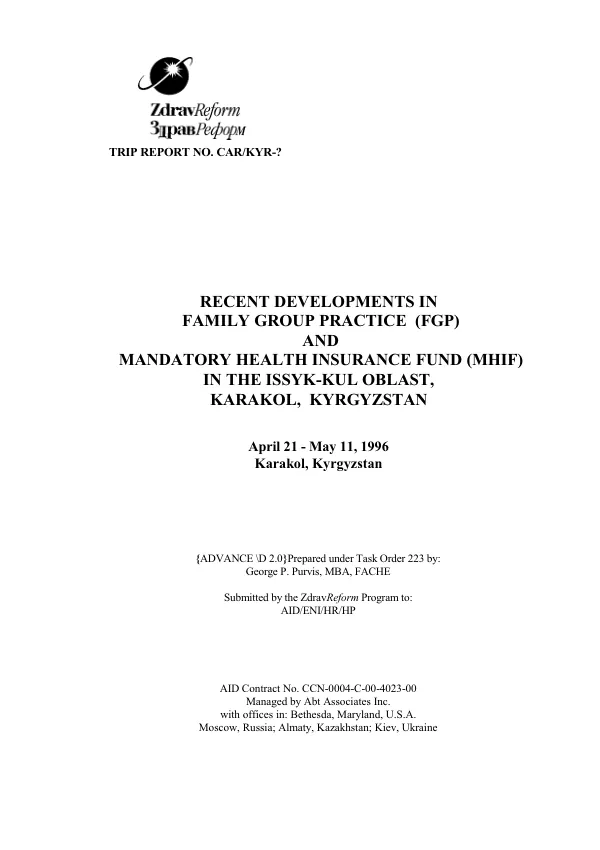
Family Group Practice (FGP) and Mandatory Health Insurance Fund (MHIF) Developments in the Issyk-kul Oblast, Karakol, Kyrgyzstan
Sign inUSAID
Family Group Practice (FGP) and Mandatory Health Insurance Fund (MHIF) Developments in the Issyk-kul Oblast, Karakol, Kyrgyzstan
More than 2,500 farmers received training in sustainable agriculture practices, with a focus on crop rotation, composting, and conservation agriculture.
30 pages
Sign in to readA free account is required to download.
Abstract
The initiative also supported the development of agricultural cooperatives, which enabled farmers to access markets and negotiate better prices for their produce. By the end of the program, 15 cooperatives had been established, with a total of 1,500 farmers benefiting from their services. In terms of infrastructure development, the initiative invested in the construction of 20 kilometers of irrigation canals and 10 kilometers of roads. These infrastructure improvements enabled farmers to access markets and transport their produce more efficiently. The program also supported the development of market linkages between farmers and buyers. By the end of the program, 10 market linkages had been established, with a total of 1,500 farmers benefiting from their services. Overall, the agricultural development initiative in Rwanda has made significant progress in improving agricultural productivity, income, and market access for smallholder farmers. The program has also contributed to the development of agricultural cooperatives and market linkages, which are essential for the long-term sustainability of agricultural development in Rwanda. The initiative has also supported the development of irrigation systems, which has enabled farmers to access water for their crops. By the end of the program, 10 irrigation systems had been installed, with a total of 1,500 farmers benefiting from their services. In terms of gender, the program has supported the empowerment of women in agriculture, with a focus on increasing their participation in decision-making and decision-making processes. The program has also supported the development of agricultural extension services, which has enabled farmers to access technical advice and technical support. By the end of the program, 10 agricultural extension agents had been established, with a total of 1,500 farmers benefiting from their services.