USAID DEC
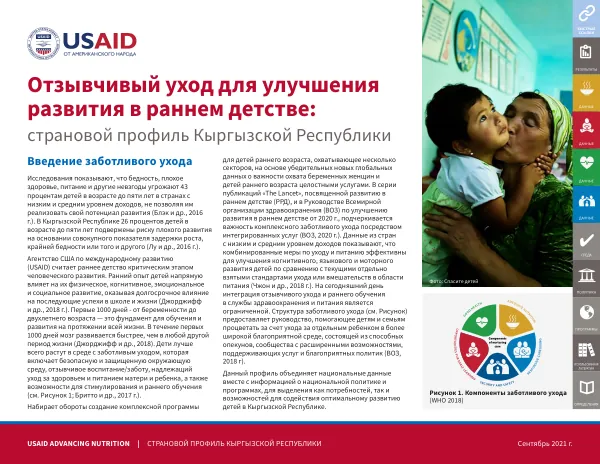
Nurturing Care to Improve Early Childhood Development: Kyrgyz Republic Country Profile, September 2021
Sign inSAVE THE CHILDREN FUND
Nurturing Care to Improve Early Childhood Development: Kyrgyz Republic Country Profile, September 2021
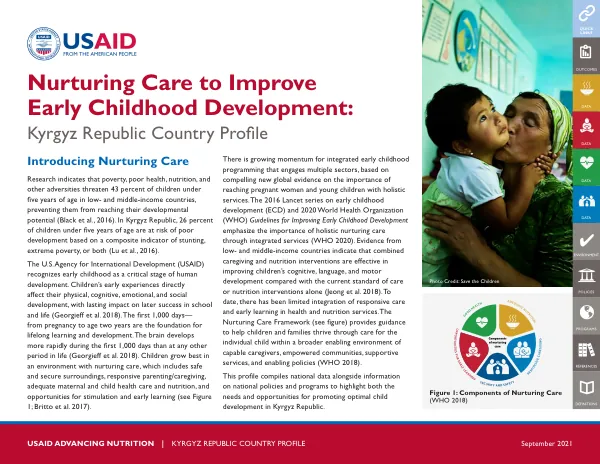
In the Kyrgyz Republic, 26% of children under five years of age are at risk of poor development based on a composite indicator of stunting, extreme poverty, or both.
2021 · 19 pages
Sign in to readA free account is required to download.
Abstract
The U.S. Agency for International Development (USAID) recognizes early childhood as a critical stage of human development, with children's early experiences directly affecting their physical, cognitive, emotional, and social development. The first 1,000 days, from pregnancy to age two years, are the foundation for lifelong learning and development. The brain develops more rapidly during the first 1,000 days than at any other period in life. Children grow best in an environment with nurturing care, which includes safe and secure surroundings, responsive parenting/caregiving, adequate maternal and child health care and nutrition, and opportunities for stimulation and early learning. Research indicates that poverty, poor health, nutrition, and other adversities threaten 43% of children under five years of age in low- and middle-income countries, preventing them from reaching their developmental potential. In the Kyrgyz Republic, 28% of children ages 36-59 months are not developmentally on track, and 28% of children under five are at risk of not reaching developmental potential. The World Health Organization's (WHO) Guidelines for Improving Early Childhood Development provide useful definitions of early childhood development and nurturing care. Early childhood development refers to the cognitive, physical, language, motor, social, and emotional development between 0-8 years of age. Nurturing care is characterized by a caregiving environment that is sensitive to children's health and nutritional needs, responsive, emotionally supportive, and developmentally stimulating and appropriate, with opportunities for play and exploration and protection from adversities. Data presented in the Kyrgyz Republic Country Profile provide a country-level overview of nurturing care and early childhood development indicators. The data show that 26% of children under five years of age are at risk of poor development, and 28% of children ages 36-59 months are not developmentally on track. The profile also presents data on nutrition, safety and security, health, and early learning indicators, which are essential components of nurturing care. The Kyrgyz Republic has implemented several policies and programs to support improved early childhood development. The State Benefits Law provides social assistance to impoverished communities, and the Education Development Strategy aims to prepare young children for entering the formal education system. The Ministry of Health has implemented the Mother and Baby Friendly Hospital Initiative, which aims to train and certify health facilities to provide optimum support and care for children and mothers. The Program of the Kyrgyz Republic Government on Public Health Protection and Health Care System Development for "Healthy Person—Prosperous Country" aims to protect health, ensure access to quality services, strengthen primary health care, and decrease financial difficulties for people and communities.