USAID. BUR. FOR AFRICA
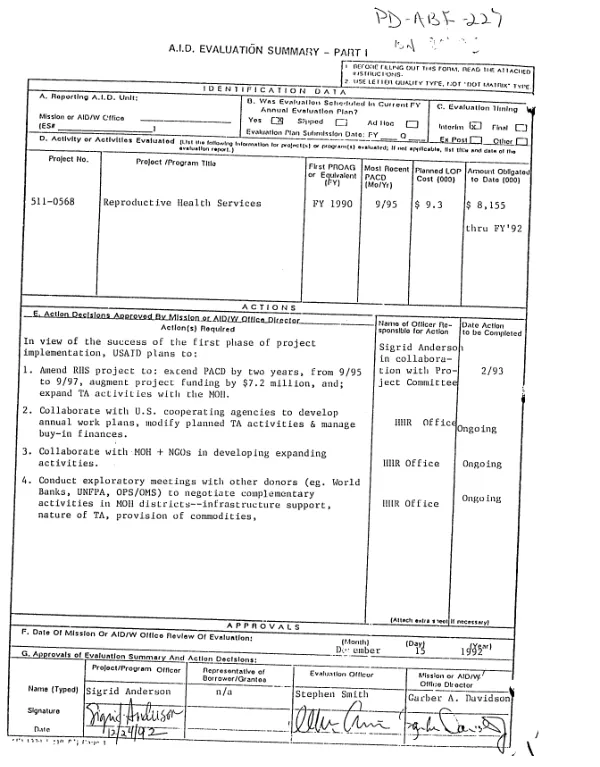
Family health initiatives (FHI-II) project
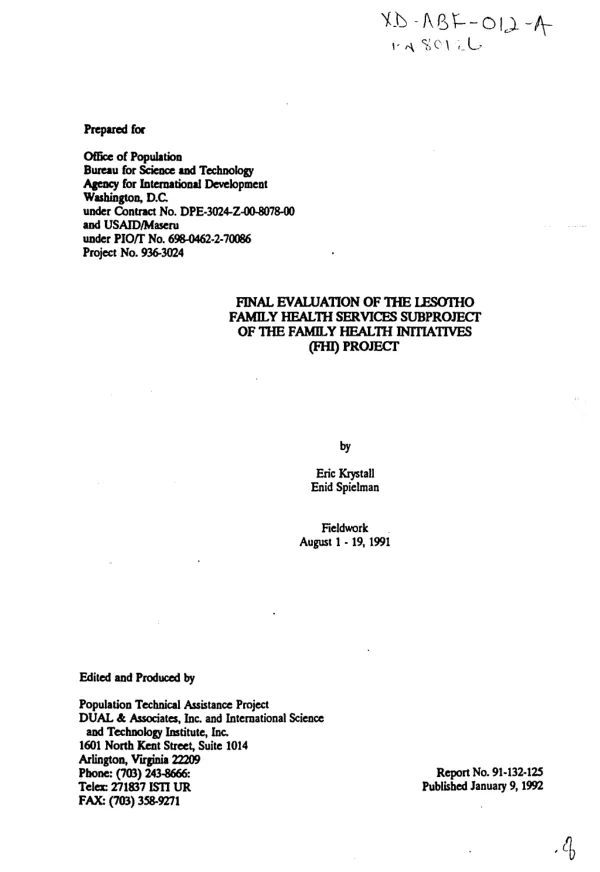
Summarizes attached final evaluation (XD-ABF-012-A) of a project (8/87-8/91) to strengthen family planning (FP) promotion and delivery programs in Lesotho.
1992
Sign in to readA free account is required to download.
Abstract
Despite an overly complex design, inadequate counterpart staffing, and some delays in initial TA, the project met most of its objectives, and its six components have become an integral part of the national FP program. (1) The information, education, and communication (IEC) component created two important entities: an IEC Technical Task Force, which proved effective in program planning and coordination and in introducing IEC materials via various media; and a National FP Coordinating Committee. Problems included a lack of IEC experts, inadequate funding for urgently needed materials, and unmet training needs due to a lack of TA and the aforesaid shortage of personnel. (2) A consultant from the Center for African Studies (CAFS) helped the Family Life Education (FLE) Task Force to develop a detailed FLE strategy and workplan, but the plan was overly ambitious, and so only partially implemented, while delays at both CAFS and the local level left several crucial activities incomplete. A FLE curriculum is still not in place, and only one youth counselor is currently working, since the planned youth center is not yet constructed. (3) TA provided via the FP Logistics Management project improved management of contraceptive supplies at all levels. However, while condom and IUD stocks are adequate, a lack of forecast planning has resulted in stockouts and inadequate supply overall of orals, usage of which has increased. Statistical reporting is are expected to become more accurate with the revision of forms to reflect community-based, AIDS, and natural family planning (NFP) programs as well as the already included clinic-based distribution. Also, lack of personnel at the Family Health Division resulted in insufficient feedback to the field. (4) Two of four planned operations research studies were completed and have proved useful. The NFP study was dropped due to lack of promised TA from Georgetown University (GU). Also, a fundraising study for the Lesotho Planned Parenthood Association was canceled due to late project start-up. (5) Despite the lack of help from GU, the NFP program has trained six groups of NFP trainers. (6) Training of 36 mid- and top-level FP managers has strengthened overall management and led to implementation of a supervisory checklist. Short-term out-of-country, training was effectively utilized. Lessons learned are as follows. (1) There was shared frustration among the implementing agencies and USAID/L with fitting the various project pieces together in a way that would accomplish objectives in a timely manner. (2) The weak managerial capacity of cooperating institutions (due to lack of and high turnover among staff) forced USAID/L to direct implementation.
Related documents