USAID. MISSION TO KENYA
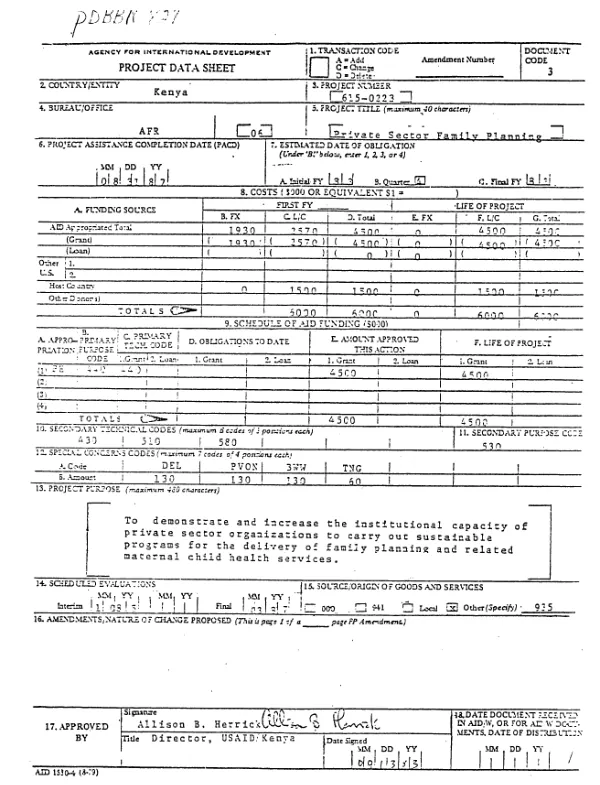
Family planning management and research project
Project to help the International Medical and Research Foundation (IMREF) establish a Maternal Child Health/Family Planning (MCH/FP) and Nutrition Unit at the African Medical and Research Foundation (AMREF) in Kenya.
1983
Sign in to readA free account is required to download.
Abstract
The Unit will implement and evaluate five pilot FP/health interventions, disseminate evaluation findings, and test intervention-generated training materials through further in-country training. An MCH/FP and Nutrition Unit will be established in AMREF"s Community Health Department to institutionalize FP activities within AMREF and act as a clearinghouse for FP information and a technical resource for the Government of Kenya and PVO"s in the area of MCH/FP and nutrition. The Unit will also be responsible for coordinating AMREF"s MCH/FP and nutrition activities, providing inservice training for AMREF staff in these areas, and identifying inputs for ongoing and future programs. An Advisory Committee widely representative of Kenyan organizations will be formed to help establish the Unit and promote collaboration and exchange of information among participating agencies. The Unit will design, implement, and evaluate five pilot FP/health interventions which will benefit 5,250 poor Kibwezi children in an integrated project for child survival; provide 2,000 women with obstetric and postnatal care and 5,000 men and women of reproductive age with FP services; and train 60 AMREF Kibwezi community health workers (CHW"s), 200-250 traditional birth attendants (TBA"s) (as FP advocates), 25 Ministry of Health staff in Kibwezi, and two staff members of the private Agricultural Estate in Kibwezi. The Unit will disseminate results of intervention evaluations to some 120 individuals through six 1-week workshops and will distribute reports on the workshops to appropriate agencies and decisionmakers. The Unit will also conduct four 1-week training courses for a total of 150 district hospital and health center/dispensary personnel, CHW"s, and TBA"s in order to test and assess the training modules and learning materials developed during the project. Finally, the project will support 9-month U.S. Master of Public Health training for two candidates.
Related documents