USAID DEC
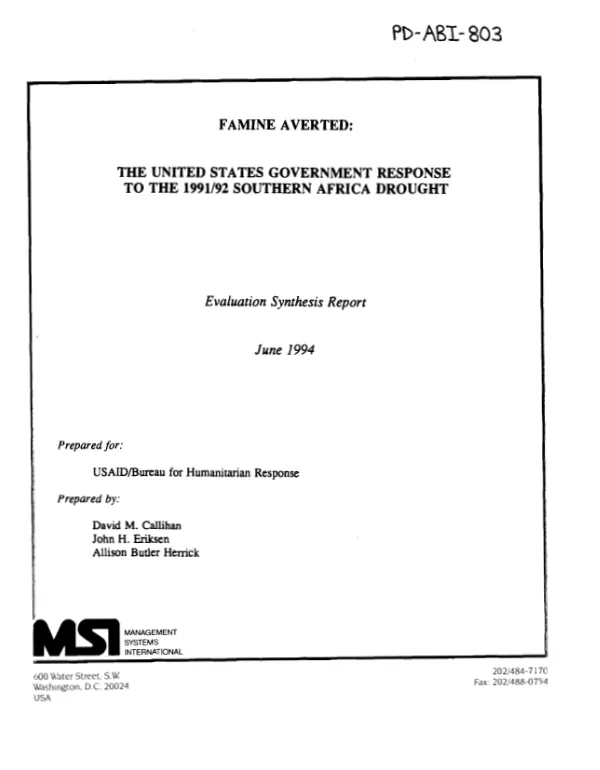
Famine averted : the United States Government response to the 1991/92 Southern Africa drought -- evaluation synthesis report
Sign inMANAGEMENT SYSTEMS INTERNATIONAL, INC. (MSI)
Famine averted : the United States Government response to the 1991/92 Southern Africa drought -- evaluation synthesis report
Evaluates U.S.
Callihan, David M.|Eriksen, John H.|Herrick, Allison Butler · 1994
Sign in to readA free account is required to download.
Abstract
emergency food assistance provided to southern Africa during the 1991-92 drought. The report synthesizes material contained in individual country evaluation reports. Southern African cereal harvests during the 1991/92 drought were 11.4 million MTs less than average, placing more than 17 million persons at risk, some 15 million of them in Malawi, Zimbabwe, Mozambique, and Zambia. A massive and timely international response averted famine, prevented off-farm migration, and facilitated recovery. With the exception of Mozambique, which had been experiencing prolonged civil war, there were no famine deaths reported. By a significant margin, the United States was the largest contributor to the relief program; moreover, the United States provided significant quantities of food sooner than any other donor. The following lessons were learned. (1) Donors should begin shipping food as quickly as possible. The fastest that relief food can be delivered is 2-3 months. In this case, 4-5 months were required to deliver U.S. food to inland destinations in landlocked countries. In early 1992, USAID shipped 45,000 MT to maize to Durban, South Africa in response to the first indications of a serious regional crisis. This was allocated to Malawi, where it arrived in 6/92 (5 months before any Malawi-specific food aid), and was critical to the prevention of widespread famine. (2) Governments faced with extraordinary food shortages should quickly purchase cereal from commercial sources to satisfy early drought relief needs and reduce reliance on donor food, which cannot always be supplied quickly enough in sufficient quantities. The ability of Zambia and Zimbabwe to purchase grain was critical to their being able to avert famine. (3) Use existing food distribution channels, which are likely to be more cost-effective and efficient than setting up a parallel distribution system. (4) Food for work (FFW) projects may be appropriate if they are operational prior to the emergency, or if the affected country already has an inventory of labor-intensive projects. In general, however, short-term FFW projects are not an effective alternative to free food distribution. Botswana's cash-for work program should be studied as a possible model. (5) Use of NGOs was a resounding success in getting food to those most in need. (6) Planning and administrative capability is a country's best preparation for managing a drought. Simply having a unit in place is not the answer, however. Mozambique, Lesotho, and Malawi had pre-existing structures, but these in no way guaranteed an effective response. The willingness of governments to decentralize operations was also a factor in success. Many conditions contributed to the successful drought relief response. (1) Except for Mozambique and Angola, there were no civil conflicts which inhibited access to vulnerable populations. The Mozambican conflict came to a peaceful settlement during the drought. (2) The drought came at a time when the USDA had on hand record amounts of surplus yellow corn. (3) Several countries in the region were undertaking transitions toward democracy, increasing U.S. political interest in promoting stability. (4) The region's linked rail systems, which have received massive support from A.I.D. and other donors, were sufficient to carry the extra volume of food imports. The region also has relatively good road and communications systems. (5) Fortunately, rainfalls during 1992/93 returned to normal; plantings during this time yielded above average harvests in most of the affected countries. (6) Considerable, unprecedented cooperation was exhibited between the Republic of South Africa and its southern African neighbors. Similarly unprecedented were the efficiency of and cooperation among USAID, USDA, the World Food Program (WFP), the U.S. State Department's Bureau for Refugee Programs, governments within the region, and other donors in transporting over 11 million MTs of emergency food aid under pressing circumstances.