USAID/FFP
Humanitarian Assistance in Review: Southern Africa | FY 2003 – 2012
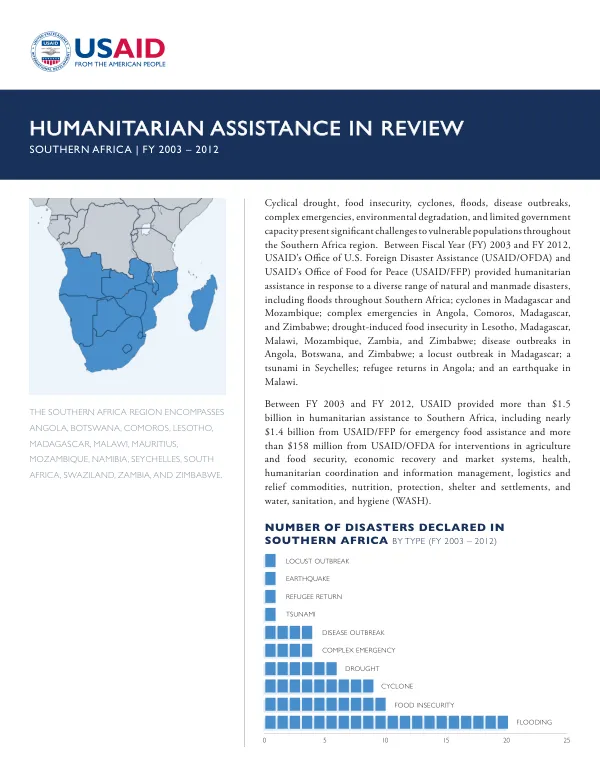
Cyclical drought, food insecurity, cyclones, floods, disease outbreaks, complex emergencies, environmental degradation, and limited government capacity present significant challenges to vulnerable populations throughout the Southern Africa region.
2012 · 2 pages
Sign in to readA free account is required to download.
Abstract
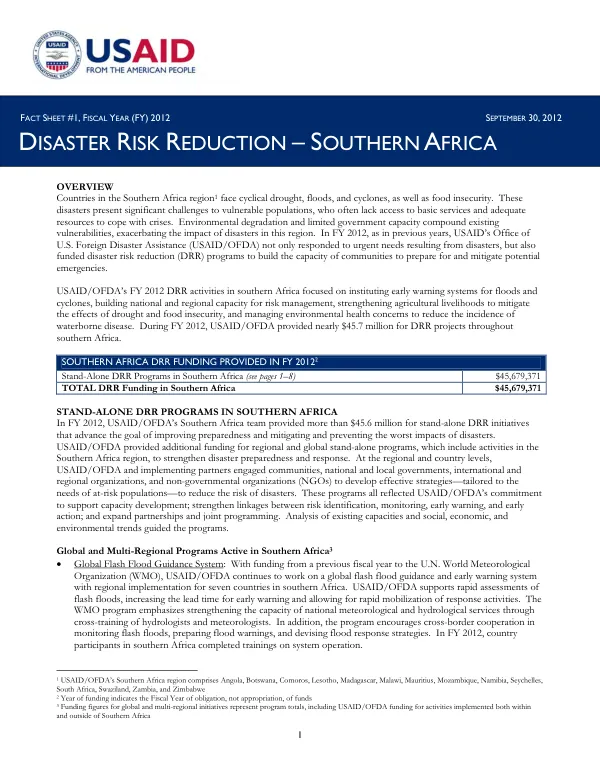
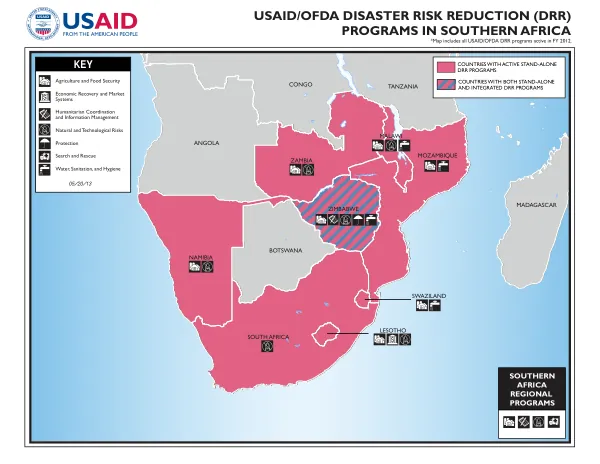
Between Fiscal Year (FY) 2003 and FY 2012, USAID's Office of U.S. Foreign Disaster Assistance (USAID/OFDA) and USAID's Office of Food for Peace (USAID/FFP) provided humanitarian assistance in response to a diverse range of natural and manmade disasters. The Southern Africa region encompasses Angola, Botswana, Comoros, Lesotho, Madagascar, Malawi, Mauritius, Mozambique, Namibia, Seychelles, South Africa, Swaziland, Zambia, and Zimbabwe. Between FY 2003 and FY 2012, USAID provided more than $1.5 billion in humanitarian assistance to Southern Africa, including nearly $1.4 billion from USAID/FFP for emergency food assistance and more than $158 million from USAID/OFDA for interventions in agriculture and food security, economic recovery and market systems, health, humanitarian coordination and information management, logistics and relief commodities, nutrition, protection, shelter and settlements, and water, sanitation, and hygiene (WASH). In the last decade, USAID deployed multiple humanitarian assessment and response teams to the region, including a Disaster Assistance Response Team (DART) for the 2008/2009 cholera outbreak in Zimbabwe. USAID/OFDA disaster response activities frequently focus on providing emergency relief supplies, such as plastic sheeting and water containers; supporting agriculture and food security activities, such as distribution of seeds and other farming inputs; and promoting WASH interventions, such as hygiene awareness campaigns. Through emergency and development food assistance programs, USAID/FFP works to save lives and reduce food insecurity in times of crisis and situations of chronic food insecurity. USAID/FFP emergency food assistance includes both in-kind food aid and cash-based assistance in the form of local and regional procurement of food commodities, cash transfers, and food vouchers, where market conditions allow. USAID/OFDA has employed a regional disaster risk reduction (DRR) strategy since FY 2009 to promote activities that help reduce the vulnerability of at-risk populations to climate-induced disasters and increase their resilience to future shocks.
Related documents