USAID. MISSION TO MALI
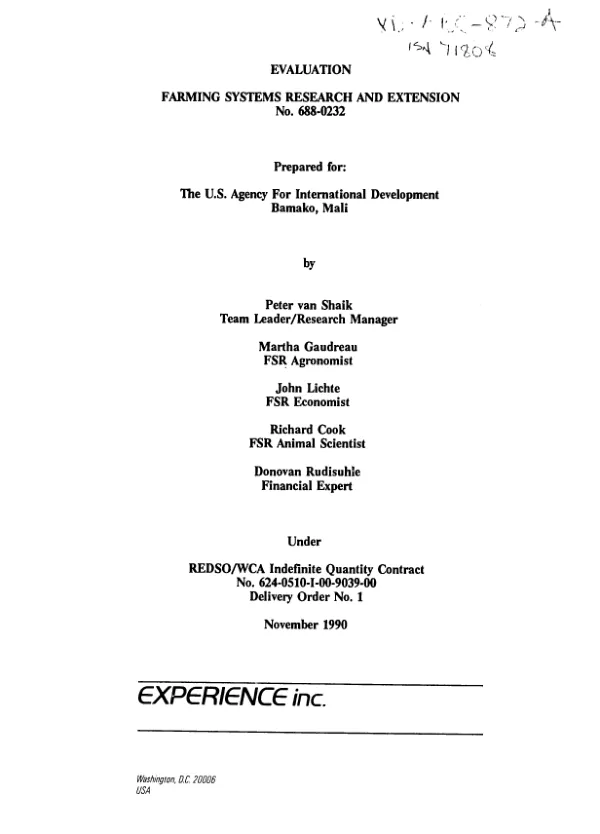
Farming systems research and extension
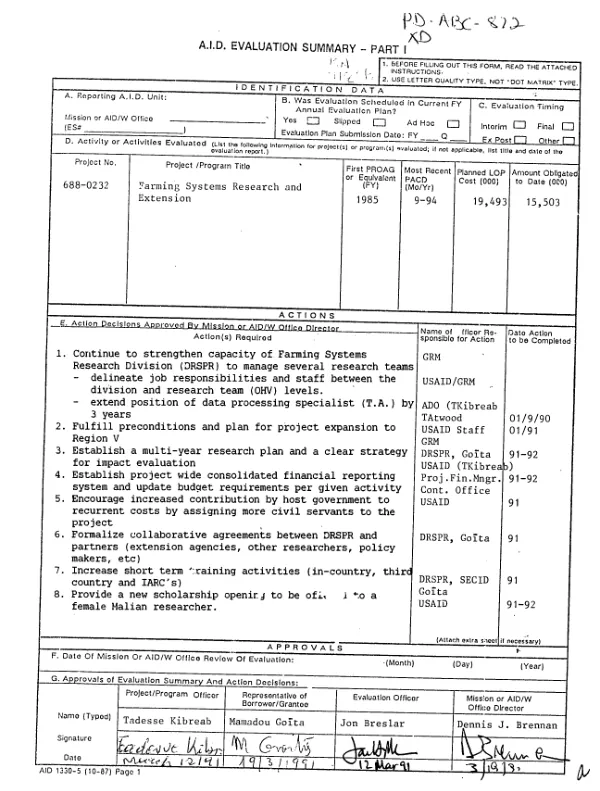
Summarizes interim evaluation of a project to strengthen Mali"s Institute of Rural Economy (IER) and its Division of Farming Systems Research and Extension (DRSPR).
1991
Sign in to readA free account is required to download.
Abstract
The external evaluation covered the period FY85-11/89. The DRSPR has been relocated to Bamako as planned and a new headquarters building is nearly completed. However, the Government of Mali"s contribution to recurrent costs has been less than half its commitment, resulting in a shortage of Malian staff members. As a result, the DRSPR"s capacity to manage several research teams is still weak. The project has also suffered from problems with the TA team. Advisors did not arrive until 1986 and most of them quit after two years. Seventeen participant trainees have been placed in U.S. institutions, and the first two have returned with M.Sc."s. Good progress has also been made with on-the-job training of computing, accounting, and field research staff. However, short- term training has been poorly coordinated, overseas short-term training was not extended to participants outside DRSPR, and there are no female long-term trainees. Project accounting has been adequate, but the financial reporting system does not provide consolidated expenditures by all parties and line item classification is not consistent among the parties. Key lessons include the following. (1) The period allowed for graduate training (36 months for Master"s and 48 months for Ph.D.) is too short. (2) The time allocated for evaluation (3.5 weeks) is too short to allow visits to the new region and to address some issues in depth. (3) Project budgets were affected by the change from Malian francs to francs CFA and the relative devaluation of the dollar. (4) Support staff requirements for farming systems research/Operation Haute Vallee have been double that estimated in the project design.
Related documents