USAID. MISSION TO PAKISTAN
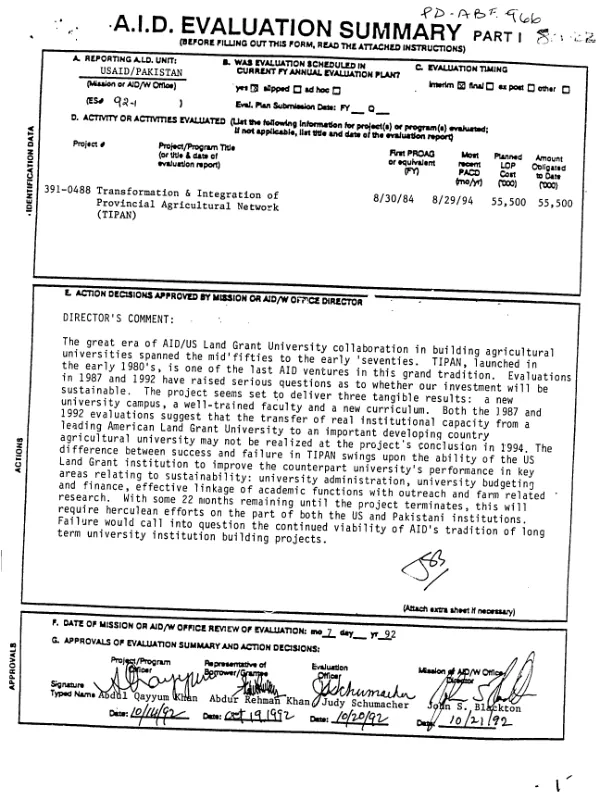
Transformation and integration of provincial agricultural network (TIPAN)
Summarizes interim evaluation (XD-ABE-966-A) of a project to establish the Northwest Frontier Provincial Agricultural University (NWFPAU) in Pakistan as a center for integrating agricultural research, education, and extension in the region.
1992
Sign in to readA free account is required to download.
Abstract
The evaluation covered the period 8/84-10/92. Of the project"s five major activity areas -- education, research, outreach, administration and governance, and construction -- the most significant achievements have been in the area of education. Extensive U.S. degree training has produced a cadre of faculty who are contributing to the process of curriculum reform and revision, and NWFPAU is making progress in producing high quality graduates and in assuming a dynamic role in agricultural development. Other achievements include the establishment of a modern library with links to international data bases, and the development of linkages with international agricultural research centers. Nevertheless, the project is far from achieving many of its goals. Progress is notably lacking in integrating research and education and in strengthening NWFPAU linkages with the provincial civil service research and extension systems; NWFPAU"s efforts in the area of farmer-oriented outreach are particularly disappointing, but understandably so as this is a new concept for Pakistani universities. Also, NWFPAU management remains deficient; decisionmaking continues to be centralized, key management positions remain unfilled, and budget and accounting systems are grossly inadequate. The U.S. land grant university contractor has failed on many counts in developing NWFPAU"s institutional capabilities. Finally, construction delays have seriously compromised attainment of project goals. Faculty and researchers lack offices, classrooms, and labs in which to work, and equipment and commodities remain stored for lack of space. Most of the blame rests with the prime construction contractor, whose work has been characterized by poor planning, lack of onsite personnel, and poor coordination with the Pakistani subcontractor and the A&E firm. It is unlikely that the project will achieve its goals before the 8/94 PACD. In fact, unless NWFPAU"s performance in key areas relating to sustainability -- administration, budgeting and finance, and linkages of academic functions with outreach and farm related research -- is improved, the investments made so far may be compromised. Since the restrictions of the Pressler Amendment forbid A.I.D. from giving further development assistance after the PACD, extensive efforts are needed during the 2 years remaining to the project to consolidate the investments made so far. It is also likely that NWFPAU will have to increase its investment and find additional funding sources. The difficulties encountered in this project confirm international experience suggesting that a period longer than a decade is needed to develop such a large and complicated institution. Such a project should be approached in discrete, doable units that are self-sustaining within the time period of project assistance. Any one of several deficiencies, e.g., marginal outreach efforts, dissynchronized construction, can seriously compromise the benefits accruing from such an institution building effort. Other lessons for university projects are: (1) concentration on the academic side is not nearly enough -- management and administrative issues must be addressed; (2) strategic planning and intellectual leadership by experienced and internationally known advisors are required to guide a university through change; (3) self-financing components, such as endowments and tuition fees, need to be incorporated into the project design.
Related documents
![Project assistance completion report : UAF/GRTSM [University of Agriculture, Faisalabad/Grain Research, Training and Storage Management (Cell)] project activities, July - August, 1994](https://covers.devme.ai/gen/7043.webp)