WORLD WILDLIFE FUND INTERNATIONAL
Fauna Analysis for Identification of Biodiversity Priority Zones
Markhor, the species Capra falconeri, inhabits conifer forests, stony ravines, cliffs, and gorges at elevations below 4,000 meters.
108 pages
Sign in to readA free account is required to download.
Abstract
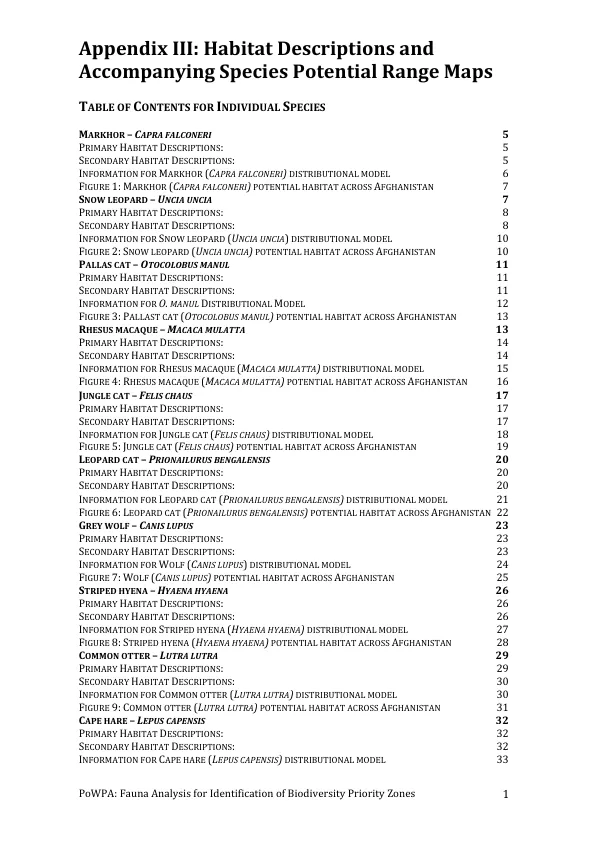
This habitat is characterized by rugged terrain and limited vegetation cover. The primary habitat descriptions for C. falconeri are based on information from Habibi (2003). Secondary Habitat Descriptions: Markhor also inhabits scrublands, grasslands, and rocky outcrops at lower elevations. These areas provide suitable habitat for the species, particularly during the summer months when conifer forests are less accessible. Information for Markhor (Capra falconeri) Distributional Model: The distributional model for C. falconeri is based on a combination of field observations, remote sensing data, and species distribution modeling techniques. The model predicts the potential habitat of the species across Afghanistan, taking into account factors such as elevation, vegetation cover, and land use patterns. Figure 1: Markhor (Capra falconeri) Potential Habitat Across Afghanistan: The figure shows the predicted potential habitat of C. falconeri across Afghanistan, highlighting areas with suitable terrain and vegetation cover for the species. The map is based on the distributional model and provides a visual representation of the species' potential range. Snow Leopard – Uncia uncia Primary Habitat Descriptions: The snow leopard, Uncia uncia, inhabits mountainous terrain with steep slopes, rocky outcrops, and limited vegetation cover. The primary habitat descriptions for U. uncia are based on information from various sources, including field observations and remote sensing data. Snow leopards also inhabit alpine meadows, scrublands, and grasslands at higher elevations. These areas provide suitable habitat for the species, particularly during the summer months when snow cover is limited. Information for Snow Leopard (Uncia uncia) Distributional Model: Figure 2: Snow Leopard (Uncia uncia) Potential Habitat Across Afghanistan: Pallas Cat – Otocobolus manul The Pallas cat, O. manul, inhabits mountainous terrain with rocky outcrops, scrublands, and limited vegetation cover. The primary habitat descriptions for O. manul are based on information from various sources, including field observations and remote sensing data. Pallas cats also inhabit alpine meadows, grasslands, and rocky outcrops at higher elevations. These areas provide suitable habitat for the species, particularly during the summer months when snow cover is limited. Information for Pallas Cat (Otocobolus manul) Distributional Model: Figure 3: Pallas Cat (Otocobolus manul) Potential Habitat Across Afghanistan: Rhesis Macaque – Macaca mulatta The Rhesis macaque, M. mulatta, inhabits tropical and subtropical forests, scrublands, and grasslands at lower elevations. The primary habitat descriptions for M. mulatta are based on information from various sources, including field observations and remote sensing data. Rhesis macaques also inhabit agricultural areas, urban centers, and human-dominated landscapes. These areas provide suitable habitat for the species, particularly in areas with abundant food resources. Information for Rhesis Macaque (Macaca mulatta) Distributional Model: Figure 4: Rhesis Macaque (Macaca mulatta) Potential Habitat Across Afghanistan: Jungle Cat – Felis chaus