AFGHANISTAN MINISTRY OF AGRICULTURE, IRRIGATION AND LIVESTOCK
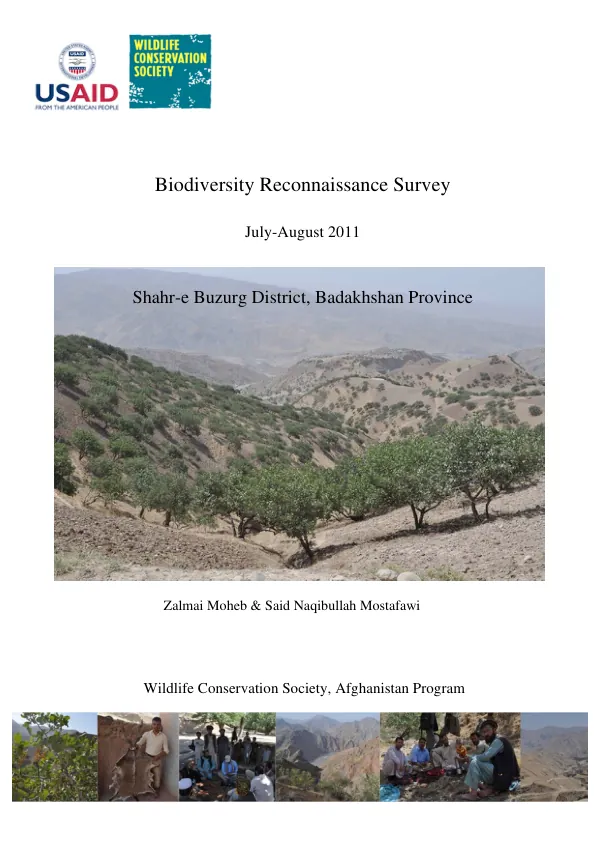
Biodiversity Reconnaissance Survey in Shahr-e Buzurg
The Shahr-e Buzurg District in Badakhshan Province, Afghanistan, is a remote area with a poor road network.
2011 · 26 pages
Sign in to readA free account is required to download.
Abstract
The district is divided into five zones and has a population of approximately 42,000 people spread across 74 villages. Villages are far away from each other, and people lack public transportation. The major livelihood products coming from natural resources include pistachios, medicinal plants, pastures, fuel wood, and gold. The landscape is mostly undulating terrain with little water. People grow rain-fed wheat, and there is very little irrigated land. In the south of the district, people keep sheep, goats, horses, donkeys, and cattle, whereas in the north, there are fewer livestock, mostly goats and cattle. There are gold mines across the district, and people excavate the sand to extract fragments and powdered gold pieces using traditional methods. The aim of the survey was to carry out a rapid assessment of wildlife across Shahr-e Buzurg. The objectives of the survey were to assess the status of mammals and birds across the district, pay particular attention to evidence of markhor still occurring in the area, carry out villager interviews to understand local perceptions and threats to wildlife and other natural resources, gather information relevant to establishing a conservation program in the area, and train counterparts, particularly the Ministry of Agriculture. The survey was carried out from August 21st to 30th, 2011. The survey team consisted of Zalmai Moheb and Said Naqibullah Mostafawi (WCS), Mawlawi Ainuddin (District Forestry Officer, MAIL), Commander Khan Mohamad (field guide), Habib (driver), and various villagers who acted as field guides. The survey was split between community interviews and field assessments. A large proportion of the survey was spent interviewing people and educating them, and finding out information about wildlife. The survey team inquired about the presence and status of various species of large mammals. They focused their interviews on the village headman, village elders, hunters, and shepherds because they are the most knowledgeable about wildlife in the area. The team also gathered information on the local perceptions and threats to wildlife and other natural resources. The survey results will be used to establish a conservation program in the area and to train counterparts, particularly the Ministry of Agriculture. The survey team observed various species of wildlife, including mammals and birds. They noted that the landscape is mostly undulating terrain with little water, which affects the distribution and abundance of wildlife. The team also observed that the local people have a good knowledge of wildlife and their habitats, but they are facing various threats, including habitat loss, hunting, and poaching. The survey results indicate that the Shahr-e Buzurg District has a rich biodiversity, with various species of mammals and birds present in the area. However, the local people are facing various threats to wildlife and other natural resources, including habitat loss, hunting, and poaching. The survey results will be used to establish a conservation program in the area and to train counterparts, particularly the Ministry of Agriculture.