USAID DEC
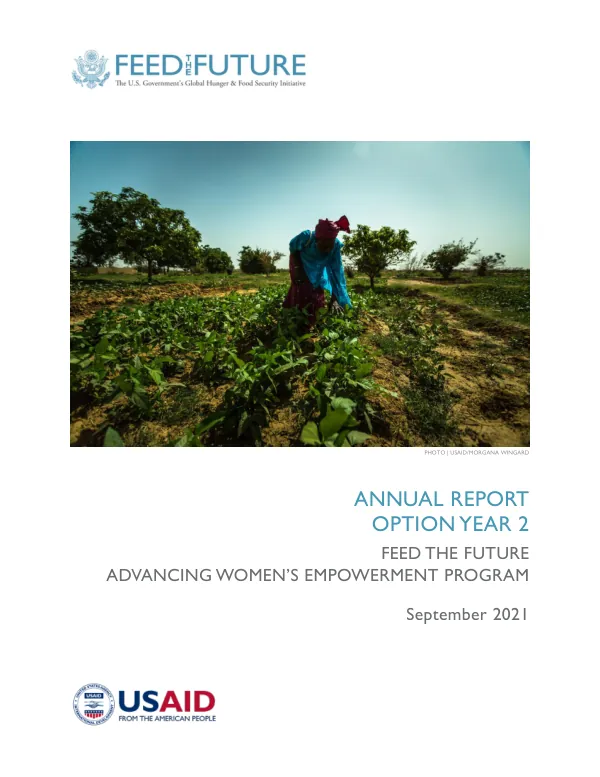
Feed the Future Advancing Women’s Empowerment Program – Annual Report, September 2021
Sign inENCOMPASS, LLC
Feed the Future Advancing Women’s Empowerment Program – Annual Report, September 2021
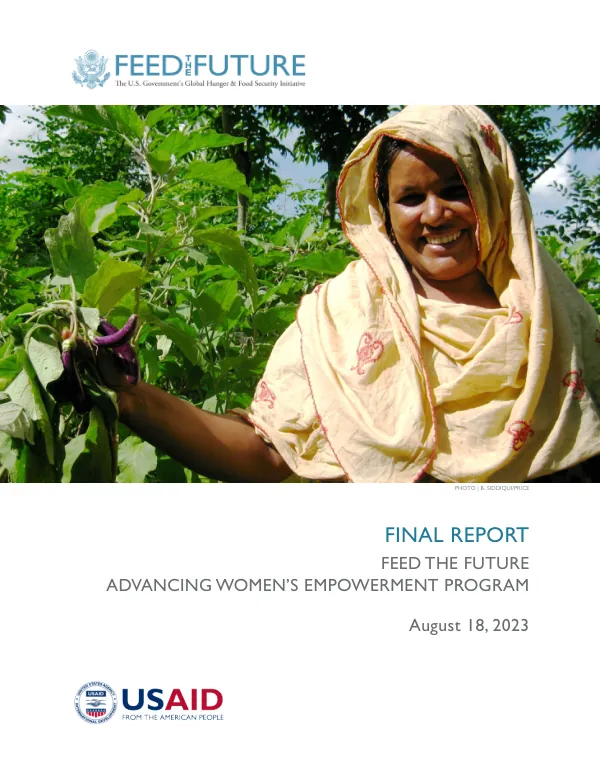
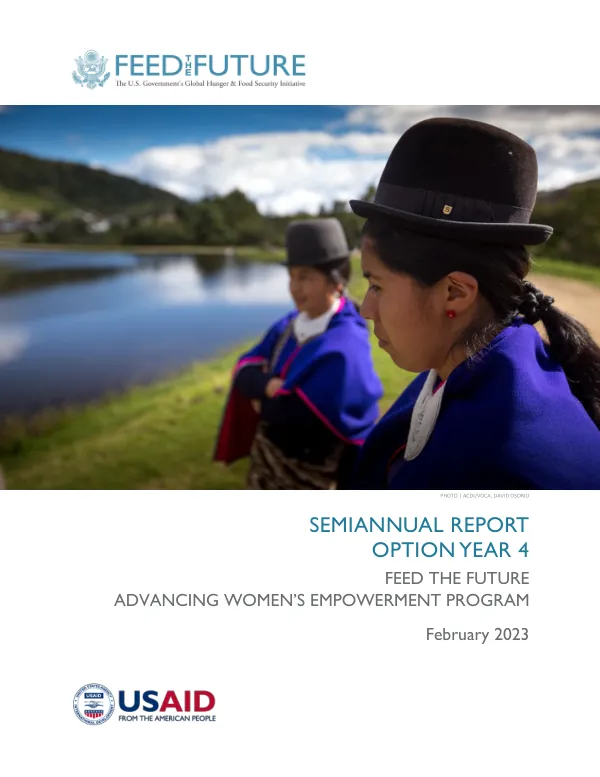
The Feed the Future Advancing Women's Empowerment Program (AWE) aims to enhance Feed the Future agriculture programming by increasing the meaningful engagement of women, improving women's returns from agricultural activities, and improving women's empowerment in the Gender Integration Framework domains.
2021 · 34 pages
Sign in to readA free account is required to download.
Abstract
AWE's objectives are to apply evidence-based analysis and learning on gender to Feed the Future project designs, activity designs, and work plans, to support activities to address women's empowerment deliberately and at scale, and to expand evidence on good practices to address women's empowerment in agriculture and food systems. During Option Year 2 (OY2), which spanned from August 23, 2020, to August 22, 2021, the AWE Program achieved several key milestones. Phase 1 of Call Order 4 was completed, which involved a three-year learning and research activity that explored gender-based violence (GBV) in the agriculture sector and women's empowerment in roles beyond agricultural production. The AWE team completed a first draft of the Toolkit for Addressing GBV in Agriculture and began piloting the tool with USAID/Uganda's Feed the Future Inclusive Agricultural Markets (IAM) activity. Additionally, phase 1 of Call Order 7 was completed, which involved a two-year learning and research activity to review and curate evidence of programmatic approaches for increasing women's decision-making power in both agricultural production and in food system institution levels. The AWE team completed an evidence scan report of programmatic approaches and a summary deck of promising tools and resources that implementing partners can use to promote women's increased decision-making power. The AWE Program also launched Call Order 8, a 10-month-long research and learning activity on how to use digital finance to increase women's economic empowerment in agriculture and food systems. Phase 1 of this activity entailed consultations and a desk review of existing digital financial tools and services and programming that can increase women's economic empowerment. Furthermore, the AWE team held a session for RFS staff on Challenges and Opportunities of Working with and for LGBTI Populations in Agriculture/Market Systems Development (MSD) Programs, which allowed RFS to begin a dialogue to better understand the specific challenges and opportunities for working with LGBTIQ+ communities and hear from implementing partners. The AWE Program promotes a cycle of learning across its three objectives by capturing technical best practices, generating practical resources for gender equality and women's empowerment, developing practitioners' capacity, and widely sharing information and resources developed through its work. The program's achievements and lessons learned during OY2 are captured in this report, which provides a comprehensive overview of the program's progress and achievements during this reporting period.
Related documents