ENCOMPASS, LLC
Feed the Future Option Year 3 Report
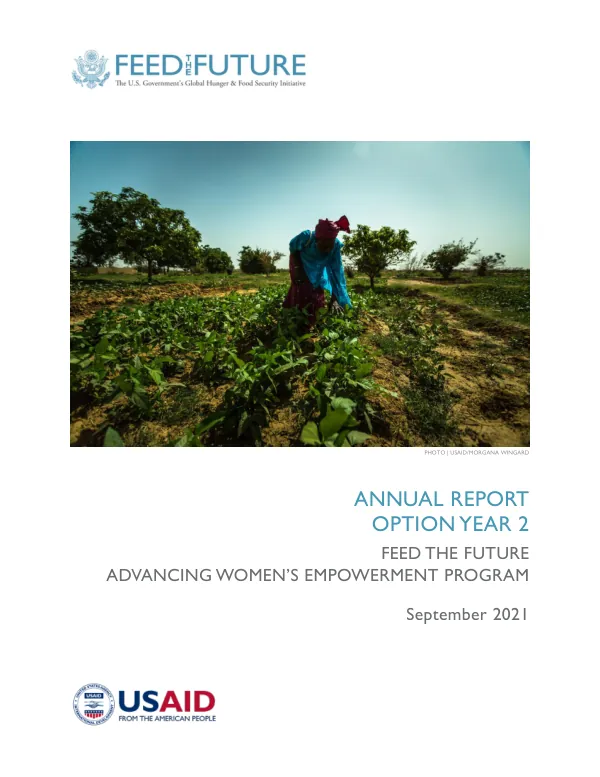
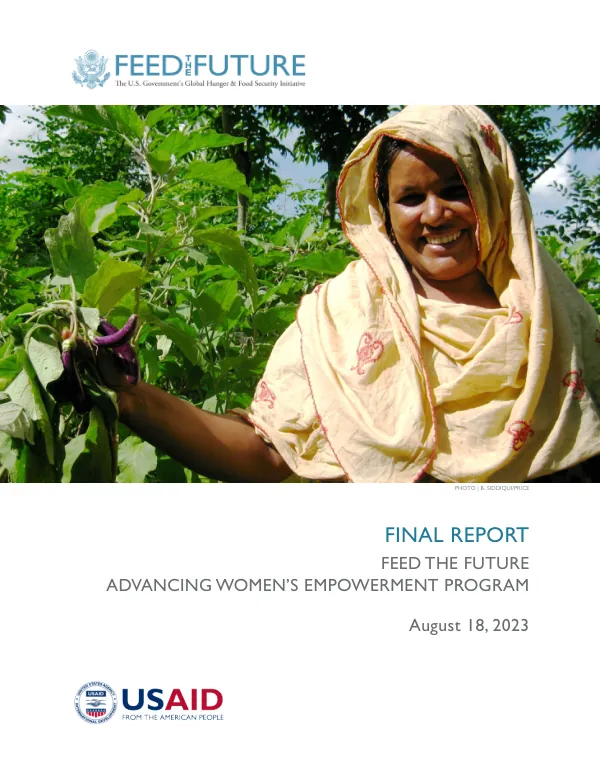
The Feed the Future Advancing Women's Empowerment Program (AWE) was a consulting services project funded by the USAID Bureau for Resilience and Food Security (RFS) and Missions.
2023 · 46 pages
Sign in to readA free account is required to download.
Abstract
The project aimed to enhance Feed the Future agriculture programming by increasing the meaningful engagement of women, improving women's returns from agricultural activities, and improving women's empowerment in the Gender Integration Framework domains. AWE's objectives were to apply evidence-based analysis and learning on gender to Feed the Future project designs, activity designs, and work plans; to support activities to address women's empowerment deliberately and at scale, emphasizing one or more Gender Integration Framework domains; and to expand evidence on good practices to address women's empowerment in agriculture and food systems. AWE promoted a cycle of learning across these three objectives by capturing technical best practices, generating practical resources for gender equality and women's empowerment, developing practitioners' capacity, and widely sharing information and resources developed through their work. The project achieved several key successes, including informing the development of USAID/Ghana's upcoming five-year Global Food Security Strategy Project Appraisal Document and subsequent activities, identifying and prioritizing six core behaviors that can encourage or hinder women's and youths' engagement and empowerment in food security, agriculture, and nutrition-sensitive programming. The project also conducted a synthesis of key findings and best practices on gender integration in USAID's agricultural research investments, identified tools and examples of gender integration in research among 20 USAID-supported agriculture and food security research activities, and was accompanied by four case studies to inform best practices. Additionally, AWE conducted a gendered landscape analysis to increase understanding of the nature, scope, and scale of women's participation, benefit, and empowerment in beyond production interventions, and developed a toolkit to address gender-based violence in agriculture and market systems development and other resources. The project also trained USAID Bureau for Resilience and Food Security (RFS) staff on how to apply gender, social inclusion, and intersectionality (GSI/I) lenses in development programming, and identified strategies to integrate women and youth into agriculture and market systems programs, accompanied by best practice case studies. Furthermore, AWE provided evidence of specific programmatic approaches and their outcomes, as well as methodologies and metrics to measure women's decision-making power in their programming, and addressed knowledge gaps on how agriculture and food systems programs can address women's financial exclusion through accessible and useful financial platforms and promote economic empowerment. The AWE Learning Seminar Series was a highly successful series that engaged USAID Missions from Latin America and the Caribbean (LAC), then expanded to engage USAID Missions and stakeholders globally, to share best practices, lessons learned, and resources structured on increasing women's empowerment in agriculture and market systems through co-creation and private sector engagement. The series engaged more than 1,000 participants globally, with Missions who shared that they found the discussions and resources highly valuable to their work. The project's achievements are visualized in Exhibit 1, which presents a dashboard of key achievements during the life of the project. The project's work was organized by objective, with the first objective focusing on applying evidence-based analysis and learning on gender to Feed the Future project designs, activity designs, and work plans. The second objective supported activities to address women's empowerment deliberately and at scale, emphasizing one or more Gender Integration Framework domains. The third objective expanded evidence on good practices to address women's empowerment in agriculture and food systems. The project's work was conducted in various countries, including Ghana, Bangladesh, and Latin America and the Caribbean. The project's achievements demonstrate the importance of addressing women's empowerment in agriculture and food systems, and the need for evidence-based analysis and learning on gender to inform development programming. The project's work has the potential to improve women's returns from agricultural activities, increase their meaningful engagement in agriculture, and promote their empowerment in the Gender Integration Framework domains.
Related documents