ABT ASSOCIATES
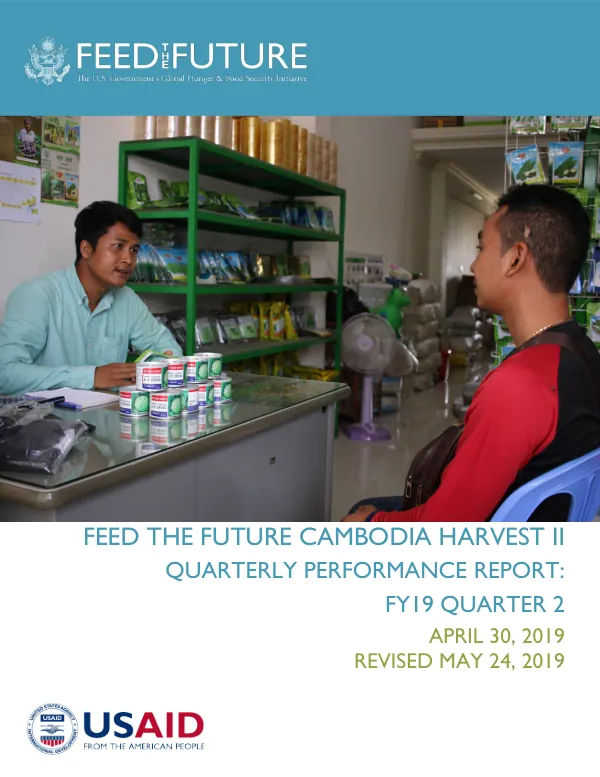
Feed the Future Cambodia Harvest II Quarterly Performance Report: FY19 Quarter 2
Feed the Future Cambodia Harvest II is an agricultural development initiative that aims to accelerate growth of the horticulture sector in the provinces of Pursat, Battambang, Siem Reap, and Kampong Thom.
2019 · 49 pages
Sign in to readA free account is required to download.
Abstract
The project employs an integrated buyer-led and market systems approach to engage diverse market actors at multiple leverage points. The initiative has three interconnected sub-purposes: improving capacities for market participation, improving market linkages, and improving governance and enabling environment. To achieve the first sub-purpose, Harvest II works with buyers, producers, and other actors to increase financial and business capacity, stimulate the use of market information to inform business decisions, and expand financial opportunities. Major activities under this sub-purpose include training programs for farmers, business development services, and market information systems. Challenges and learning from these activities include the need for more targeted training programs and the importance of building trust among market actors. Plans for the next quarter include scaling up training programs and expanding market information systems. The second sub-purpose focuses on improving market linkages by building trust and forming mutually-profitable commercial partnerships between buyers and producers. Harvest II engages other market actors, including microfinance institutions and small and medium enterprises, to facilitate market transactions. Major activities under this sub-purpose include business-to-business matchmaking, market research, and supply chain finance. Challenges and learning from these activities include the need for more effective communication among market actors and the importance of addressing market information asymmetry. Plans for the next quarter include scaling up business-to-business matchmaking and expanding supply chain finance. The third sub-purpose aims to improve governance and enabling environment by strengthening the capacity of government institutions and private sector organizations to support the horticulture sector. Harvest II works with government agencies, such as the Ministry of Agriculture, Forestry and Fisheries, and private sector organizations, such as the Cambodia Microfinance Association, to build their capacity to provide support services to farmers and other market actors. Major activities under this sub-purpose include training programs for government officials and private sector organizations, policy analysis, and advocacy. Challenges and learning from these activities include the need for more effective coordination among government agencies and private sector organizations and the importance of addressing regulatory barriers to market participation. Plans for the next quarter include scaling up training programs and expanding policy analysis and advocacy efforts. Cross-cutting issues, including gender and youth, are also addressed through Harvest II's activities. The project works with women and youth to increase their participation in the horticulture sector and to improve their access to market information and financial services. Major activities under this sub-purpose include training programs for women and youth, market research, and supply chain finance. Challenges and learning from these activities include the need for more effective targeting of women and youth and the importance of addressing market information asymmetry. Plans for the next quarter include scaling up training programs and expanding market research and supply chain finance. Coordination efforts are also critical to the success of Harvest II. The project works closely with government agencies, private sector organizations, and other development partners to ensure effective coordination and collaboration. Major activities under this sub-purpose include work with government agencies, work with other projects, and public-private dialogue. Challenges and learning from these activities include the need for more effective communication among stakeholders and the importance of addressing coordination challenges. Plans for the next quarter include scaling up public-private dialogue and expanding coordination efforts. Monitoring, evaluation, and learning are essential components of Harvest II's activities. The project uses a range of monitoring and evaluation tools, including performance indicators and progress tracking tables, to assess its progress and identify areas for improvement. Major activities under this sub-purpose include data collection, analysis, and reporting. Challenges and learning from these activities include the need for more effective data collection and analysis and the importance of addressing data quality issues. Plans for the next quarter include scaling up data collection and analysis and expanding reporting efforts. Overall, Harvest II is making progress in achieving its sub-purposes and improving the horticulture sector in Cambodia. However, challenges and learning from the project's activities highlight the need for continued effort and improvement in areas such as training programs, market information systems, and coordination efforts.