USAID DEC
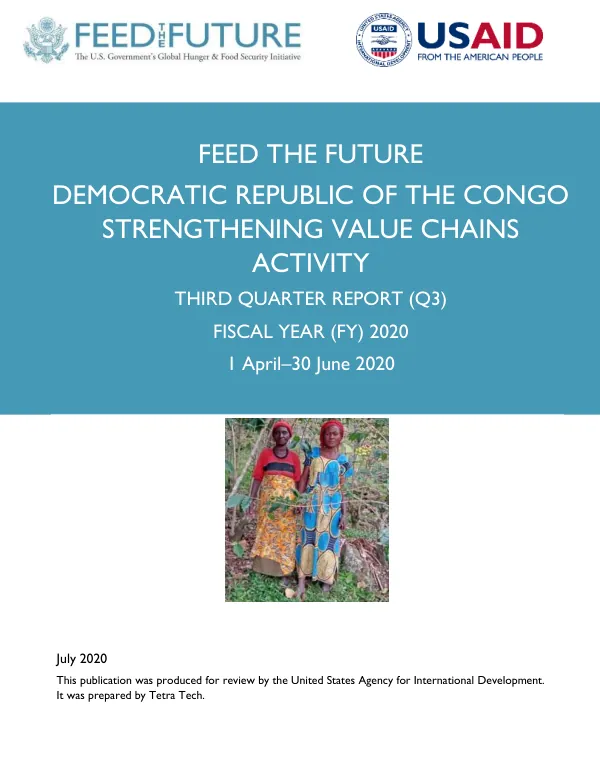
Feed the Future Democratic Republic of the Congo Strengthening Value Chains Activity Quarterly Report (FY 2020, Q3)
Sign inTETRA TECH
Feed the Future Democratic Republic of the Congo Strengthening Value Chains Activity Quarterly Report (FY 2020, Q3)
The Feed the Future DRC Strengthening Value Chains Activity is a program implemented by Tetra Tech in the Democratic Republic of the Congo (DRC) to strengthen the country's coffee and cocoa value chains.
2020 · 97 pages
Sign in to readA free account is required to download.
Abstract
The program aims to improve the livelihoods of smallholder farmers and their families by increasing their income and improving their access to markets. The program is divided into four components: Building capacity of vertical and horizontal actors, Enhancing coffee production, Developing Public Private Partnerships (PPP), and Access to Finance (A2F). Component 1 focuses on building the capacity of smallholder farmers, coffee cooperatives, and other stakeholders to improve their management and marketing skills. Component 2 aims to enhance coffee production by providing training and support to farmers on best practices, improving access to inputs and services, and promoting the use of high-quality coffee varieties. Component 3 focuses on developing PPPs between the private sector and smallholder farmers to improve the efficiency and effectiveness of the coffee value chain. Component 4 provides access to finance for smallholder farmers through microfinance institutions and other financial services. Cross-cutting priorities include environmental monitoring and mitigation, gender, and social inclusion. During the third quarter of Fiscal Year 2020 (April-June 2020), the program made significant progress in all components. In Component 1, 2,500 smallholder farmers received training on sustainable agriculture practices, and 15 demonstration plots were established to showcase the benefits of these practices. In Component 2, 1,500 farmers received training on coffee production, and 10 coffee cooperatives were established to improve the marketing and sales of coffee. In Component 3, 10 PPPs were established between the private sector and smallholder farmers, and 5,000 farmers benefited from these partnerships. In Component 4, 2,000 farmers received access to finance through microfinance institutions, and 10 financial services were established to support smallholder farmers. The program also made progress in environmental monitoring and mitigation, with the establishment of an environmental monitoring system to track the impact of the program on the environment. The program also made progress in gender and social inclusion, with the establishment of a gender action learning system to promote the participation of women and other marginalized groups in the program. Overall, the program has made significant progress in improving the livelihoods of smallholder farmers and their families in the DRC. The program has increased the income of smallholder farmers, improved their access to markets, and promoted the use of sustainable agriculture practices. The program has also made progress in environmental monitoring and mitigation, gender, and social inclusion. The program's key findings and lessons learned include the importance of building the capacity of smallholder farmers and other stakeholders to improve their management and marketing skills. The program also found that the development of PPPs between the private sector and smallholder farmers is critical to improving the efficiency and effectiveness of the coffee value chain. The program also found that access to finance is essential for smallholder farmers to improve their livelihoods. The program's recommendations include continuing to build the capacity of smallholder farmers and other stakeholders, developing more PPPs between the private sector and smallholder farmers, and increasing access to finance for smallholder farmers. The program also recommends continuing to monitor and mitigate the environmental impact of the program and promoting the participation of women and other marginalized groups in the program.