USAID DEC
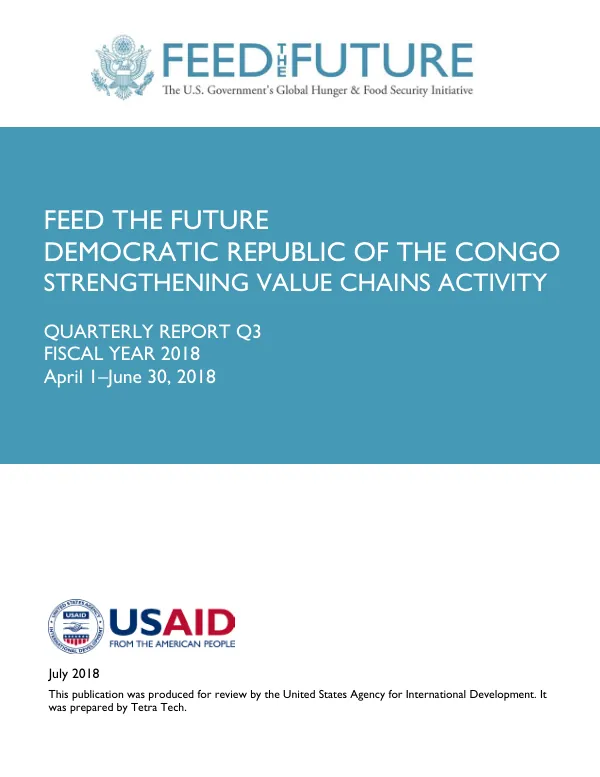
Feed the Future DRC Strengthening Value Chains Activity: Quarlterly Report Q3 Fiscal Year 2018, April 1-June 30, 2018
Sign inTETRA TECH
Feed the Future DRC Strengthening Value Chains Activity: Quarlterly Report Q3 Fiscal Year 2018, April 1-June 30, 2018
The agricultural development initiative in the Democratic Republic of the Congo began in 2018 with funding from USAID's Feed the Future program.
2018 · 59 pages
Sign in to readA free account is required to download.
Abstract
The initiative aimed to strengthen value chains in the coffee sector by improving access to finance, enhancing coffee quality, and increasing market linkages. The program focused on three key components: building capacity among vertical and horizontal actors, enhancing coffee production, and developing public-private partnerships. Component 1: Building Capacity among Vertical and Horizontal Actors The program aimed to improve the capacity of farmers, cooperatives, and other stakeholders in the coffee value chain. This was achieved through training and capacity-building activities, including workshops and on-farm trials. The program also provided support for the development of business plans and market linkages. Component 2: Enhancing Coffee Production The program focused on improving coffee production through the use of best practices, such as the use of improved varieties, fertilizers, and pest management techniques. The program also provided support for the development of coffee processing and storage facilities. Component 3: Developing Public-Private Partnerships The program aimed to develop partnerships between private sector companies and smallholder farmers to improve coffee production and quality. This was achieved through the development of Memoranda of Understanding (MOUs) between private sector companies and smallholder farmers. Progress was made in all three components, with notable achievements including: * Over 2,500 farmers received training in sustainable agriculture practices * Demonstration plots established in 10 communities showed yield improvements of 60% when applying the recommended practices * Women-headed households showed higher adoption rates of all practices except mechanical land preparation * Midterm evaluation revealed a 27% increase in income among program participants compared to the control group The program also made progress in enhancing access to finance, with the development of a credit facility for smallholder farmers. The program also supported the development of a market information system to improve market linkages. Challenges and constraints faced by the program included: * Limited access to finance for smallholder farmers * Limited capacity among farmers and cooperatives to adopt best practices * Conflict and insecurity in some areas, which affected program implementation Lessons learned from the program included: * The importance of building capacity among farmers and cooperatives * The need for improved access to finance for smallholder farmers * The importance of developing public-private partnerships to improve coffee production and quality Best practices and recommendations from the program included: * The use of improved varieties and fertilizers to improve coffee production * The development of business plans and market linkages to improve market linkages * The importance of training and capacity-building activities to improve capacity among farmers and cooperatives The program concluded that the program's achievements were significant, with notable progress made in all three components. However, challenges and constraints faced by the program highlighted the need for continued support to improve access to finance, capacity, and market linkages for smallholder farmers.
Related documents