USAID DEC
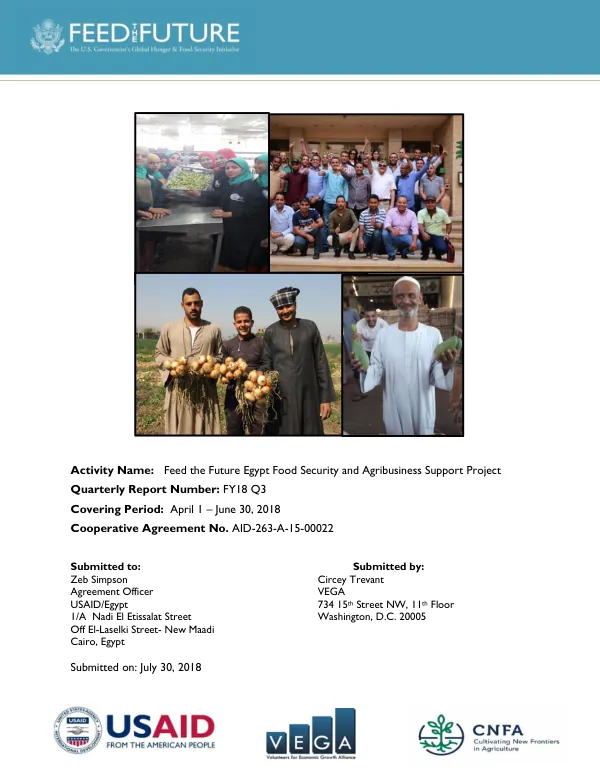
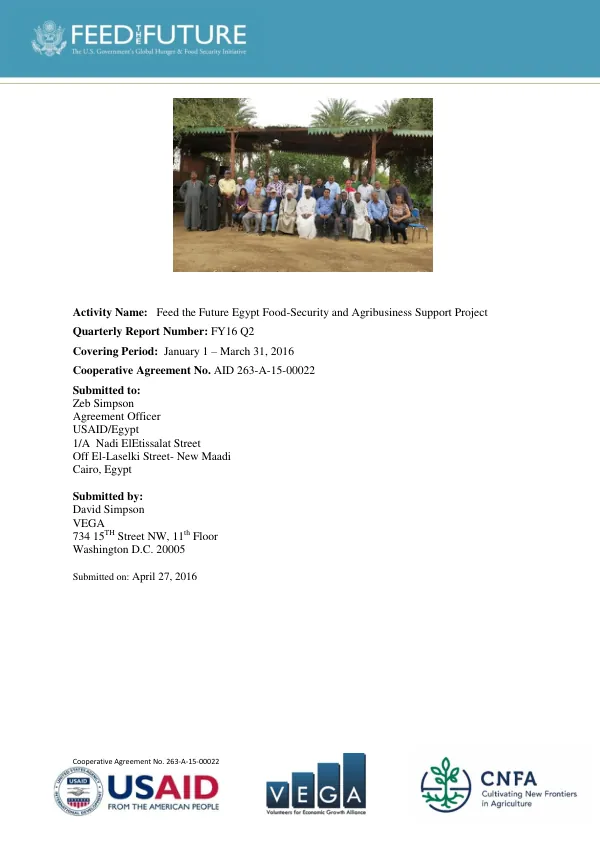
Feed the Future Egypt Food-Security and Agribusiness Support Project FY16 Q2 Quarterly Report
Sign inCNFA, INC.
Feed the Future Egypt Food-Security and Agribusiness Support Project FY16 Q2 Quarterly Report
The Feed the Future Egypt, Food-Security and Agribusiness Support project is a market-driven initiative aimed at increasing incomes and food security for 14,000 Upper Egypt smallholder farmers.
2016 · 23 pages
Sign in to readA free account is required to download.
Abstract
The program was awarded in July 2015 to VEGA, with CNFA as the prime implementer. VEGA provides oversight on award compliance and support to ensure successful implementation of the project. The program's overarching goal is to increase incomes and improve food security for smallholder farmers in Upper Egypt. To achieve this goal, the project is supported by four interrelated components: Improved on-farm production, More efficient post-harvest processes, Improved marketing of agriculture crops and products, and Improved nutritional status, especially for women and children. The project has made significant progress in completing the inception phase, with the launch event held on March 14th, 2016, at the Old Cataract Hotel in Aswan. The event was attended by over 110 participants, including representatives from the Ministry of Agriculture and Land Reclamation, USAID, VEGA, CNFA, implementing partners, stakeholders, and farmers. The agronomy and marketing teams have begun to rollout field activities, including the development of various assessment tools. The agronomy team has conducted an assessment in Aswan and Luxor to determine the availability of seeds, fertilizers, and other inputs for onions and green beans, which are expected to be two of the project value chains due to their high growth potential and profitability in export and domestic markets. The marketing team has developed a tool for the selection of associations and cooperatives and has created a database of local exporters, exhibitions, potential associations, and cooperatives in the seven governorates. The project has also engaged in strategic discussions with end market actors interested in purchasing Upper Egyptian horticulture projects. OLAM, a British firm, has expressed interest in purchasing onions, and Total World Fresh has expressed interest in purchasing strawberries from Upper Egypt. The project is exploring opportunities to secure input financing from these companies. Operationally, the project has established two of its offices (Aswan and Luxor) with furniture, Wi-Fi, and landline, and has hired five new positions, bringing the total number of local staff to 16. The project has also engaged BLUE Consulting to complete the End Market and Value Chain Analysis, and ASU has commenced work on the cost-benefit analysis to demonstrate potential economic benefits for smallholders across each prospective value chain. The project's progress has been hindered by delays in obtaining authorization from the Ministry of Agriculture and Land Reclamation to begin field operations. The project has been working closely with the Ministry to resolve this issue, and the Office of Foreign Relations has indicated that the matter is close to resolution. However, the project has been halted from proceeding with any associations until further notice. The project's overall goal is to increase incomes and improve food security for smallholder farmers in Upper Egypt. The project's four components aim to achieve this goal by improving on-farm production, post-harvest processes, marketing of agriculture crops and products, and nutritional status, especially for women and children. The project's progress has been hindered by delays in obtaining authorization from the Ministry of Agriculture and Land Reclamation, but the project is working closely with the Ministry to resolve this issue. The project's inception phase has been completed, with the launch event held on March 14th, 2016. The project has made significant progress in completing the inception phase, with the agronomy and marketing teams beginning to rollout field activities. The project has also engaged in strategic discussions with end market actors interested in purchasing Upper Egyptian horticulture projects. The project's achievements this quarter have been significant, with the launch event attended by over 110 participants. The project has also engaged in strategic discussions with end market actors interested in purchasing Upper Egyptian horticulture projects. The project has also established its operational activities, with two of its offices fully established and five new positions hired. The project's activities for the next quarter will focus on completing the End Market and Value Chain Analysis, and ASU will continue work on the cost-benefit analysis to demonstrate potential economic benefits for smallholders across each prospective value chain. The project will also continue to engage