USAID DEC
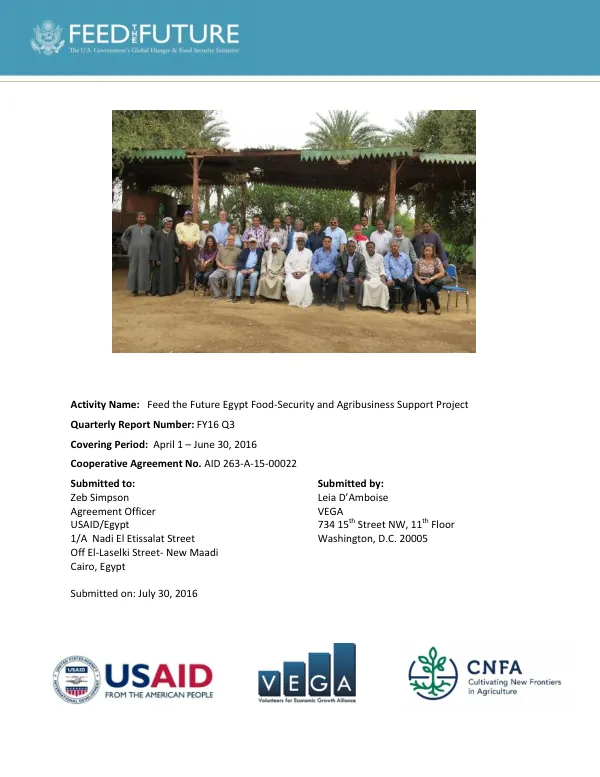
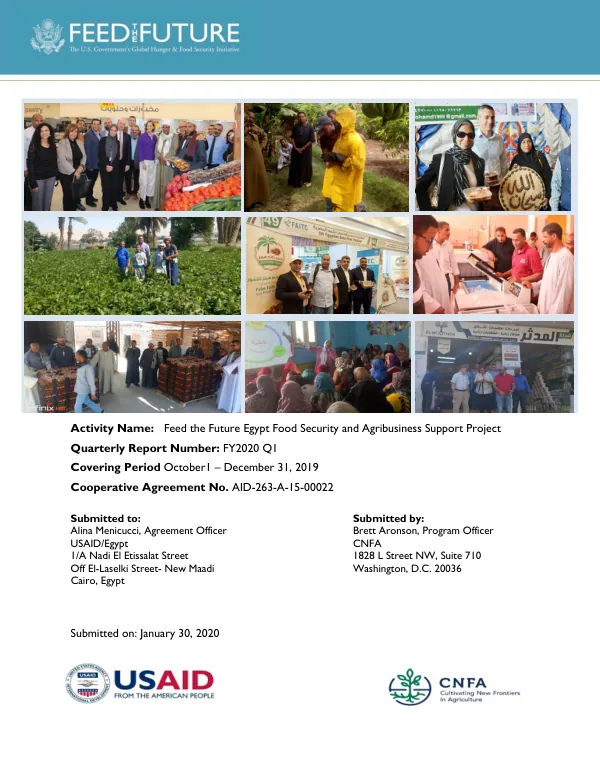
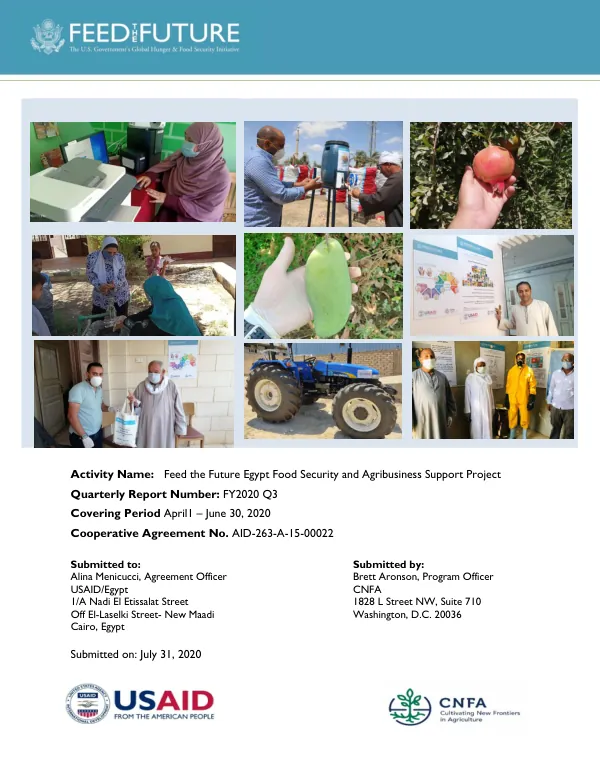
Feed the Future Egypt Food Security and Agribusiness Support Project Quarterly Report Number: FY18 Q3
Sign inCNFA, INC.
Feed the Future Egypt Food Security and Agribusiness Support Project Quarterly Report Number: FY18 Q3
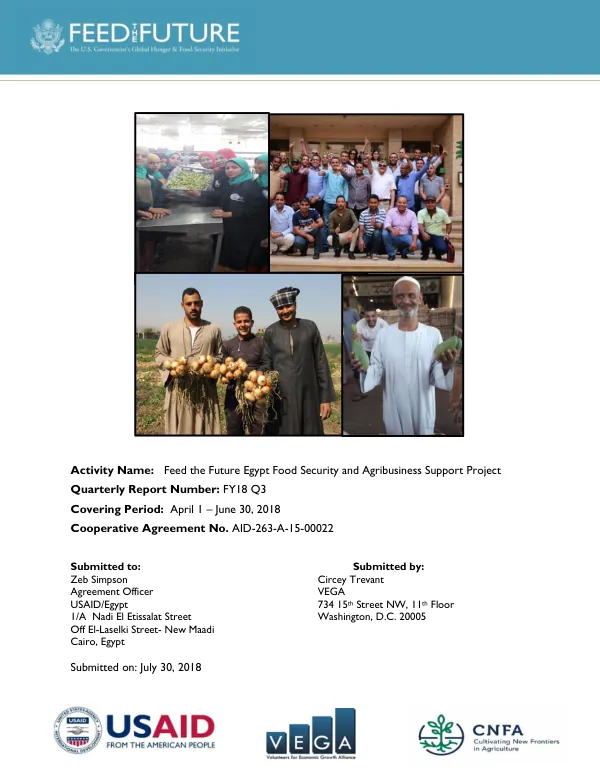
The Feed the Future Egypt Food Security and Agribusiness Support Project, also known as the FAS Project, aims to increase incomes and improve food security for 14,000 Upper Egypt smallholder farmers.
2018 · 25 pages
Sign in to readA free account is required to download.
Abstract
The project was awarded in July 2015 to VEGA with CNFA as the prime implementer. The program's overarching goal is to increase incomes and improve food security for smallholder farmers in Upper Egypt. The FAS Project is implemented by a strong consortium of partners with complementary technical expertise. The consortium is led by CNFA and includes Winrock International, World Food Logistics Organization (WFLO), Blue Moon, and Souktel. CNFA provides contractual accountability, strategic leadership, financial management, volunteer technical assistance, subcontract and grant management, and technical expertise. Winrock International assesses irrigation-related constraints and opportunities, provides technical oversight for irrigation-related grant projects, and improves irrigation at the producer association level. The project has a $5.75 million grants fund used to refurbish and develop productive infrastructure, catalyze innovation, stimulate investment, and support the development of critical value chain segments. The grant fund will also leverage $2.6 million of private sector investment by the end of the project. The project design framework includes four interrelated components: Improved on-farm productivity and income for smallholder farmers, More efficient post-harvest processes, Improved marketing of agriculture crops and products, and Improved nutritional status especially for women and children. During the third quarter of FY2018, the FAS Project made significant progress in all areas of the program. The project signed fourteen memorandums of understanding (MOUs) with six agriculture cooperatives and eight associations in Luxor and Aswan, bringing the total number of cooperatives/associations who have signed MOUs to 95. The production team provided on-farm technical training to 1,358 farmers in Aswan, Menia, Assiut, Sohag, and Beni Suef, focusing primarily on good agricultural practices for grapes. FAS provided production-related technical support to 2,671 farmers on onion, fennel, grapes, and basil. The post-harvest team started to use the Pesticides Residues Detector, a mobile testing kit that detects pesticide residues in production. The project delivered trainings to 397 participants (214 men and 183 women) on the safe use of pesticides based on the project's safe use of pesticides training guide, which was finalized this quarter. The training introduced the use of color traps as a key technology to manage pests and reduce pesticide residues in production. The FAS Project also made significant progress in agri-nutrition, grants, and monitoring and evaluation. The project prepared for the summer harvest season of grapes and mangoes, introduced new marketing techniques that helped to increase farmers' sales revenues and incomes, and facilitated forward contracts between FAS associations and growers. The project's new Chief of Party, Dominic Graham, attended an onboarding session at CNFA headquarters in Washington DC in June to orient him to the FAS cooperative agreement and programmatic and compliance priorities.