USAID DEC
Feed the Future Egypt Food-Security and Agribusiness Support Project Quarterly Report FY16 Q3
Sign inARIZONA STATE UNIVERSITY
Feed the Future Egypt Food-Security and Agribusiness Support Project Quarterly Report FY16 Q3
The Feed the Future Egypt Food-Security and Agribusiness Support Project is a market-driven program aimed at increasing incomes and improving food security for 14,000 Upper Egypt smallholder farmers.
2016 · 20 pages
Sign in to readA free account is required to download.
Abstract
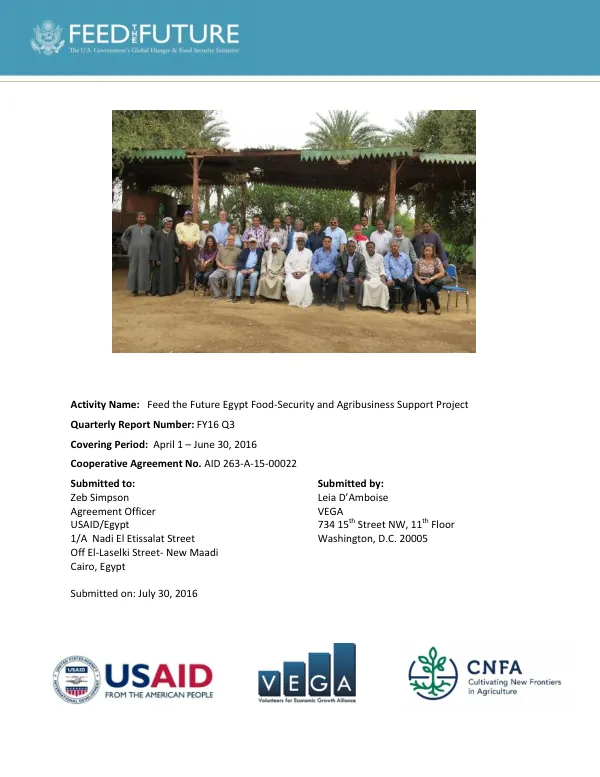
The program's overarching goal is to increase agriculture-related incomes of smallholder farmers in Upper Egypt. To achieve this goal, the program is supported by four interrelated components: Improved on-farm production, more efficient post-harvest processes, improved marketing of agricultural crops and products, and improved nutritional status, especially for women and children. The program is implemented by a strong consortium of partners with complementary technical expertise, led by CNFA and including Winrock International, Arizona State University, World Food Logistics Organization, Blue Moon, and Souktel. CNFA provides contractual accountability, strategic leadership, financial management, volunteer technical assistance, subcontract and grant management, and technical expertise. Winrock International assesses irrigation-related constraints and opportunities, provides technical oversight for irrigation-related grant projects, and improves irrigation at the producer association level. ASU conducts cost-benefit analyses, develops methodology, and implements baseline and annual follow-up to track on-farm net present value indicator. The project received official authorization from the Ministry of Agriculture and Land Reclamation (MALR) to begin field activities in the three southern-most governorates of Aswan, Luxor, and Qena on May 26, 2016. The FAS technical team mobilized immediately to finalize identification of 17 target farmers' groups in the governorates of Aswan, Qena, and Luxor to participate in the first phase of farmer group training and engagement for the winter growing season. Over 350 farmers attended these meetings, where the project staff explained the goals of the FAS program and potential lead farmers were identified in each group. The FAS marketing team attended two trade shows in Aswan and Cairo this quarter, where they met with several companies who expressed interest in providing inputs, technical knowledge, and post-harvest infrastructure to farmers' groups. To promote sustainability and strengthen private sector linkages directly with farmers, the project is pursuing a model of buyers and input companies pre-financing inputs for the winter season, which will be repaid by farmers at harvest time. The project team met with more than ten private sector partners who have expressed interest in providing both inputs and logistical support to farmers' organizations, including Technogreen, Blue Nile, Fridal, Daltex, and O. The project's implementation is focused on several key activities, including associations and cooperative strengthening, on-farm training to improve volumes and quality, promotion of innovative tools and technology, ICT solutions for extension and irrigation, strengthening input suppliers (agrodealers), preparation for successful post-harvest handling, vertical integration of farmer groups, post-harvest facility operator capacity building, agroprocessing enterprise development, ICT solutions for post-harvest processes, forward contracting between suppliers and buyers, trade show attendance, ICT solutions for marketing, buyer visits, expanding GlobalGAP and Fair Trade certification of farmer groups, targeted ICT nutrition messaging, community-based health worker training, and nutrition messaging targeted to women in the agroprocessing workforce. The project's progress this quarter has been significant, with major milestones achieved in the areas of farmer group identification, trade show attendance, and private sector engagement. The project's focus on sustainability and strengthening private sector linkages directly with farmers is expected to have a positive impact on the project's overall goal of increasing agriculture-related incomes of smallholder farmers in Upper Egypt.