USAID DEC
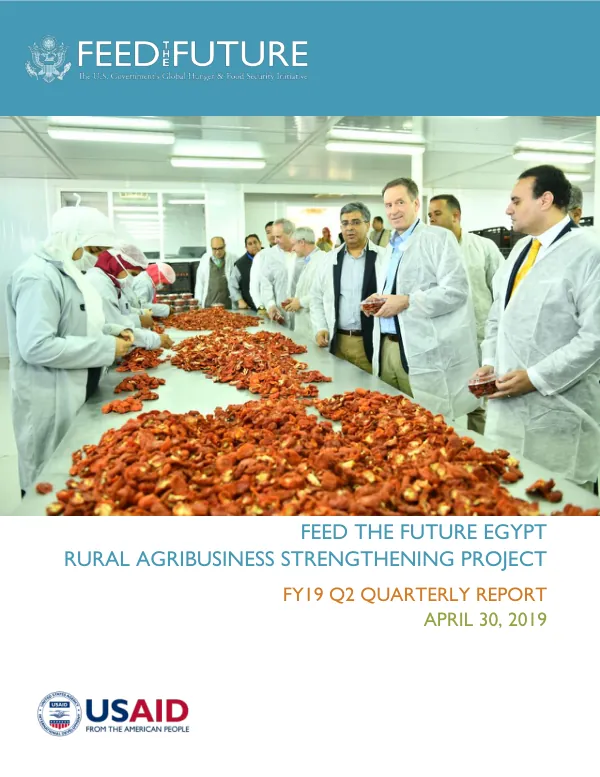
Feed the Future Egypt Rural Agribusiness Strengthening Project FY19 Q2 Quarterly Report
Sign inABT ASSOCIATES
Feed the Future Egypt Rural Agribusiness Strengthening Project FY19 Q2 Quarterly Report
The Feed the Future Egypt Rural Agribusiness Strengthening Project is a USAID-funded activity that aims to develop the horticulture industry's ability to better respond to domestic and international buyer demand and improve the industry's competitiveness.
2019 · 35 pages
Sign in to readA free account is required to download.
Abstract
The project will strengthen Egypt's horticulture market system and improve the capacity of smallholder farmers and processors, producer organizations, and horticultural institutions through agricultural knowledge transfer and trainings. Improvements to the value chain will raise employment and incomes for vulnerable Egyptians and enhance food security throughout the country. The project will work in Upper Egypt through main offices in Cairo and strategic regional offices in Luxor and Minya. The targeted areas include Beni Suef, Minya, Asyut, Sohag, Qena, Luxor, and Aswan. The project's five-year activity was awarded on August 1, 2018, and will be completed by July 31, 2023. In its second full quarter of implementation, the project achieved numerous milestones, including submitting an access to markets action plan, holding a launch event, conducting stakeholder meetings, and conducting field visits to Luxor, Aswan, Qena, and Minya governorates. The project has also explored developing a trilateral partnership between USAID, the Project, and PepsiCo that features an integrated model for potato sourcing and supply chain management. Additionally, the project has identified an initial list of forty potential buyers, nineteen of which are already validated, to facilitate business linkages with producer organizations in Upper Egypt. A mapping, needs assessment, and evaluation of 50 pack houses and cold storage facilities in Beni Suef, Minya, Assuit, Qena, and Luxor governorates have also been developed. The project's objectives include improving the capacity of smallholder farmers and processors, producer organizations, and horticultural institutions through agricultural knowledge transfer and trainings. The project aims to raise employment and incomes for vulnerable Egyptians and enhance food security throughout the country. The project's activities will focus on strengthening sustainable domestic and international market linkages, improving post-harvest handling and storage, increasing productivity for small farmers and food processors, and improving nutritional status of women and children. The project's implementation will be carried out through a market-driven, systems-strengthening approach. The project will work with Egyptian firms, U.S. small businesses, and international organizations to achieve its objectives. The project's progress will be monitored and evaluated through regular assessments and evaluations. The project's ultimate goal is to create a more competitive and inclusive Egyptian economy through horticulture sector growth, with special focus on securing employment and increasing agriculture-related incomes of smallholder farmers in Upper Egypt. The project's activities will be implemented in the targeted areas, including Beni Suef, Minya, Asyut, Sohag, Qena, Luxor, and Aswan. The project's main office will be located in Cairo, and strategic regional offices will be established in Luxor and Minya. The project's implementation will be carried out in collaboration with the Government of Egypt, USAID/Egypt, and other stakeholders. The project's progress will be reported quarterly to USAID/Egypt, and the project's final report will be submitted upon completion of the project.