USAID DEC
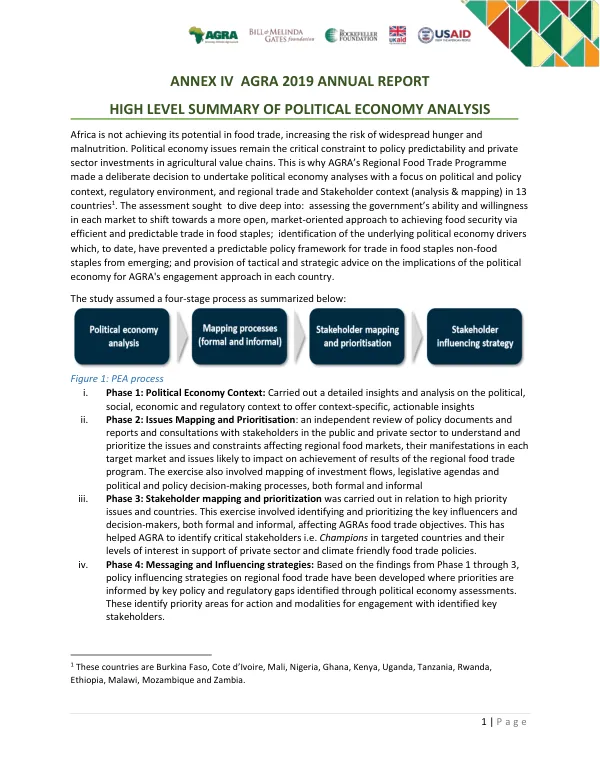
Feed the Future Enabling Environment for Food Security Project Enabling the Business of Agriculture Data Snapshot: Tanzania
Sign inFINTRAC
Feed the Future Enabling Environment for Food Security Project Enabling the Business of Agriculture Data Snapshot: Tanzania
The Enabling Environment for Food Security Project in Tanzania is a key component of the Feed the Future initiative, which aims to address policies, legal, institutional, and regulatory factors affecting food security.
2017 · 2 pages
Sign in to readA free account is required to download.
Abstract
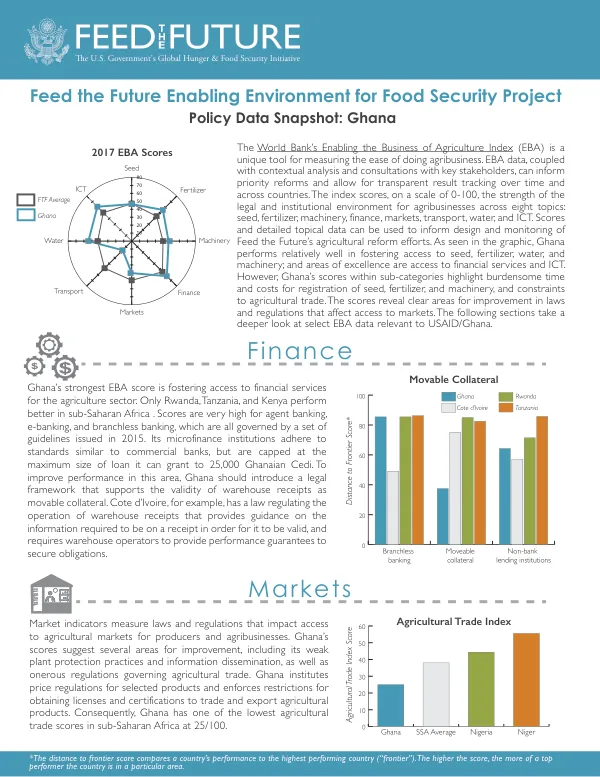
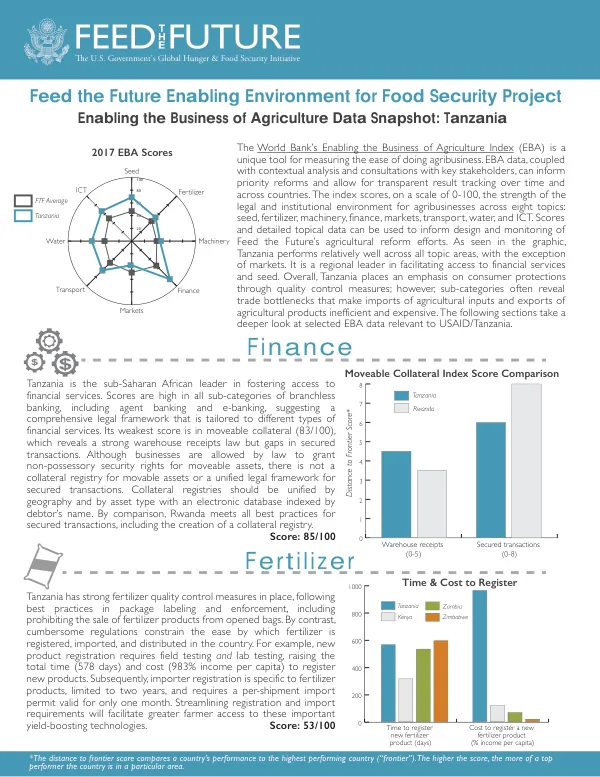
The project utilizes the Enabling the Business of Agriculture Index (EBA) to measure the ease of doing agribusiness in Tanzania. The EBA scores, ranging from 0 to 100, assess the strength of the legal and institutional environment for agribusiness across eight topics: seed, fertilizer, machinery, finance, markets, transport, water, and ICT. Tanzania performs relatively well across all topic areas, with the exception of markets. The country is a regional leader in facilitating access to financial services and seed. Tanzania's emphasis on consumer protections through quality control measures is evident, but sub-categories often reveal trade bottlenecks that make imports of agricultural inputs and exports of agricultural products inefficient and expensive. The country's strong fertilizer quality control measures are in place, following best practices in package labeling and enforcement. However, cumbersome regulations constrain the ease by which fertilizer is registered, imported, and distributed in the country. For example, new product registration requires field testing and lab testing, raising the total time (578 days) and cost (983% income per capita) to register new products. Subsequently, importer registration is specific to fertilizer products, limited to two years, and requires a per-shipment import permit valid for only one month. Streamlining registration and import requirements will facilitate greater farmer access to these important yield-boosting technologies. Tanzania is also a sub-Saharan African leader in seed policy, falling just behind Zimbabwe and Kenya. Plant breeder's rights are granted and protected for 25 years, and companies access germplasms conserved in public gene banks to produce breeder and foundation seed from local public varieties. However, weaknesses in seed quality control highlight the need to expand labeling requirements to include production date, certificate number, and chemical treatment. Establishing and enforcing penalties for mislabeled bags can also improve quality controls and consumer confidence. Market indicators measure laws and regulations that impact access to agricultural markets for producers and agribusinesses. Tanzania has a strong legal framework for the creation and operation of producer organizations, an important mechanism for farmers' collaboration in achieving economies of scale and meeting market demand. However, restrictive agricultural trade procedures and poor plant protection measures diminish agribusiness competitiveness. Tanzania's onerous regulations governing agricultural trade impose bottlenecks that increase export time and costs, such as establishing price regulations in selected products, requiring sale in fixed markets, and submitting four trade documents per shipment. Furthermore, plant protections that offer benefits throughout value chains are currently minimal in Tanzania. Boosting plant protections requires a specific government agency to conduct phytosanitary inspections on plants and maintain a list of regulated quarantine pests.