USAID DEC
Feed the Future Enabling Environment for Food Security Project Policy Data Snapshot: Ghana
Sign inFINTRAC
Feed the Future Enabling Environment for Food Security Project Policy Data Snapshot: Ghana
The Enabling Environment for Food Security Project in Ghana is a critical component of the Feed the Future initiative, aimed at improving the country's agricultural sector.
2018 · 2 pages
Sign in to readA free account is required to download.
Abstract
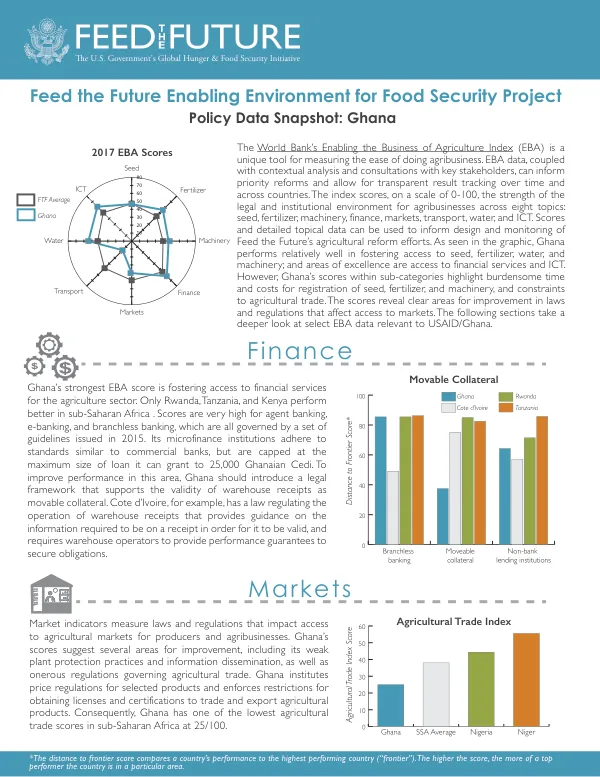
The project utilizes the Enabling the Business of Agriculture Index (EBA) to assess the ease of doing agribusiness in Ghana. The EBA scores, which range from 0 to 100, evaluate the strength of the legal and institutional environment for agribusinesses across eight topics: seed, fertilizer, machinery, finance, markets, transport, water, and ICT. Ghana performs relatively well in fostering access to seed, fertilizer, water, and machinery, with areas of excellence in access to financial services and ICT. However, the country's scores within sub-categories highlight burdensome time and costs for registration of seed, fertilizer, and machinery, as well as constraints to agricultural trade. The scores reveal clear areas for improvement in laws and regulations that affect access to markets. Ghana's strongest EBA score is in fostering access to financial services for the agriculture sector, with a score of 90/100. This is due to the country's strong agent banking, e-banking, and branchless banking systems, which are governed by a set of guidelines issued in 2015. To improve performance in this area, Ghana should introduce a legal framework that supports the validity of warehouse receipts as movable collateral. Market indicators measure laws and regulations that impact access to agricultural markets for producers and agribusinesses. Ghana's scores suggest several areas for improvement, including weak plant protection practices and information dissemination, as well as onerous regulations governing agricultural trade. Ghana institutes price regulations for selected products and enforces restrictions for obtaining licenses and certifications to trade and export agricultural products, resulting in one of the lowest agricultural trade scores in sub-Saharan Africa at 25/100. Ghana's seed score falls slightly behind the sub-Saharan Africa average, with a score of 43/100. The country has a strong seed quality control process for the release and multiplication of new varieties, but weaknesses in its plant breeding system, particularly the lack of laws protecting plant breeder's rights and onerous testing requirements, weigh down the overall seed score. Ghana also has exorbitant time and expenses required for the variety release process, making it the most costly country in which to release new seed varieties. Ghana's fertilizer scores outperform its sub-Saharan Africa and FTF peers, but reveal registration bottlenecks. It takes 231 days to register new fertilizer products with a cost of 337% per capita income, which is a significant burden for farmers. Many African countries require a similar number of days, but can achieve this at a much lower cost. Ghana's fertilizer importing and distribution scores reflect the greatest area for improvement, with a score of 36/100. Easing requirements for companies to obtain and maintain fertilizer import registration and permits will allow for a freer flow of fertilizer imports, ultimately lowering the cost to farmers. Ghana's machinery ranking falls within the average of its sub-Saharan Africa peers, with a score of 45/100. The country excels in its tractor import scores, reflecting few regulatory barriers to the private sector's ability to import and sell tractors. However, there is no law requiring tractors to obtain type approval before they are marketed in the country. Once imported, tractors must undergo a lengthy and costly registration process, requiring 30 days to register. By comparison, Ethiopia registers tractors within 2 days at 18 percent of the cost of Ghana. Finally, there are few national operator safety standards in place to ensure tractor safety and technical reliability.