USAID DEC
Feed the Future Enabling Environment for Food Security Project: The Enabling Environment for Food Traceability System Success
Sign inFINTRAC
Feed the Future Enabling Environment for Food Security Project: The Enabling Environment for Food Traceability System Success
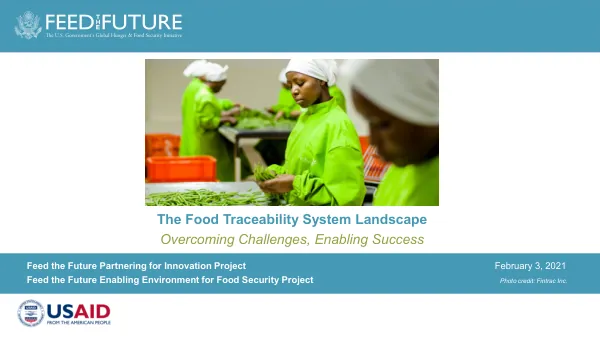
The Feed the Future Partnering for Innovation Project, in collaboration with the Feed the Future Enabling Environment for Food Security Project, conducted a study on the Food Traceability System Landscape.
2021 · 50 pages
Sign in to readA free account is required to download.
Abstract
The study aimed to understand the challenges and opportunities for implementing food traceability systems (FTS) in developing countries. Food traceability systems refer to the broader operating context for market systems, encompassing the systemic incentives for all market actors and the formal and informal barriers to competitive, inclusive, and nutrition-sensitive outcomes in food systems. The study identified several key benefits of FTS, including the mitigation of food safety risks, expansion of market access, and increase in supply chain efficiency. The study highlighted the importance of FTS in advancing key strategies outlined in the U.S. Global Food Security Strategy, the Multi-Sectoral Nutrition Strategy, and the Digital Strategy. These strategies emphasize the need to link producers and other agribusinesses to end markets, build capacity to improve food safety policies, and strengthen digital ecosystems. The study also identified four key factors that affect FTS adoption and successful implementation: operator incentives, operator capacity, operator access to technology, and supply chain coordination. These factors are critical in determining the success of FTS in developing countries, where adoption remains low. The study's findings suggest that FTS can have a significant impact on food systems, particularly in terms of improving food safety, expanding market access, and increasing supply chain efficiency. However, the successful implementation of FTS requires careful consideration of the four key factors identified in the study. The Feed the Future Enabling Environment for Food Security Project, led by Adam Keatts, Chief of Party, has been working to build the evidence base for interventions in agricultural market systems. The project's study on FTS is a critical contribution to this effort, providing valuable insights into the challenges and opportunities for implementing FTS in developing countries. The study's recommendations and findings are expected to inform USAID's efforts to promote FTS adoption in developing countries, ultimately contributing to improved food security and nutrition outcomes.
Related documents