NATIONAL AGRICULTURE INSTITUTE
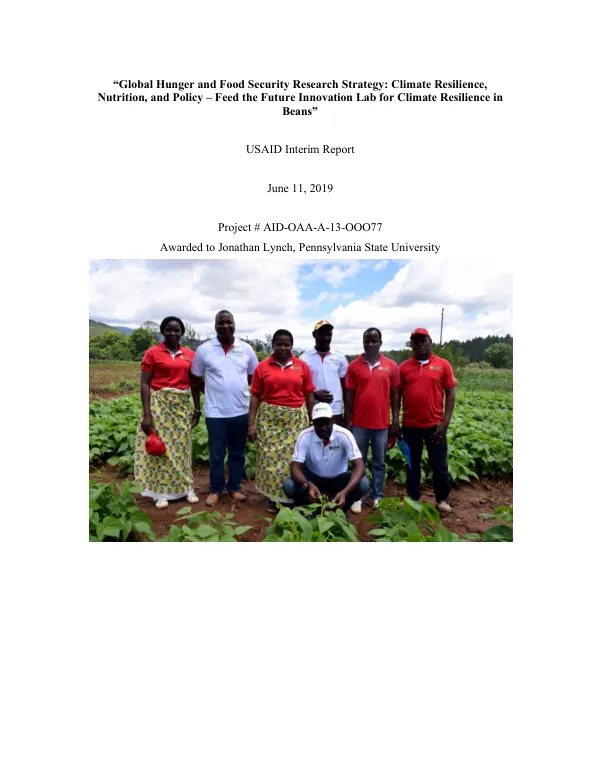
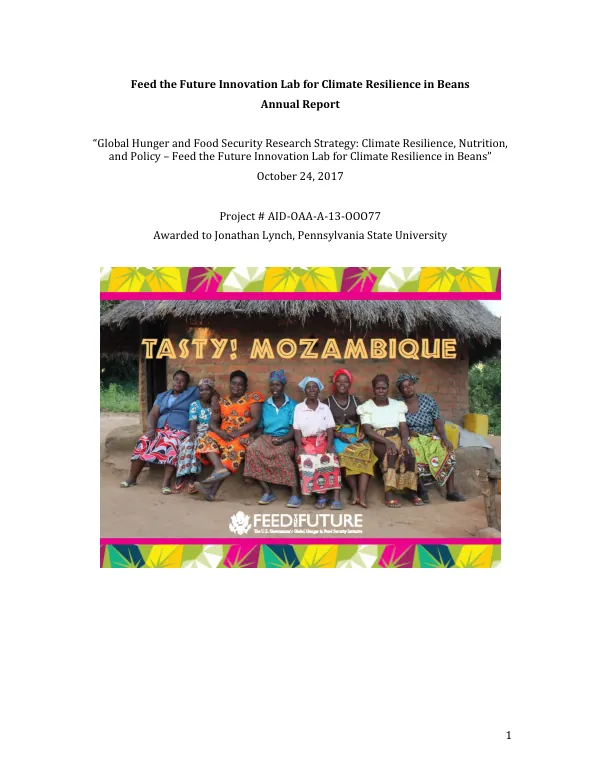
Feed the Future Innovation Lab for Climate Resilience in Beans Annual Report
The Climate Resilient Bean Project, a global initiative aimed at improving food security and climate resilience in bean production, has made significant progress in its penultimate year.
2017 · 55 pages
Sign in to readA free account is required to download.
Abstract
The project, launched in 2017, has achieved multiple goals and is well-positioned to achieve its main objectives. Extensive phenotyping of common bean panels in multiple locations has identified key traits related to stress tolerance and enhanced productivity. Comparative analysis of results across years and environments has led to the development of elite panels of germplasm and informed decision-making in breeding programs. The project has developed and is using state-of-the-art tools, such as proximal sensing and drones, as well as simple methods like roll-up phenotyping. This multi-location collaboration has advanced the development of new common bean lines through evaluations at multiple locations and has resulted in the release of three new varieties in 2017 in Central America. Phenotypic data has been combined with genomic data to identify genetic regions involved in controlling traits of interest, which will be useful beyond the duration of the project. Extensive quantitative and qualitative surveys with common bean farmers in Mozambique have provided important insight into their needs and habits, preparing the project to deploy a well-designed pilot promotional campaign to accompany the release of six new cultivars in Mozambique. The project has made significant strides in understanding the biology of the principal root components. The Phenomics group at Pennsylvania State University developed a screening system that enables the root architecture to be fully expressed without the challenges it would normally face in a soil environment. This approach removes the genotype by environment interaction that can mask the genetic effects controlling a trait. Data produced from this screening procedure enabled the Genomics group, including North Dakota State University and USDA-ARS Prosser, Washington, to discover a number of genetic factors associated with the biology of the tap root, root hairs, and basal roots. These factors can now be utilized as molecular markers. The Phenomics group evaluated multiple panels, including the Durango Diversity Panel (DDP), using the roll-up procedure. The Durango gene pool originated in the central valley of Mexico, which typically experiences drought conditions. Genotypes in this gene pool typically perform better under drought conditions, and discovering the genes controlling key root traits in this panel may provide genetic guidance as breeders look to bring these key traits from the Durango germplasm into other races. The McClean group at NDSU, working with the Miklas group at Prosser, Washington, mined a total of ~780,000 SNPs by performing 8X resequencing on the DDP. That genotypic data set was combined with the data from the phenotypic data set collected by the Phenomics group, and multiple genetic analyses were performed using genome-wide association study (GWAS) methods. Tap root length is hypothesized to be important for deep soil exploration and water acquisition in a drought environment. Those with longer tap roots may perform better under drought. Tap root, basal root, and root hair phenes can be quantified using the roll-up phenotyping method, which involves rolling seeds into germination paper and allowing them to germinate and grow for seven days in controlled conditions. Using data produced by the roll-up phenotyping method, the Genomics group discovered a major gene located on Pv01 and Pv06 using GWAS methods. The Pv01 locus maps just downstream of the common bean ortholog of PTR3, a member of a peptide transporter shown to regulate organ size. The other gene, located on Pv06, is a previously unknown gene that is associated with tap root length.
Related documents
Documents in this collection
 2018
2018USAID DEC
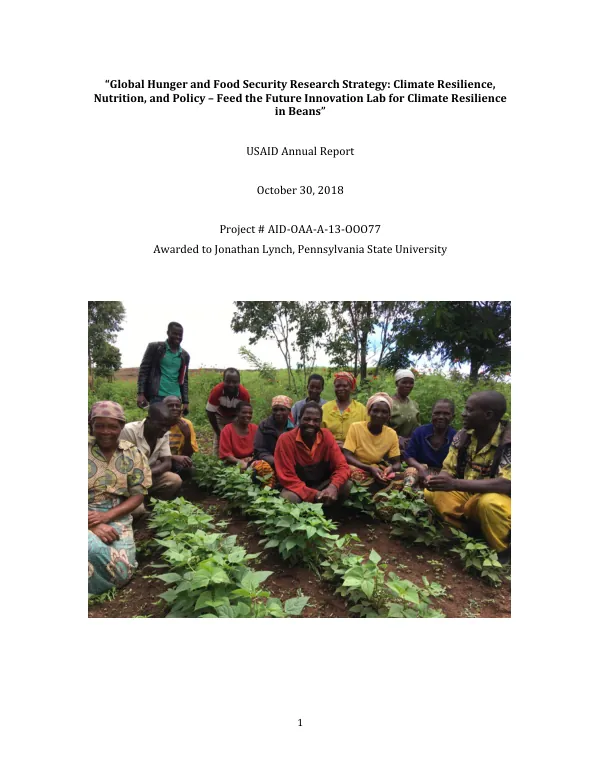
Global Hunger and Food Security Research Strategy: Climate Resilience, Nutrition, and Policy – Feed the Future Innovation Lab for Climate Resilience in Beans
Open record 2014
2014USAID DEC
Evidence Review on Social and Behavior Change for Child Survival in Africa Scaling Up with Mass Media and ICT
Open record