USAID DEC
Global Hunger and Food Security Research Strategy: Climate Resilience, Nutrition, and Policy – Feed the Future Innovation Lab for Climate Resilience in Beans
Sign inNATIONAL AGRICULTURE INSTITUTE
Global Hunger and Food Security Research Strategy: Climate Resilience, Nutrition, and Policy – Feed the Future Innovation Lab for Climate Resilience in Beans
The Climate Resilient Bean Project, a research initiative led by Jonathan Lynch of Pennsylvania State University, aimed to develop climate-resilient bean varieties for smallholder farmers in Africa and Latin America.
2018 · 63 pages
Sign in to readA free account is required to download.
Abstract
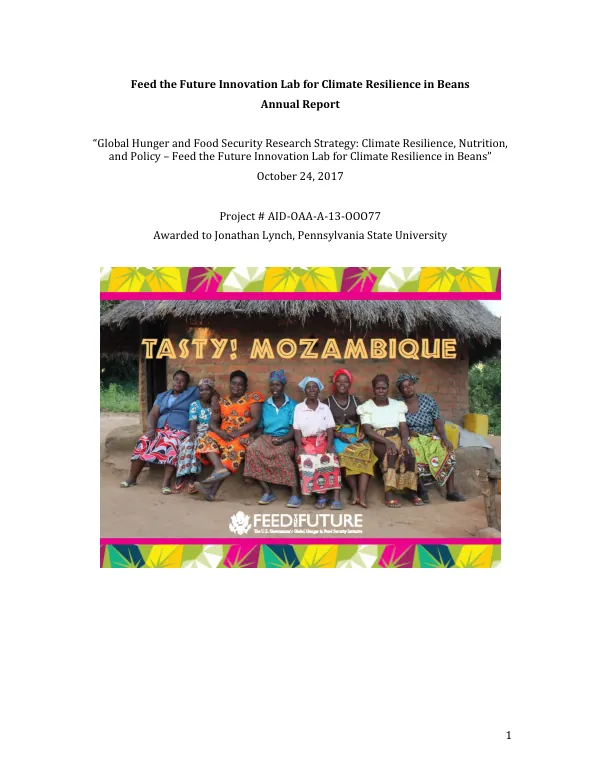
The project was funded by USAID's Feed the Future Innovation Lab for Climate Resilience in Beans and operated in six countries: the United States, Honduras, Colombia, Mozambique, Zambia, and Malawi. The project's research focused on breeding, physiology, social science, and genomics. The breeding program involved the development of new bean varieties with improved drought and disease tolerance. The physiology research team studied the physiological responses of beans to abiotic and biotic stresses, while the social science team conducted research on the social and economic impacts of climate change on bean production. The project's breeding program made significant progress, releasing eight new bean varieties in the 2017-2018 reporting period. These varieties were released in Mozambique and Central America, and their release is expected to have a positive impact on thousands of smallholder farmers. The project also collaborated with African scientists to improve drought and disease tolerance in US breeding programs. One of the project's success stories is the collaboration among American and African scientists, which contributed to drought and disease tolerance in US breeding programs. The project's breeding program in Tanzania identified novel genetic diversity for stress tolerance in large-seeded US kidney, cranberry, and yellow bean cultivars. Ninety PIC lines from the Tanzanian breeding efforts were increased in South Africa and sent to Michigan, Nebraska, Puerto Rico, and Washington for examination in field trials in 2018. The project also designed and executed a pilot promotional campaign to demonstrate the utility of a model to engage with smallholder farmers and seed companies. The campaign involved multiple festival-style events to publicize and support the release of three new phosphorus-efficient bean varieties in Mozambique. The events included communal meals, giving away small packets of seed, singing, dancing, and speakers from national, regional, local, and village levels. The project's research and activities have been influential in promoting the adoption of climate-resilient bean varieties among smallholder farmers. The project's success stories demonstrate the potential of collaboration among American and African scientists, as well as the effectiveness of promotional campaigns in engaging with smallholder farmers and seed companies.