USAID DEC
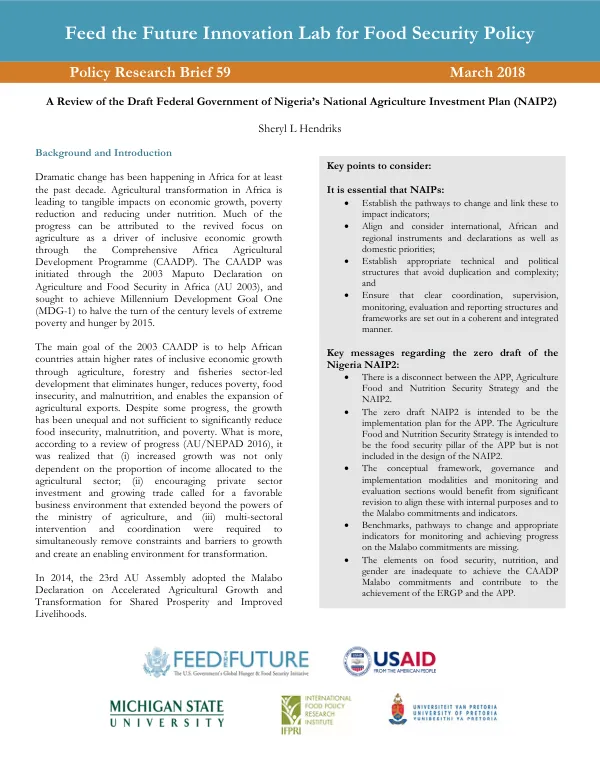
Feed the Future Innovation Lab for Food Security Policy Policy Research Brief 59
The Comprehensive Africa Agricultural Development Programme (CAADP) was initiated through the 2003 Maputo Declaration on Agriculture and Food Security in Africa.
2018 · 8 pages
Sign in to readA free account is required to download.
Abstract
The primary goal of the CAADP is to achieve inclusive economic growth through agriculture-led development, reducing poverty, hunger, and malnutrition, and increasing agricultural trade. Despite some progress, the growth has been unequal and insufficient to significantly reduce food insecurity, malnutrition, and poverty. The 2014 Malabo Declaration reaffirms the central commitments of the 2003 Maputo Declaration, but shifts focus from single-sector development to a broader economic and social development agenda. The Malabo-aligned country-specific National Agriculture Investment Plans (NAIPs) provide a prioritized set of strategic initiatives for food security, nutrition, and economic growth. The NAIPs aim to increase investment in agriculture, end hunger, improve food security, and reduce poverty through agriculture-led development. The Feed the Future Innovation Lab for Food Security Policy (FSP) seeks to support government policy and related reforms in Africa, including the design of the CAADP NAIPs. The FSP aims to increase the probability that countries will deliver fully on the food security and nutrition commitments flowing from the 2014 AU Malabo Declarations and the Sustainable Development Goals (SDGs). A team has developed methodologies for evaluating the alignment and linkages of international, African, and regional commitments with national development imperatives, assessing the quality of NAIPs in attaining the Malabo and SDG2 targets, and evaluating the gender components against commitments. The zero draft of the Federal Government of Nigeria's National Agriculture Investment Plan (NAIP2) was reviewed against this framework. The NAIP2 is the implementation plan for the 2016-2020 Agriculture Promotion Policy (APP) and aims to achieve food security, import substitution, job creation, and economic diversification. The APP sets out to implement, review, and deploy human and material resources to achieve existing objectives and strategies, including the establishment of a virile Breeder Foundation, promotion of leasing of storage and agro-industrial facilities, and reactivation of the Agricultural Development Programmes (ADPs). The NAIP2 consists of three key programmes: product development, private investment, and institutional realignment. Each programme has sub-programs that aim to achieve specific objectives, including the promotion of agricultural trade, improvement of agricultural productivity, and enhancement of the private sector's role in agriculture. The NAIP2 also aims to address the challenges of food insecurity, malnutrition, and poverty in Nigeria through a comprehensive approach that involves multiple stakeholders and sectors. The review of the NAIP2 identified several areas for improvement, including the need to align the plan with international, African, and regional commitments, strengthen the conceptual framework, and improve the programmatic areas, implementation modalities, and monitoring and evaluation elements. The review also highlighted the importance of addressing the gender components and ensuring that the plan is inclusive and equitable.