USAID DEC
Feed the Future Innovation Lab for Livestock Systems
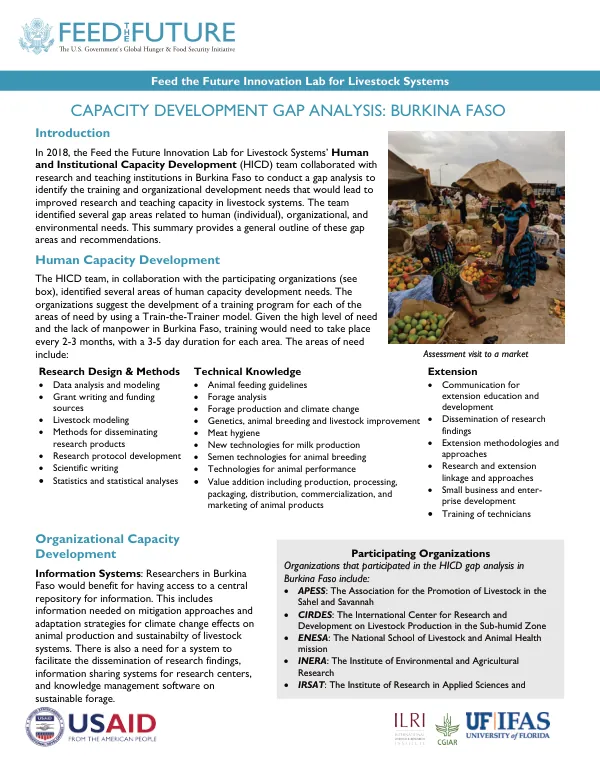
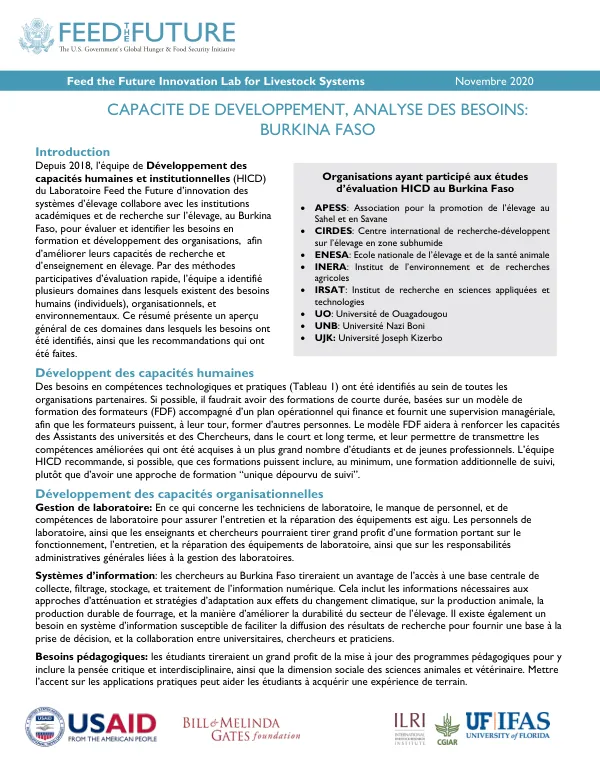
The Feed the Future Innovation Lab for Livestock Systems, in collaboration with institutions in Burkina Faso, has been evaluating and identifying needs for capacity development and training since 2018.
2020 · 4 pages
Sign in to readA free account is required to download.
Abstract
The team has used participatory rapid evaluation methods to identify areas where human, organizational, and environmental needs exist. This summary presents an overview of the identified needs and recommendations. Human capacity development needs have been identified in all partner organizations, with a focus on technological and practical skills. Short-term training programs based on a trainer-of-trainers model, accompanied by an operational plan that finances and provides managerial supervision, are recommended. This approach will help strengthen the capacities of university assistants and researchers in the short and long term, enabling them to transmit improved skills to a larger number of students and young professionals. Organizational capacity development needs have also been identified, with a focus on laboratory management, information systems, and pedagogical needs. Laboratory technicians lack personnel and technical skills to maintain and repair equipment, while researchers and teachers could benefit from training on laboratory equipment operation, maintenance, and repair, as well as general administrative responsibilities related to laboratory management. Researchers also need access to a central database for collecting, filtering, storing, and processing digital information, including data on climate change mitigation and adaptation strategies, animal production, and sustainable forage production. Pedagogical needs have been identified, with a focus on updating curricula to include critical thinking, interdisciplinarity, and social dimensions of animal and veterinary sciences. Emphasizing practical applications can help students acquire hands-on experience. Institutions have also been identified as having participated in HICD evaluation studies in Burkina Faso, including APESS, CIRDES, ENESA, INERA, IRSAT, UO, UNB, and UJK. Table 1 presents the identified needs in research and dissemination skills, including conception, methods, technical knowledge, and dissemination. Researchers and administrators have also highlighted the need for a centralized system of research management, which would consolidate resources, research funding, reports, and other institutional planning activities, improving workflow, internal control, and protection for institutions and researchers in the complex regulatory environment. An environment conducive to research and development is also necessary, with a focus on infrastructure and material resources. Institutions lack improved infrastructure and material resources, particularly laboratories and farms with sufficient resources, leading to an inability to update research portfolios and a sense of inadequacy among graduating students. There is a lack of modern equipment, knowledge to manage laboratories, maintain equipment, identify appropriate analyses, and interpret results. This has a direct impact on the ability to implement practical skills training. Sufficient library resources and information technology systems are also lacking, including access to computers, high-speed internet, online libraries, digital journals, analysis software, and distance learning tools. Gender-related constraints have also been identified, with women researchers employed by INERA and occupying high-level administrative positions in universities and INERA. Students have emphasized the need for more opportunities to meet confirmed female researchers who can serve as role models, discuss career paths, and provide guidance on balancing work and family life. Investments in R&D and infrastructure are also necessary, with a focus on increasing the percentage of agricultural research expenditure in Burkina Faso's GDP to meet the 1% target set by NEPAD and the United Nations. The current percentage is higher than that of other West African countries but is still inadequate to finance and improve agricultural R&D, including livestock research. INERA has significant infrastructure, including 21 research laboratories, but 90% are old and lack modern equipment and waste management systems.
Related documents