USAID DEC
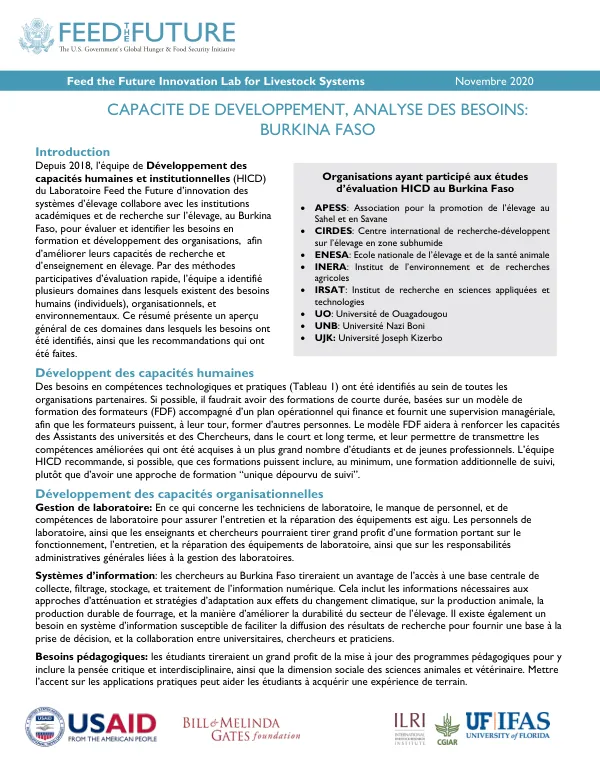
Capacity Development Gap Analysis: Burkina Faso
The Feed the Future Innovation Lab for Livestock Systems conducted a capacity development gap analysis in Burkina Faso in 2018.
2018 · 2 pages
Sign in to readA free account is required to download.
Abstract
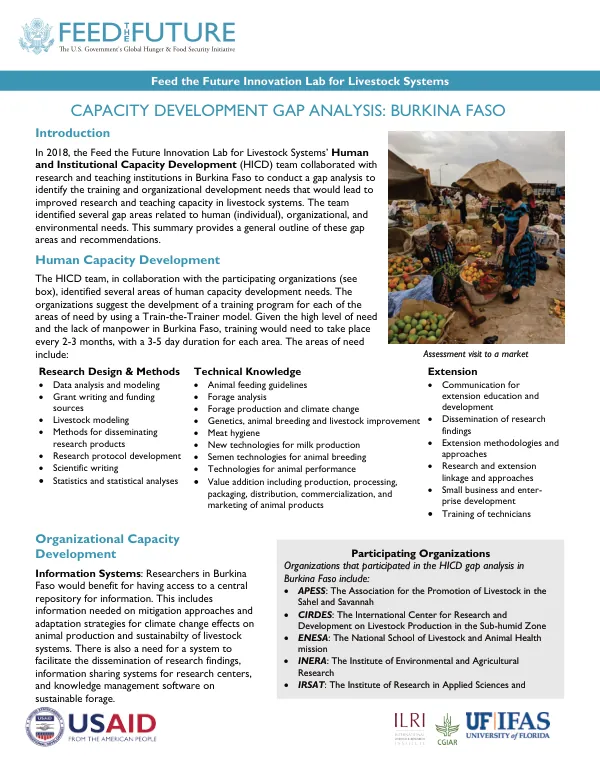
The analysis aimed to identify training and organizational development needs to improve research and teaching capacity in livestock systems. Several gap areas related to human, organizational, and environmental needs were identified. Human capacity development needs were identified in several areas, including research design and methods, technical knowledge, and extension. Research design and methods needs included data analysis and modeling, grant writing and funding sources, livestock modeling, and scientific writing. Technical knowledge needs included animal feeding guidelines, forage analysis, and new technologies for milk production. Extension needs included communication for extension education and development, dissemination of research findings, and small business and enterprise development. Organizational capacity development needs were identified in several areas, including information systems and infrastructure and material resources. Researchers in Burkina Faso would benefit from having access to a central repository for information, including information on mitigation approaches and adaptation strategies for climate change effects on animal production and sustainability of livestock systems. There is also a need for a system to facilitate the dissemination of research findings, information sharing systems for research centers, and knowledge management software on sustainable forage. Infrastructure and material resources are lacking in research institutions and universities in Burkina Faso, particularly laboratories and well-resourced farms. This results in an inability to update the research portfolio and a sense that graduates lack sufficient practical skills. There is a lack of updated equipment, knowledge of how to properly run a lab and maintain equipment, knowledge of the appropriate tests, and a lack of understanding of how to read test results. These issues are resulting in an inability to modernize the research focus. Recommendations were made to address the identified gap areas. Human capacity development recommendations include improving the capacity of researchers and laboratory technicians to manage a laboratory, conducting short-term training to improve research capacity, and developing a Train-the-Trainer program. Organizational capacity development recommendations include developing an information sharing system for research centers and developing a new cadre of professionals, technicians, and other staff in the field of forage. Environmental recommendations include increasing the availability of low-cost resources, including assistance with accessing journals and strengthening e-library resources.
Related documents