USAID DEC
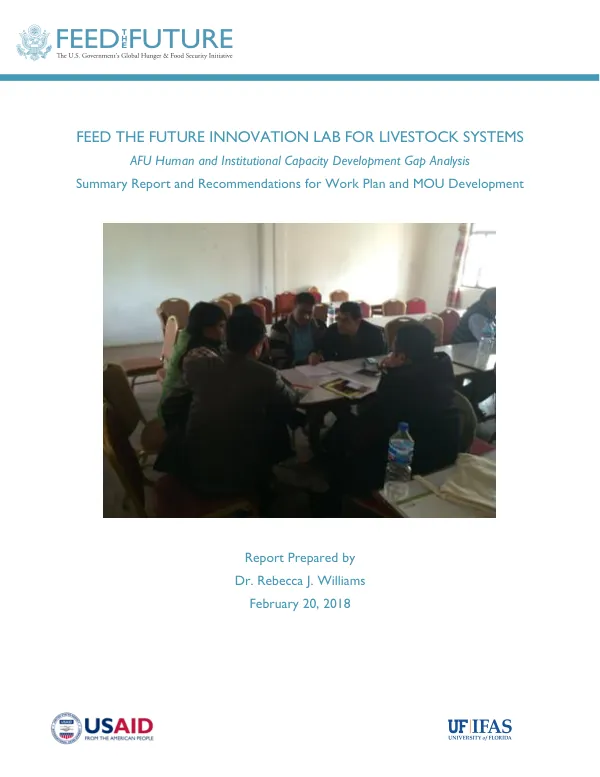
Feed the Future Innovation Lab for Livestock Systems AFU Human and Institutional Capacity Development Gap Analysis Summary Report and Recommendations for Work Plan and MOU Development
Sign inFLORIDA INTERNATIONAL UNIVERSITY
Feed the Future Innovation Lab for Livestock Systems AFU Human and Institutional Capacity Development Gap Analysis Summary Report and Recommendations for Work Plan and MOU Development
The Livestock Systems Innovation Lab Capacity Development Approach emphasizes the connection between building the capacity of an individual and organization, and systemic change at the institutional and enabling environment level.
2018 · 32 pages
Sign in to readA free account is required to download.
Abstract
Human capacity development can only function for the growth of the individual, organization, and institution when newly acquired skills are supported by infrastructure, resources, policies, and the capacity to change and adapt. In-depth analyses of human and organizational capacity, institutional gap assessments, and collaboration with key stakeholders must be conducted to fully address HICD needs. These efforts must align with organizational needs and abilities and use an iterative and collaborative process. The rapid gap analysis on the human and institutional capacity development (HICD) strengths and weaknesses of AFU as providers of manpower, education, and research in livestock systems included in-depth interviews and focus groups with stakeholders internal to and external to AFU. Interview and focus group questions investigated the strengths and weaknesses of the college at the individual, organizational, and enabling environment levels. These questions were intended to determine the training needs for improving research and teaching in livestock systems as well as the blockages within the organization and environment to effective research and teaching. The results of the rapid gap analysis revealed that AFU's human capacity development is hindered by limited resources, inadequate infrastructure, and a lack of institutional support. The organizational capacity development is constrained by inadequate policies, procedures, and systems, as well as a lack of collaboration and coordination among stakeholders. The enabling environment is characterized by a lack of government support, limited access to funding, and inadequate networking opportunities. The AFU HICD Priority Setting Workshop Results highlighted the need for capacity development in the areas of research and teaching in livestock systems, as well as the need for institutional support and resources. The workshop participants prioritized the following areas for capacity development: human capacity development, organizational capacity development, and enabling environment development. The participants also identified the need for collaboration and coordination among stakeholders, as well as the need for adequate policies, procedures, and systems. The Livestock Systems Innovation Lab HICD Team presented the results of the rapid gap analysis and facilitated a participatory workshop to discuss the results and prioritize the capacity development gaps for potential collaboration between the Livestock Systems Innovation Lab and AFU. The workshop participants identified the following areas for potential collaboration: human capacity development, organizational capacity development, and enabling environment development. The participants also identified the need for a scope of work (SOW) and memorandum of understanding (MOU) to guide the collaboration between the Livestock Systems Innovation Lab and AFU. The Livestock Systems Innovation Lab HICD Team will work with AFU to develop a scope of work (SOW) and memorandum of understanding (MOU) to guide the collaboration between the Livestock Systems Innovation Lab and AFU. The SOW and MOU will outline the specific activities and deliverables for the collaboration, as well as the roles and responsibilities of the partners. The collaboration will focus on capacity development in the areas of research and teaching in livestock systems, as well as institutional support and resources.
Related documents