USAID DEC
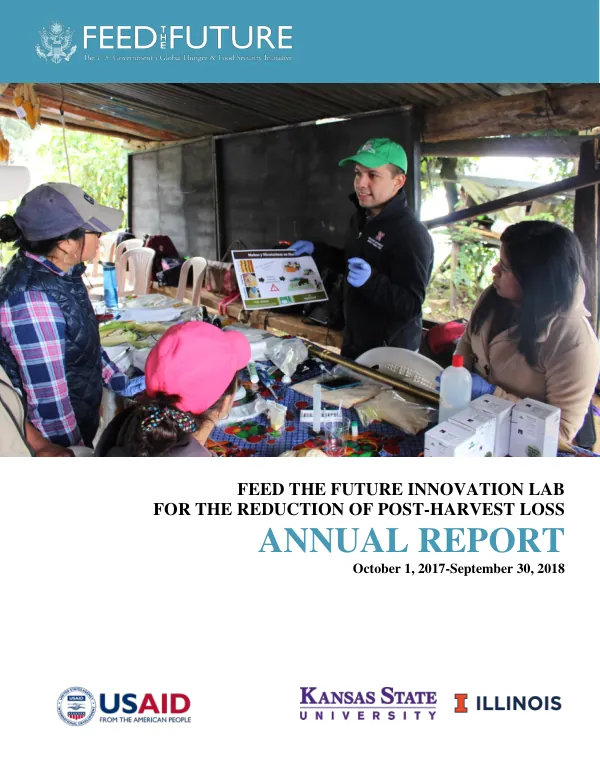
Feed the Future Innovation Lab for the Reduction of Post-Harvest Loss Annual Report 2017-2018
Sign inADVENTIST DEVELOPMENT AND RELIEF AGENCY INTERNATIONAL
Feed the Future Innovation Lab for the Reduction of Post-Harvest Loss Annual Report 2017-2018
The Feed the Future Innovation Lab for the Reduction of Post-Harvest Loss (PHLIL) is a strategic, applied research and education program aimed at improving global food security by reducing post-harvest losses in stored product crops.
2018 · 45 pages
Sign in to readA free account is required to download.
Abstract
The Lab's efforts are focused in four Feed the Future countries: Bangladesh, Ethiopia, Ghana, and Guatemala. Projects in each country are led by a U.S. or in-country Principal Investigator (PI) and in-country coordinators, overseen by the Lab's Director, with input from local and international academic, private sector, governmental, and non-governmental organizations. The program has continued making significant advances towards scalable innovation packages and cultivating the necessary capacity to reduce post-harvest losses at scale in the target countries. With a focus on end users and building partnerships with scaling organizations, the fifth year of the Innovation Lab's existence was intentionally designed with activities moving from full implementation to synthesis, targeted stakeholder discussions, and reporting, progressing through the fiscal year. PHLIL has formed strategic partnerships and enhanced human and institutional capacity in its core countries. The program has successfully characterized and gleaned insights into various post-harvest losses in chickpea, dried fruits, maize, nuts, rice, sesame seeds, and wheat. This information has set the foundation for and has begun making a positive impact in the livelihood of producers and other target beneficiaries in each country. Further, a more advanced understanding of the socioeconomic, gender, and nutrition context is coming into focus through surveys, trainings, workshops, and focus group discussions. A matrix of adapted and validated post-harvest interventions has been produced, which were effectively moved from research into piloting and technology transfer. Building partnerships with strategic actors ensured that each innovation kept the end users in mind, increasing the buy-in of important actors who are continually faced with post-harvest challenges that lead to economic and nutritional losses. The activities and outcomes of the last five years have placed PHLIL in a strategic position to address the next stage of critical research questions. These include expanding research into areas such as mycotoxin contamination, safe alternatives to pesticide use, and addressing market needs in drying technologies, while still addressing critical questions around barriers to adoption, effective extension and education, and sustainable scaling, including gender and youth considerations in all of these areas. PHLIL has a strong external advisory council, comprising experts from various fields, including plant pathology, science and technology, and global post-harvest knowledge and operations. The council provides guidance and oversight to the program, ensuring that it remains focused on its goals and objectives. The program has a comprehensive post-harvest program in its four core countries, with additional Mission Buy-In projects in Nepal and Honduras and a previous Mission Buy-In in Afghanistan. PHLIL has a strong network of partners, including academic institutions, private sector companies, governmental organizations, and non-governmental organizations, which collaborate to achieve the program's objectives. PHLIL has made significant progress in reducing post-harvest losses in its target countries. The program has characterized and gleaned insights into various post-harvest losses, developed adapted and validated post-harvest interventions, and built partnerships with strategic actors to ensure that each innovation kept the end users in mind. The program's activities and outcomes have placed it in a strategic position to address the next stage of critical research questions and continue to make a positive impact in the livelihood of producers and other target beneficiaries in each country.
Related documents